
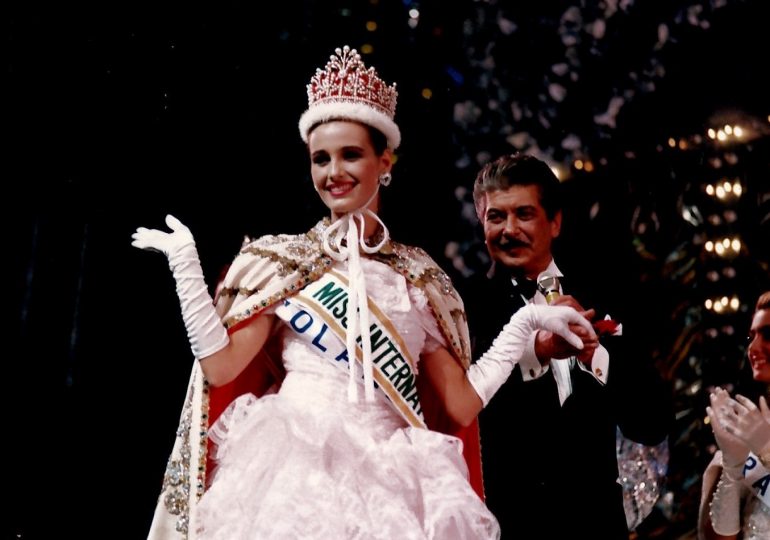
Obsession: Murder of a Beauty Queen, out Dec. 17 on HBO Max, revisits the life and death of Agnieszka Kotlarska, one of Poland’s most accomplished young models of the early 1990s. The documentary examines how her ascent from a local pageant winner to an international fashion hopeful was overshadowed—and ultimately destroyed—by a man whose fixation escalated into lethal violence.
What emerges is not only the story of a promising career cut short, but also a portrait of a time when stalking carried little legal protection—and a detailed look at the real events behind Kotlarska’s tragic fate.
[time-brightcove not-tgx=”true”]
Agnieszka Kotlarska’s journey on and off the stage
Agnieszka Kotlarska was born in Wrocław, Poland, in 1972 and attracted attention in the city’s modest modeling scene as a teenager. At 17, she signed with a local agency, and within a few years she had become a national sensation.
Her breakthrough was fast: she was crowned Miss Wrocław in 1990, Miss Poland in 1991, and, later that same year, became the first Polish contestant to win the Miss International title in Tokyo. The victory launched an international modeling career. Kotlarska worked in New York, Milan, and Paris, collaborating with respected designers—including Ralph Lauren and Calvin Klein—and appearing in global editions of Vogue and Cosmopolitan.
During this period, she married Jarosław Świątek, a man she had first met during her early competitions. The couple lived temporarily in Manhattan before returning to Wrocław in 1993, where they settled into family life and welcomed a daughter.
By 1996, Kotlarska was balancing motherhood with an expanding career and early plans to transition into film. She was widely viewed as one of Poland’s most promising cultural exports.
The stalker
Long before Kotlarska became a public figure, a man named Jerzy Lisiewski noticed her as a teenager. According to investigators and statements referenced in the documentary, he first saw her photograph in a shop window and fixated on her immediately.
Throughout the early 1990s, his interest escalated from curiosity to fixation. He followed her route home from school, attempted to initiate conversations, and waited outside her family home. Kotlarska repeatedly rejected his attempts at contact, but the refusals only intensified his pursuit.
When she moved abroad for work, Jerzy continued writing to her—at one point proposing marriage in a letter she may never have read.
A narrow escape: Flight 800
In July 1996, Agnieszka Kotlarska was preparing for an international photo shoot scheduled in Paris. At the time, she was in Poland and had initially planned to travel first to New York to meet the photography team before continuing on to France. Her husband advised her instead to fly directly from Warsaw to Paris—a decision that would prove life-saving.
Shortly afterward, Agnieszka learned that the flight she would have taken from New York to Paris, TWA Flight 800, had tragically exploded shortly after takeoff over Long Island, killing all passengers on board, including the photographers she would have worked with.
The incident was widely covered in the media, highlighting her narrow escape from disaster. These reports also caught the attention of Lisiewski, who used public telephone listings to locate her new residence in Wrocław. At that time, Poland had few legal mechanisms in place to address stalking, and Kotlarska had no formal recourse against his escalating behavior.
The day of the murder
On Aug. 27, 1996, at approximately 2:30 p.m., Lisiewski arrived outside the home where Kotlarska lived with her husband and their two-and-a-half-year-old daughter. The family was preparing to leave by car when he approached, insisting he needed to speak with her.
Świątek, sensing danger, moved to call the police. The situation escalated quickly. Lisiewski pulled out a knife and stabbed Świątek in the leg. Kotlarska, attempting to protect her husband, stepped toward the attacker. Lisiewski turned the knife on her, delivering several fatal wounds.
He then walked away from the scene, reportedly informing a passerby that he had just committed a killing and waiting calmly for authorities to arrive. Lisiewski was later convicted and sentenced to 15 years in prison. After his release in 2012, he was arrested again in 2014 for a separate violent offense. He is currently out of prison.
After the trial, Kotlarska’s husband and daughter moved abroad, quietly stepping away from the public eye. Since then, they have lived largely out of the spotlight, keeping their lives private.
Kotlarska’s death prompted renewed public discussion in Poland about stalking, gender-based violence and the lack of protective legislation at the time—conversations the documentary reopens nearly three decades later.
Stalking laws and Kotlarska’s lasting impact
In Poland, stalking is recognized under Article 190a of the Penal Code. The law defines it as persistent harassment that causes the victim to feel threatened, humiliated, or distressed, or that significantly violates their privacy. Convictions can carry up to eight years in prison, and if the stalking leads to the victim’s suicide, the sentence can reach fifteen years. The term was officially incorporated into Polish law in June 2011.
In response to the risks victims face, the Agnieszka Kotlarska Foundation, also known as “AGA,” was founded in 2022. One of its flagship initiatives is the “Oasis of Peace,” a safe space providing survivors with counseling, psychological support, and self-defense training. Through these programs, the foundation seeks to honor Kotlarska’s legacy while addressing the ongoing issue of harassment and empowering those affected.
Leave a comment