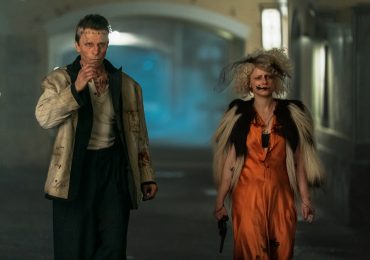
How much do ambition and chutzpah count in filmmaking these days? The Testament of Ann Lee, directed by Mona Fastvold, is for better or worse like no other movie you’ve seen. A musical about the founder of a religious sect established in the 18th century, a woman who believed in a Utopian society, even as she espoused that the only way to earn God’s grace was to embrace celibacy? If you’re looking for a conceit that’s going to pack ’em in, that’s not it. But in a world where we’re handed predigested information every day, as if we can’t be trusted to use even a flicker of our own imagination, The Testament of Ann Lee urges us to flex whatever brain cells we’ve got left. It may amount to nothing more than a well-executed curiosity, but it also boasts one quality that plenty of mega-budget blockbusters lack: it’s never boring.
[time-brightcove not-tgx=”true”]
Amanda Seyfried stars as Lee, and the movie begins at the beginning—the story is narrated, storybook-style, by one of the film’s secondary characters, Thomasin McKenzie’s Mary Partington—with details about her birth, in 1736 Manchester, England, and her youth, growing up with her adoring brother, William. Lee is a dutiful, placid, God-loving child, who works hard at her loom, covering her face with a handkerchief to protect her from breathing in stray fibers. But she doesn’t like the way her mother keeps popping out babies—it’s hard to count the number of children gathered around the family’s rough wooden table, but it’s probably more than a dozen—and she wisely links this particular hardship to her parents’ conjugal activities, which are difficult to hide in the family’s cramped quarters. Later, she herself will marry, and though she’s OK with sex at first, her blacksmith husband, (Christopher Abbott’s Abraham), finds a dirty book at work—or so he says—and lures her into some kinkiness she doesn’t feel comfortable with. Presumably, this contributes to her later views that celibacy is the way to go.
But Lee’s devotion goes beyond psychosexual issues. She falls in with a group of “Shaking Quakers,” worshipers whose services include chanting, ululating, and ecstatic, improvised dance steps. Her faith is so fervent, and so charismatic, that before long, she has her own set of followers, who will come to be known as Shakers. They’ll call her Mother; her brother William (played by Lewis Pullman), will become her right-hand man. But before any of this happens, Lee conceives and loses four children, and a montage detailing this period is blunt and effective. At one point we see, in a discreetly respectful long shot, Lee’s Abraham gently trying to remove a dead infant from Lee’s arms; she appears physically incapable of letting go.
Lee becomes more resolute in her ideas of what a religion should be, and her followers grow. She faces persecution and charges of witchcraft; she’s thrown in jail repeatedly. In 1774, she and her loyal posse board a condemned ship for North America, settling in upstate New York. Their hope is to build a society where men and women are equal, where everyone works hard and to the best of their ability, and where the wealth is shared by all. Again, sex is off the table. It’s easy to see why people found the Shakers weird and fanatical, and more persecution, some of it murderous, follows.
Fastvold moves through this sometimes-brutal story gracefully, gently dropping a musical number here and there. The songs, written by Daniel Blumberg and inspired by Shaker hymns, are about devotion, hard work, and metaphysical longing; the choreography, by Celia Rowlson-Hall, drawn from the history of Shaker worship, has a kind of Twyla Tharp-style angularity and urgency. If you’re a fan of Shaker boxes, chairs, décor, and the Shaker aesthetic in general, you’ll have to wait until about two-thirds in to see any action there. But if I were trying to sell Ann Lee to audiences William Castle–style, I’d use the tagline, “No one will be seated during the daring Shaker-box-making scene!” It’s the weirdest, finest sequence in the movie, set to a number whose chanting chorus is “I love Mother, I love her way,” hypnotic in a way that’s both soothing and unsettling.
As a character, Lee, with her resolute pronouncements about abstinence and steadfastness, is at times insufferable, though the movie doesn’t recognize her as being so: it remains rapt by her nobility and chastity, even when she deserves some side-eye. Essentially worshipful in its view of Lee, the movie never acknowledges that one person drawing so much unbridled admiration is more than a little creepy. (The script was written by Fastvold and her husband and frequent collaborator Brady Corbet; their last picture was The Brutalist.)
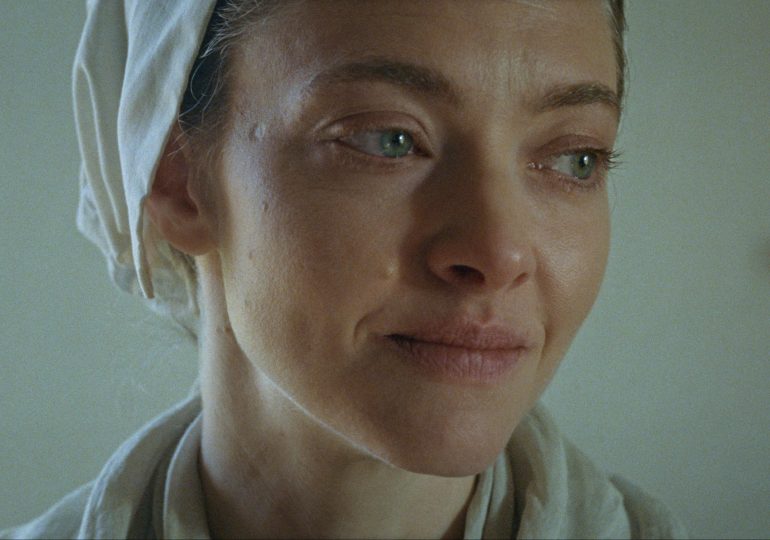
But the fact that Lee is a woman, albeit a forceful, determined one, does make a difference. History usually tells us that it’s men who have all the charisma; women are stuck with that dud quality known broadly and rather vaguely as charm. The Testament of Ann Lee is reaching beyond that kind of language, to tell a story that no one else has, in a way few filmmakers would attempt. And there’s no way around it: Seyfried is remarkable. Her moon-maiden eyes really do make her look as if she were channeling messages from a divine world. She takes the script’s clunkiest lines and spins them out like a web of gold. The Testament of Ann Lee is unimaginable with any other actress—but then again, it’s unimaginable, period, a movie that takes big chances in a culture that, most days, seems allergic to them.
Leave a comment