
Dear European friends,
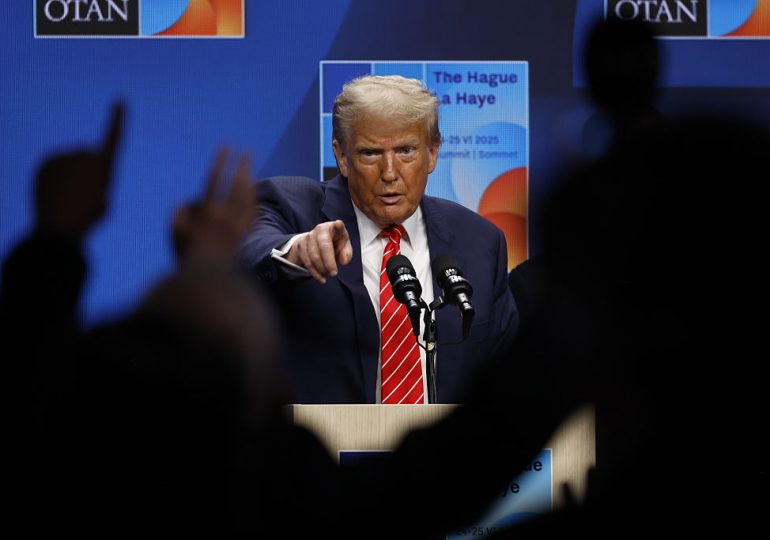
I understand the change in our relationship is nearly incomprehensible. Your ancestors helped found the U.S. 250 years ago. Many of our nations fought shoulder to shoulder during two world wars, and you stood by our side after the 9/11 attacks. We created the world’s most successful military alliance in NATO, and built the largest bilateral trade and investment partnership with the E.U. Being described by President Trump as a “decaying” group of nations led by “weak” people makes it painfully clear that you can no longer count on our global leadership and must strengthen your own hand.
[time-brightcove not-tgx=”true”]
During the first Trump Administration, you withstood shocks to our relationship. The President pressured you on defense spending, imposed tariffs on dubious grounds, and withdrew from international agreements and organizations. You were advised to take Trump seriously but not literally and to trust the adults in the room, who largely succeeded in providing guardrails while American institutions held.
The election of Joe Biden brought the promise of renewed stability. As his Europe advisor, I was charged with trying to restore trust with you. It wasn’t easy at first, as feelings were raw and skepticism was high. When Biden announced at the Munich Security Conference in February 2021 that “America is back,” he acknowledged that your leaders asked him for how long. Early trust-building efforts were hindered by our poor diplomatic handling of AUKUS, the chaotic withdrawal from Afghanistan, and your unhappiness with the Inflation Reduction Act. But we learned from those experiences and redoubled our engagement. By the time Russian tanks rolled into Ukraine, our alliance was stronger than ever, as we worked closely with the E.U. and NATO on sanctions and military aid. My biggest regret is being too reassuring, wanting to believe that American politics had returned to normal. And in hindsight, we have long held strong views about how Europe should strengthen its own capabilities.
The second Trump Administration is very different from the first, as it is staffed by loyalists who are eliminating dissent, challenging long-standing institutional norms, and systematically implementing Project 2025 proposals. Vice President JD Vance first articulated the Administration’s opinion of Europe at the Munich Security Conference in February 2025, saying that you were undermining democracy and retreating from fundamental values. The new National Security Strategy (NSS), which warned of “civilizational erasure” in Europe and accused your institutions of undermining political liberty, codified those views. In fairness, the Administration likes some of you, as it has championed far-right parties and feted leaders like Nigel Farage and Viktor Orbán in the White House.
There is an uncomfortable truth in some of the Trump Administration’s critiques. Europe has made different choices than the U.S., prioritizing investment in infrastructure, education, and social welfare. Your high quality of life, which I am experiencing firsthand in Madrid, reflects those priorities. But these expenditures were premised in part on American willingness to underwrite your security, which is no longer sustainable—irrespective of which party governs Washington. Our choices have resulted in failing infrastructure, sky high medical costs, and economic inequality, contributing to the current protectionist tendencies. And, we both face problems with immigration and questions of belonging.
You have made admirable progress on defense spending since the full-scale Russian invasion, with all 32 NATO members projected to meet or exceed the 2% target in 2025 and agreeing—under duress—to spend 5% by 2035. However, you still lack critical enablers like strategic airlift and intelligence; this limits your capacity to field a reassurance force in Ukraine without U.S. involvement. You are also heavily dependent on American technology, including software and cloud computing, while excessive regulation has long stifled innovation.
To date, your leaders have handled Trump with a mixture of flattery and deference. When I co-authored an article in October cautioning against remaining silent on American actions in the hope of preserving your security and economic interests, you told me privately that pushback was impossible. You were too dependent on the U.S., needing to keep Trump on side for Ukraine’s future and Europe’s defense. Yet the Administration’s 28-point plan for Ukraine and the NSS should end any illusions that this approach is working.
The Trump shock, while painful, is an opportunity that should provide clarifying energy. A significant amount of work has already been done to identify needed reforms. The former Italian Prime Ministers Mario Draghi and Enrico Letta provided detailed blueprints for deepening your single market to boost economic competitiveness. NATO planners tasked each member with specific capability requirements, including the acquisition of enablers, while the E.U. has introduced programs to support defense industrial development and procurement. On Ukraine, you picked up a substantial share of the burden in 2025, including the provision of weapons and budget support. But you need to reduce your reliance on American intelligence and weapons production. In addition, you should rapidly bolster your digital sovereignty to address another critical dependency. The E.U.’s new Democracy Shield rightly acknowledges the threat to your democracies from foreign actors, but it is equally important to counter challenges from within.
The roadmap is clear. What’s required now, as you’ve told me across the continent in recent months, is an affirmative vision and political will. Trump’s “America First” approach has left a vacuum in Europe. Throughout the post-war period, the U.S. provided clarity and focus to our shared goals—investing in your reconstruction, championing the integration of post-communist states, and then helping shore up your single currency. Absent America’s convening role and in the face of outright hostility, your future depends on leaders driving institutional resilience and gaining public backing for needed reforms. The trifecta of French President Emmanuel Macron, German Chancellor Friedrich Merz, and British Prime Minister Keir Starmer has been working hard in recent months to steer the ship. However, their efforts are complicated by the extent to which populism is challenging democratic norms and values in Europe, creating the same risks that are playing out in the U.S. This makes it even more urgent to safeguard your national and European institutions against internal and external attacks while engaging your citizens and developing responsive policies.
Sometimes you underestimate your own strength. The E.U. has 450 million citizens, an integrated economic market setting global standards, and a highly educated workforce with world-class universities. Rather than letting the Trump Administration amplify populist forces and challenge individual countries, harness the power of your unity and stand strong. This may require ceding national sovereignty and reducing unanimous decision-making in some cases. But managing that discomfort is arguably better than relying on an ambivalent superpower.
I have dedicated my career to strengthening our relationship because I believe in you. That is why I write with tough love rather than false assurances. Stop waiting for America to return. Stop believing these policies are temporary. Hope is not a strategy. Yes, Democrats won key off-cycle elections in November and may do well in mid-terms next fall. But a Democrat-controlled Congress cannot reverse this trajectory alone. The next President will still need to address fundamental shifts in American society. There will be no building back this time; rather, it will be building something new. In the best case scenario, a stronger Europe will be waiting for us when that work begins. The world has changed and Europe cannot afford to wait.
Yours always,
Amanda
Leave a comment