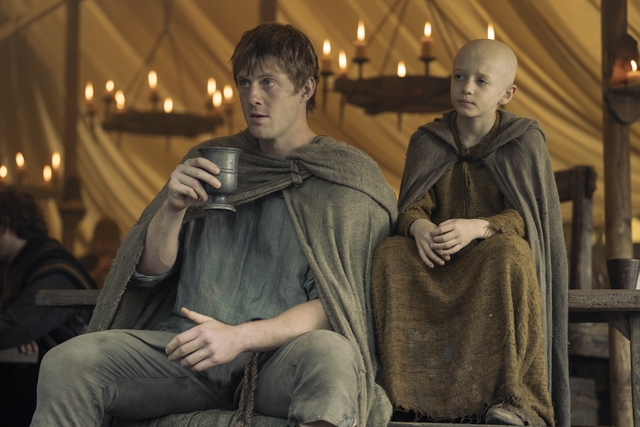
A Knight of the Seven Kingdoms is not like other Game of Thrones shows. Or, at least, it’s not so much like them that you have to take it seriously. Less than five minutes into the premiere, the HBO series conspicuously adjusts the expectations of anyone who might be confused. Sword in hand, our strapping hero, Ser Duncan the Tall (Irish actor Peter Claffey, lately seen in Bad Sisters), decides to enter a tournament. As he lifts his face heavenward, we hear Thrones’ solemn, churning theme song, the same one that now plays at the top of House of the Dragon episodes. Suddenly, the music stops. Cut to a closeup of the knight’s face as he audibly defecates. In case we still haven’t gotten the message that earthy hilarity awaits, the shot widens to reveal his naked butt and what’s coming out of it.
[time-brightcove not-tgx=”true”]
So, yes, Seven Kingdoms, premiering Jan. 18, explores a more playful side of Westeros. Based on George R. R. Martin’s Tales of Dunk and Egg novellas—which sound like they should chronicle a national coffee chain’s breakfast offerings but actually follow Duncan, a.k.a. Dunk, and his pipsqueak squire, Egg—its first season runs just six episodes of around 35 minutes apiece. (It has already been renewed for a second, as part of HBO’s promise to give us new Thrones content every year through 2028.) Instead of juggling multiple storylines, a sprawling map, and dozens of characters, most of them nobles warring for control of a continent, it confines its attention to two humble leads in a meadow. The lowered stakes do make for a lighter watch, except towards the end of the season, which is heavy on murk and gore. But the show’s anemic plot and spotty attempts at humor also raise questions about the health of the franchise. Is this really the most compelling, or even the most entertaining, story left to mine from Martin’s A Song of Ice and Fire canon?
Created by the author and showrunner Ira Parker, a House of the Dragon veteran, Seven Kingdoms takes place a century before the events of the original Game of Thrones series. Though the Targaryens still rule Westeros, the towheaded dynasty is suffering through a dragon drought that
won’t end until Daenerys comes into the picture, generations in the future. This is all well above the figurative pay grade of Dunk, a simple, hulking youth who grew up squiring for Ser Arlan of Pennytree (Danny Webb). A chronically intoxicated but good-hearted master, Arlan has just died. But first, he knighted Dunk. Like his surrogate father, Dunk is a hedge knight—that is, an itinerant, often penniless and disrespected swashbuckler for hire, rather than a well-compensated, ornately armored, widely venerated defender of a noble lord. As one scornful character puts it: “There are as many hedge knights as there are hedges.”
Traveling to Ashford Meadow for the tourney with the three horses he inherited in tow, Dunk meets a stable boy who introduces himself as Egg (a precocious Dexter Sol Ansell), a fitting name seeing as he is bald. Egg is everything Dunk is not: tiny, clever, bold. He wants to be Dunk’s squire, but Dunk has doubts that mainly stem from his own insecurities; flashbacks imply that he still feels like the scared teen in need of Arlan’s tutelage. He and Egg negotiate their odd-couple alliance as Dunk attempts to prove his mettle in the games and find some way forward without Arlan. It’s all pretty twee, until the Targaryens, with their notoriously equal distribution of valor and madness, ride in to ratchet up the drama.
There’s nothing inherently wrong with putting common people at the center of a story set in a universe that viewers have mostly seen, in previous incarnations, through the eyes of its ruling class. The angle certainly worked for the revolutionary-minded Disney+ series Andor, which might be the best thing the Star Wars franchise has produced in five decades of pop-culture prominence. And Seven Kingdoms does meet the high technical standards of the Thrones brand—immersive, bloody combat, dim lighting, and all. Claffey exudes just enough charisma to make us root for Dunk without undermining the character’s unpolished oafishness; he and Ansell can be very sweet together.
But unlike Andor, which used its relatively obscure protagonist to showcase regular citizens’ resistance to the tyranny that’s so integral to the Star Wars mythology, Seven Kingdoms seems to exist mostly to tide us over between Dragon seasons. It tries hard, especially in early episodes, to be funny. Sadly, its idea of humor is, for example, a running joke about Dunk’s eternal gratitude towards Arlan for only beating him when he deserved it. Elsewhere, bodily excretions of various sorts stand in for punchlines. Crudeness is in no way new to the pseudo-medieval Thrones landscape, but it worked better as a counterweight to the high rhetoric of would-be sovereigns. (You could even argue that Martin’s high-low mix echoed that of Shakespeare and Chaucer.) Here, that balance of tones is somewhat restored in the second half of the season, after a revelation that establishes Dunk and Egg’s relevance to Westeros lore—and in doing so kind of undermines the show’s initial commitment to bringing the Thrones saga down to earth.
The show also falls prey to a few unfortunate streaming-era trends, from a penultimate flashback episode that delays the payoff of a cliffhanger by filling in backstory of questionable utility, to a scantness of plot that makes the whole short season feel like an overgrown prologue. A franchise that once set the standard for prestige television is now, in an apparent effort to keep Thrones fans subscribed to HBO Max indefinitely, perpetuating some of the category’s moldiest clichés. Instead of the best Martin’s bibliography has to offer, it seems we are now getting whatever is the most convenient to adapt. Seven Kingdoms may be too benign to hate, but in its debut season, it is also too meager to love.
Leave a comment