Warning: Spoilers ahead for The Rip
The home on 169th Terrace in Miami Lakes sat along a palm-lined street of spacious, well-kept houses—quiet and unremarkable, offering no hint of what it held, until June 29, 2016, when Miami-Dade Police officer Chris Casiano and his narcotics team executed a search warrant on the house. What was supposed to be the final phase of a years-long drug trafficking investigation became much more when the team made a startling discovery.
[time-brightcove not-tgx=”true”]
In the attic lay a garden rake, with a cable running from its handle into the wall. When an officer lifted it, drywall gave way and a false wall moved, revealing a hidden room stacked with 24 orange buckets purchased from Home Depot. Each one was packed with bundles of $100 bills—$24 million in all—the largest cash seizure in the history of the Miami-Dade Police Department. Officers used sledgehammers to break through and pull them free.
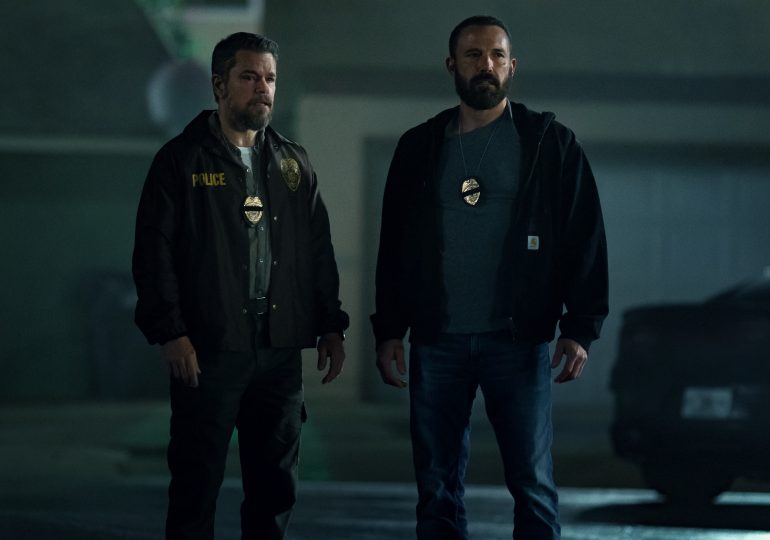
That night became the foundation for The Rip, Netflix’s crime thriller starring Matt Damon, Ben Affleck, Steven Yeun, Teyana Taylor, Catalina Sandino Moreno, and Kyle Chandler, premiering Jan. 16. Inspired by Casiano’s experience, the film is as concerned with how a raid unfolds as it is with what follows: how money tests the soul, strains loyalty, and traces the thin line between duty and temptation when escape isn’t an option. Here, officers are trapped by protocol, left to count the cash knowing it has made them targets—even as trust within the room begins to erode.
“The devil is in the details in this film,” writer-director Joe Carnahan says. “It’s really about human beings. It’s about the connections between people: what your team means to you, what your friends mean to you, and what the people you love mean to you.”
The real raid
Years of investigative work led to the raid that later inspired The Rip—the culmination of a long-running probe into a marijuana trafficking operation that stretched from South Florida to Tennessee, built through surveillance, confidential sources, wiretaps, and coordinated law enforcement work across state lines.
The Miami Lakes home Casiano and his team raided in June 2016 belonged to Luis Hernandez-Gonzalez, the longtime owner of Blossom Experience, a North Miami gardening supply store frequented by marijuana growers from across the country. Investigators believed the business operated as a front, and Hernandez-Gonzalez had been on law enforcement’s radar for years.
Detectives regularly followed customers after they left his shop. In 2005, Drug Enforcement Administration agents said Hernandez-Gonzalez discussed marijuana sales while under surveillance, though no charges followed. Five years later, a confidential source secretly recorded him discussing cultivation techniques and offering to purchase a future crop. Again, no arrest came.
That pattern changed in 2016, after Hernandez-Gonzalez was captured on a wiretap giving growing advice to South Florida marijuana traffickers arrested by federal agents in Tennessee. Investigators moved in stages, first raiding his business, then executing a search warrant at his Miami Lakes home.
Outside the house, the narcotics team’s cash-sniffing dog began “alerting”—an unmistakable signal. Marked by the dog’s urination, it meant large sums of currency were nearby. Officers understood their instincts were correct.
In the attic, hidden behind drywall in a space accessible only through a concealed opening, they uncovered 24 five-gallon buckets packed tightly with bundled $100 bills. Alongside them were marijuana strains labeled “Chernobyl” and “Super Skunk,” four types of anabolic steroids, and a loaded TEC-9 pistol.
Department protocol in these scenarios was precise: Miami-Dade officers must count seized cash on site, by hand, twice, before anyone could leave—a safeguard designed to protect procedural integrity. In practice, it locked Casiano and his team inside the home for hours, visible and stationary in a residential neighborhood, surrounded by a sum large enough to attract attention from anyone with reason to come looking. Home surveillance cameras captured their movements as they worked. Casiano’s first instinct was simple and unnerving: someone could be watching. Worse, someone might come for the money.
By the time the counting ended—more than a day later—the total reached $24 million, a record-setting seizure for the department at the time. No one took a dollar.
Hernandez-Gonzalez was initially charged in state court with marijuana trafficking and money laundering, before being indicted federally after investigators uncovered a pattern of structured bank deposits designed to evade detection. In 2018, he was sentenced to 65 months in prison for financial crimes tied to the operation.
The experience stayed with Casiano long after that night and would later lodge itself in the imagination of Carnahan, who first heard the story while working with Casiano on the 2020 buddy cop film Bad Boys for Life. Carnahan eventually left the project, but the friendship endured—as did the story.
Carnahan recalls Casiano summing up what that night revealed with stark clarity: “That amount of money just does dark things to the soul.”
When grief reshaped the story
In 2021, Casiano’s young son Jake died after being diagnosed with cancer. Carnahan’s relationship to the story changed and he reworked the script. Damon’s character, Lt. Dane Dumars, now carried the weight of a son who had passed away. The crime thriller became more intimate: a story marked by grief that had nowhere else to go.
Carnahan didn’t want Casiano to feel pressured into allowing the story to be told this way. “Had he shut it down, I would have abided that request,” he says. But Casiano was ultimately moved by how his son’s story was handled. Initially reluctant to read the screenplay because of how personal the material was, he was “blown away” once he did. The Rip is dedicated to Jake, and his name is the first to emerge from black during the closing credits.
Once Carnahan locked the script, finishing it in a five-week “sprint,” the project accelerated, reaching Dani Bernfeld, president of Artists Equity, the production company founded by Damon and Affleck. Carnahan spoke to Damon first; Affleck called 24 hours later. Within another day, they were in. The timing proved fortuitous. With Damon available and one of Affleck’s other projects delayed, production could move forward. “It almost never happens like this where the stars align and the clouds part, and you have this kind of perfect opportunity,” Carnahan says.
In adapting the story, Carnahan changed some elements while preserving others. Names changed, but main characters remained rooted in real people. The cash amount was adjusted to $20 million for the film. The real-life target, Hernandez-Gonzalez, became a young woman named Desi, played by Sasha Calle. But several crucial details remained: the false wall, the buckets, the cash-sniffing canine at the onset. Even the dog handler’s line—“There has to be a lot more money inside”—came nearly word for word from that night.
What long history brings
That opportunity mattered because of who could make it. Damon and Affleck bring over four decades of shared history that no amount of rehearsal could manufacture onscreen. Childhood friends from Boston who became movie stars without losing the thread of who they were before fame intervened, their familiarity registers in how lines are traded mid-scene and in what doesn’t need to be said.
Damon plays Dumars, newly promoted to lead the unit; Affleck plays Det. Sgt. J.D. Byrne, a longtime colleague who is now reporting to him. The shift seeds friction, testing whether hierarchy can coexist with loyalty and whether camaraderie survives when power dynamics change.
To ground their performances, Damon and Affleck each spent time in Miami with the police department, shadowing officers whose work directly informed the film. Damon rode along with the officer who inspired Dumars, learning about procedure and the pressures of the job. For Affleck, the research reinforced how tightly knit—and how specific—high-stakes work cultures become over time. That firsthand exposure carried through to the set, informing how the actors moved, spoke, and occupied space together.
Commitment surfaced in small, telling ways. During one setup, Carnahan spent nearly 40 minutes talking through a scene with Damon and Yeun before cameras rolled, interrogating what actually needed to be said. The discussion reshaped the moment entirely. “It went from a page-and-a-half scene to two words,” Carnahan recalls. “It was amazing to watch.”
During filming, Carnahan sometimes kept cameras rolling beyond formal takes, encouraging actors to remain in character between setups. Real Miami-Dade officers, often occupying background roles, interacted in character during those stretches as well, sustaining the casual banter and shared patois of a working unit. The approach helped keep performers grounded in the scene even when they weren’t the focus of the action, so that when cameras did roll, the dynamics felt continuous rather than reset.
One onscreen moment involving Taylor and Moreno crystallizes the film’s understanding of temptation, as Moreno’s character briefly contemplates taking a portion of the seized money, imagining how it would improve her family’s quality of life. “You can see her seeing her children, and you see all these wonderful things that money can do,” Carnahan says.
What remains after the counting stops
In The Rip, Carnahan builds a cinematic pressure cooker where morals are tested and loyalty bends under sustained heat. The tension comes less from action or pursuit than from hours spent waiting, counting, and watching—money sitting in plain sight between people who understand exactly how easy it would be to leave with it, and what it could cost them to stay.
For Carnahan, the film was a way to honor more than a remarkable night on the job. It became a tribute to a friend who endured what no parent should have to face—an effort to take the unbearable and carry it into a story that might last. In the end, the money matters less than who you become while standing next to it.
That idea sits at the core of The Rip: the friendships that hold, the codes people choose to live by, the understanding that character isn’t forged in comfort but revealed under duress, when every choice becomes visible and every consequence ripples outward.
Carnahan hopes audiences finish the film on a reflective note. “Think about the people you love. The people you’ve lost,” he says. “How fragile this whole experience can be, and how wonderful it can be.” Those moments matter to him—but so does the simple pleasure of entertaining audiences. “I want them to think they just saw an absolute kick-ass, big commercial cop movie.”
Leave a comment