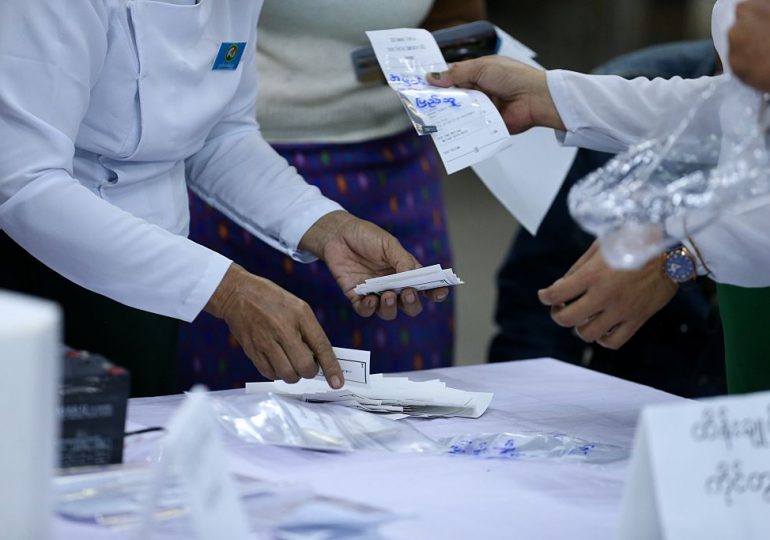
As people trickled into polling stations scattered across Myanmar to vote in the country’s first elections since the 2021 military coup, much of the nation remained consumed by war.
On a TV screen at polling stations, a smiling woman sang and danced: “Hey dear friends, so that a colorful future may bloom, let us choose those who will shape tomorrow.”
[time-brightcove not-tgx=”true”]
The military junta has billed the vote, which was held in three stages concluding this Sunday, as a return to democracy. International observers, however, have widely dismissed the election as illegitimate, held amid ongoing conflict and mass displacement. The junta-backed party has already claimed a lead in the first two rounds held in late December and early January.
Hundreds of people were killed in military crackdowns on protests and tens of thousands more arrested in the months after the coup five years ago that overthrew the democratically elected government led by Aung San Suu Kyi. Thousands of people fled to the countryside, where they coalesced into anti-junta resistance groups or joined ethnic armed groups.
By May 2021, Myanmar was plunged into a civil war that has since killed 90,000 people, according to the Armed Conflict Location & Event Data Project. According to the U.N., more than three million people have been displaced from their homes, with some fleeing mandatory conscription imposed by the junta in February 2024. The junta has bombed towns, weaponized internet shutdowns, and restricted much-needed humanitarian aid to civilians in areas controlled by resistance forces, even as it has lost control over large areas of the country to resistance groups.
Observers have warned that the elections could legitimize the junta’s rule both at home and abroad, especially at a time when it is seeking to secure backing from China. But for many Burmese people, already living in the throes of war, the outcome of the election is unlikely to change much.
“This so-called ‘election’ is an attempt to prolong the junta’s relentless violence and entrench impunity,” Justice for Myanmar, a group of activists, tells TIME.
Low turnout
Voter turnout during the first phase of the election was 52% and during the second phase 56%, according to the junta. That’s a stark contrast from the roughly 70% of people who came out to vote in the country’s 2015 and 2020 elections—the first democratic national elections in more than half a century of military rule. The excitement was palpable in those elections, with many wearing red in support of Suu Kyi’s party, the National League for Democracy, which swept the 2020 election.
Suu Kyi, now 80, has been in prison since February 2021, serving a 33-year sentence over allegations of election fraud, which she denies and which independent election observers have said lack evidence. The NLD and other major opposition parties have been disqualified from running in the election. Even if a party besides the junta’s proxy party, the Union Solidarity & Development Party, gains a foothold in the election, the military is already guaranteed a quarter of the seats in both houses of parliament under the 2008 constitution. (Still, the junta has maintained that the election is free and fair. “Even in developed democratic nations, there are situations where voter turnout does not exceed 50%,” a junta spokesperson, Zaw Min Tun, told ABC.)
“If the parties are not credible or not broadly representative, it undermines the claim that the elections are the reflection of the popular will,” says Maung Zarni, a Burmese academic and human rights activist exiled in the U.K.
The junta also enacted a law against undermining elections last year, which penalizes criticisms of the election—including online discourse or calling for an election boycott—from three years in prison to the death penalty.
Large swathes of the country are not holding elections at all. The junta controlled only around 21% of the country, as of December 2024, with ethnic armed groups and resistance forces controlling more than 40% of the country.
Much of the remaining contested areas are engulfed in intense fighting, making going out to vote an unrealistic task. Earlier this week, the junta canceled voting in two Kachin State townships and 11 villages due to clashes with forces aligned with the Kachin Independence Army.
“The reality of staggering the elections in phases and cancelling polls in several townships (a larger number than in past elections) points to ongoing security concerns,” says Moe Thuzar, a senior fellow at the Singapore-based think tank ISEAS-Yusof Ishak Institute with a focus on Myanmar.
Even in areas where people can vote, many, especially the youth, are choosing not to. “I think this is for them to change their soldier uniforms into civilian ones and to hold onto their power,” a 35-year-old from Rakhine state, which is largely controlled by the Arakan Army, told AFP.
“The junta has been decisively rejected by the people of Myanmar, with this sham election met by widespread boycotts and protests at great personal risk,” Justice for Myanmar tells TIME.
War rages on
The election has been widely dismissed by international observers and governments as illegitimate. U.N. special rapporteur on human rights in Myanmar, Tom Andrews, called the election a “sham.”
“Elections cannot be free, fair or credible when held amid military violence and repression, with political leaders detained and fundamental freedoms crushed,” Andrews said. The Association of Southeast Asian Nations (ASEAN), which Myanmar is a member of, has also refused to certify the vote.
Some have described voting out of fear, with security personnel in traditional clothing and sunglasses and armed policemen skulking around polling areas, according to ABC. People who turned up at voting stations said they were afraid that if they didn’t vote, they or their loved ones would be conscripted or that something bad might happen.
“Whether it’s legitimate or illegitimate, sham or real,” says Zarni, “it’s not going to change anything.”
The years of transition to democratic rule from 2011 to 2020 saw foreign investment pour into the country and the government implement political reforms, shoring up job opportunities and roughly halving the poverty rate from 2005 to 2017. After the 2021 coup, much of that investment was withdrawn, inflation ballooned, and the country’s currency, the kyat, collapsed.
The elections aren’t designed to address the country’s economic conditions, the civil war that is continuing to displace and kill Burmese people across the country, or the fracturing of the country into territories controlled by groups, says Zarni.
International diplomatic pressure on the junta towards a cease-fire is possible, but analysts suggest that that is a less likely outcome of the election than a continuation of conflict and fragmented rule. Western governments have largely isolated the junta through sanctions already, and they are less likely to intervene given their own problems, Zarni says. Europe is focused on Russia’s war in Ukraine and a renewed push by U.S. President Donald Trump to take control of Greenland, while the U.S. is both retreating from the world stage and focused elsewhere.
“People in Myanmar may be weary of the daily challenges to personal, socio-economic, and community security that they have had to confront as a consequence of the 2021 coup,” says Thuzar.
Zarni tells TIME that the point of the election is to “improve the optics” of the regime in the eyes of the world. Last year, the country was rocked by a powerful earthquake, which forced the junta to make a rare appeal to the international community for help, even as ethnic armed groups claimed the junta carried out strikes in areas damaged by the earthquake and attacked aid convoys. Myanmar is also on trial at the International Court of Justice for genocide over its ethnic cleansing of Rohingya Muslims; the International Criminal Court opened its own investigation into alleged crimes of humanity committed by the junta, including the persecution of the Rohingya.
Reducing Myanmar’s isolation and increasing its economic engagement would be in the junta’s interests. In that regard, it matters less what western governments or international agencies think, says Zarni. The junta is likely more interested in regional actors with which it already has a relationship, like China and Russia, which have provided diplomatic cover, arms, and economic engagement since the coup, and India and Vietnam, which have maintained pragmatic or economic relations with the junta.
“The junta’s tyranny is sustained by allied authoritarian governments, multinational corporations, international banks and Myanmar cronies that fund, arm, equip and train the military, aiding and abetting its international crimes, enabled by global inaction,” Justice For Myanmar tells TIME.
The junta may also have in mind its involvement in ASEAN, which downgraded the country’s participation, barring senior generals from high-level meetings. ASEAN membership offers the military a regional diplomatic foothold and a channel—however limited—for engagement that the junta appears keen to preserve.
“The junta doesn’t need the whole world to survive,” Zarni says. “It only needs a handful of technologically advanced and economically wealthy external actors to be its partner.”
But mostly, Zarni says, the junta are holding the election for themselves. After seizing power in 2021, the military repeatedly justified the coup by alleging fraud in the 2020 election and promising a temporary return to military rule. Senior generals, including Min Aung Hlaing, said at the time that new elections would be held and power handed to the winning party.
Even if its opponents see through the junta’s election, with some ethnic armed organizations denouncing the election, the vote could provide reassurance to its own ranks, civil servants, and supporters and shore up morale and discipline within the armed forces.
“The elections give them a chance to stand up in front of a television camera and tell a lie with a straight face,” says Zarni. “They need to tell their own rank-and-file that the military is not just there with their guns, they’re in accord with the constitution of the country, therefore they are a lawful government.”
“Even the bad guys,” Zarni says, “have to tell themselves they’re good guys.”
Leave a comment