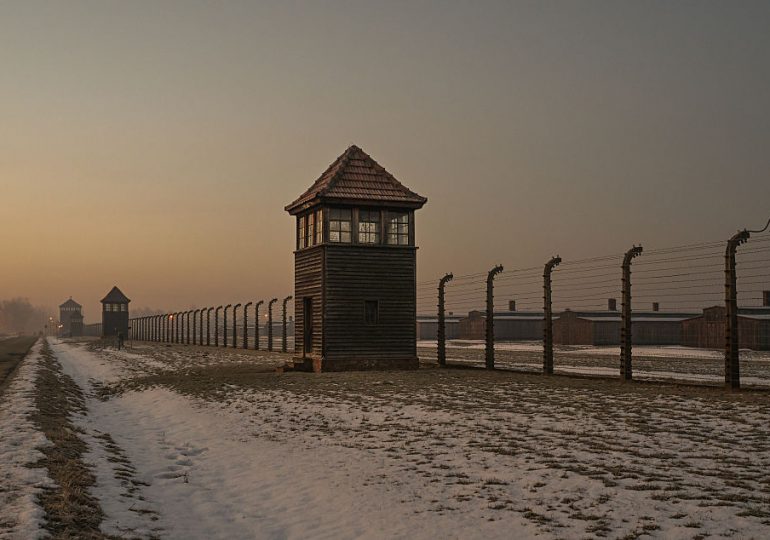
On our final day in Poland, my wife and I rose early. I could barely tie my shoelaces with my trembling hands. Unable to eat breakfast, we got on the road at daylight. I grew increasingly nervous as our destination approached. By the time we arrived, my knees were shaking. How would this day take shape? How would it feel to walk the grounds of Auschwitz?
[time-brightcove not-tgx=”true”]
My wife, Robin, initiated this journey. In the face of an intimidating milestone birthday, she refused to celebrate or even discuss it. “I just want to crawl in a hole,” she said in existential anxiety. I begged her to let us find a way to honor the moment. In the end, there would be no parties, but she relented to the idea of a trip, just the two of us.
“Anywhere you’d like to go?” I asked. “Japan? Australia?”
“Poland,” responded my beloved. A devoted student of World War II, the Holocaust, and all things Jewish, she wished to go to the country she’s read about for decades, has nightmares over, and which holds a vague sense of familial roots and one grisly memorial. Robin wanted to see Auschwitz.
On departure day, our flight, originally scheduled to leave at 6:30 PM, was delayed multiple times and finally took off after 2:00 AM. We missed our connection through Amsterdam and could only book a new transfer several hours later. We arrived in Warsaw 12 hours later than anticipated, well into the evening, and dragging our bags. What seemed like a royal pain was quickly put into perspective by all that came later.
In Warsaw, we visited the Museum of Warsaw, the encyclopedic POLIN Museum of the History of Polish Jews, and the Warsaw Ghetto Museum with many artifacts and first-person accounts. We watched a short film about Hitler’s demolition of Warsaw, which turned 90% of the city to rubble. We wandered through the area that had been the ghetto, touched some of the bricks that remain, and felt the heavy history. Over several days, we got an overview of Poland with its shifting geographic boundaries and brutal history. And I knew that the truly rough part was yet to come.
Two days later, we took the three-hour train ride through Poland’s rural landscape to Krakow. The only thing these Polish cities have in common is their nestling along the Vistula River. Krakow answers Warsaw’s Soviet-style rebuild with an idyllic European town: the picturesque Wawel Royal Castle, 14th-century Jagiellonian University, and sprawling medieval market square. Today in Krakow, as is the case throughout Poland, there are almost no Jews. Krakow’s few remaining synagogues struggle to continue with very few congregants.
Finally, at the Auschwitz entry gate, our guide Pawel Sawicki, extended a warm, strong handshake. As we moved through, he explained how the horrors crept in slowly. First, the site was used to house workers needed by local industries. Not all were Jews. We learned that it was later that the camp became a prison and then, ultimately a death factory. I felt faint as we walked beneath the infamous Arbeit Macht Frei sign. We saw piles of clipped human hair, much of it the same shade of gray as my own. We saw a room full of abandoned eyeglasses, and victims’ ransacked suitcases. Among a pile of shoes was one belonging to a child in which his mother had written her son’s name and his transport number in case he got separated from her. As a mother, I recognized that woman’s protective instinct and then felt such horror at the thought of her son and her demise.
The atrocities and methods of torture were almost too much to absorb. Pawel had a deep, resonant voice that narrated the experience in a profound way. He didn’t allow facile observations or easy answers. Pawel generously shared his nuanced insights. He talked about the victims, the perpetrators, and the bystanders with deep humanity—and didn’t allow for the dehumanization of the men, women, and children who perished there. Nor did he lump all the perpetrators into one basket of evil. As we stood at the haunting spot where selections were held, he said, “No one was born a victim, and no one was born a perpetrator.” Pawel’s view was that we are all born innocent, and things happen to people to shape their destinies.
We spoke at great length about the bystanders—citizens who were neither soldiers nor prisoners. I wondered if the farmers working the Polish fields had not seen the transport trains full of Jews headed to slaughter. What about the people living near the camp? I noticed one such home had a beautiful old apple tree. Did the family who lived there slip apples over the concentration camp wall? What did the locals do? What would I have done?
Pawel argued that we cannot comprehend the fears and conditions of the time—that we should not judge.
We can only ask ourselves, what are we doing now? How do we respond to today’s atrocities?
This question resonated with me.
For years, I have felt frustrated and frozen, unsure how to respond to the many crises I see around me every day in New York City. What can I possibly do to address the climate crisis, the refugee crisis, the mental health crisis, and the homelessness crisis? Faced with the overwhelming odds of today’s challenges, one can turn away, face inward, or do nothing.
When we left Poland, these moral questions weighed on me. We stopped in Paris upon my request.
As we walked along the Seine, Robin explained to me that near the end of World War II, Hitler had ordered the bombing and leveling of Paris just as he had done in Warsaw. But German General Dietrich von Choltitz is credited with disobeying Hitler’s command. Rather than raze the city days before it was recovered by the Allied forces, Choltitz went rogue, negotiated a truce, and surrendered the city. One man saved Paris.
Hearing this, I remembered the discussion with Pawel. And though I understand his point that we should not judge others, I also firmly believe we should never sell ourselves short on what a single individual can do.
At every turn, we can relinquish our bystander status and do something. Anything.
Leave a comment