
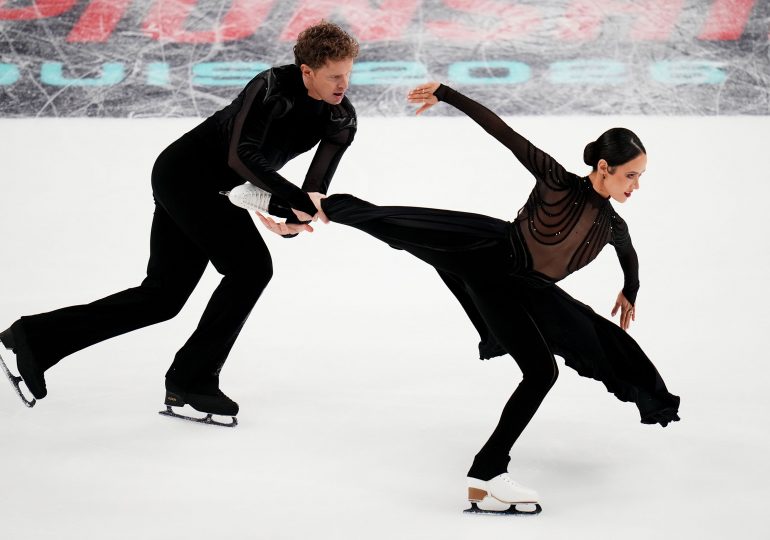
Ice dance is known for its dramatic storytelling, and no one does it better than Madison Chock and Evan Bates, the U.S. couple known for testing the limits of what’s possible on the ice with spectacular lifts, eye-catching costumes, and bold narratives that make their routines unforgettable. But in each of their Olympic efforts, they have been overshadowed by other teams or plagued by unusual mistakes that kept them off the podium.
[time-brightcove not-tgx=”true”]
The Milano Cortina Olympics will be their first as a married couple, and they are pushing the boundaries yet again with a matador-inspired routine for their free dance. “We love the creative process, and it’s fun for us to start diving into the music search, costume brainstorms, and program concept,” says Chock. “We love reinventing ourselves each season and giving the audience something they haven’t seen from us before.”
This season, in a gender-role reversal, Chock, 33, plays the matador and Bates, 36, the bull. But there is also a third member of the dance that can take on a life of its own: a long, flowing skirt that Chock wears that doubles as a cape. Maintaining control of how the skirt billows with the bursts of speed they generate has been the biggest challenge—and risk—of the season.
Read More: ‘What Is There to Lose?’ Alysa Liu on Making an Olympic Comeback After Retiring at 16
Chock, who designs the couple’s costumes, started with a heavier fabric and created a skirt that was double-faced, to throw out flashes of color as they skated. But the weight of the skirt kept getting in the way and posed a danger during some of the intricate lifts, as it blocked Bates’ view when he was holding Chock. They switched to a lighter fabric, but the skirt is still relatively long and remains an unpredictable part of their program.
“It is hard to fully control the skirt,” says their coach Patrice Lauzon. “Sometimes it has a mind of its own. If they skate slightly slower, or have a little more rotation or less rotation, all of that has an effect on it, and it reacts differently.” At one point, he says, “We said, ‘Maybe [the skirt] is not such a good idea,’ but Madi said no, she wanted to keep it. They like the challenge.”
Translating the staccato rhythm of Spanish dance to the ice was another challenge, since the dance involves stamping and crisp, solid movements while skating is all about flow and gliding. So the couple worked with an expert from Madrid to bring the spirit of flamenco to their program. “The syncopation, rhythmic clapping, and stomping was something we had to do over and over before it sunk into our bodies to the point where it feels second nature to us now,” says Bates.
Read More: How Figure Skater Amber Glenn Took Control of Her Life
Chock and Bates return to the Winter Games as the reigning world champions in ice dance, having won the title three years in a row, but those who follow the sport on only a quadrennial basis may be less familiar with their success in other international competitions than the saga that hit their sport in Beijing in 2022. At those Games, the Russians initially earned gold, the U.S. silver, and the Japanese bronze in the team event, but due to a doping scandal involving a Russian figure skater, the International Olympic Committee (IOC) decided to postpone awarding the medals until the investigation was resolved. Bates took the lead in speaking for the U.S. skaters in discussions with the IOC, expressing their desire to have some type of medal ceremony at the Games, and arguing that they shouldn’t be deprived of this experience. Ultimately, an arbitration court took nearly two years to make a final decision of striking the Russian skater’s scores from the team event, which moved the U.S. to gold, the Japanese to silver, and the Russians to bronze.
The IOC decided to award the medals at the 2024 Summer Olympics in Paris, and while it was two years later, Chock and Bates say the experience made up for the delay. “It was the absolute best scenario for our team to close off a really challenging chapter,” says Bates. “Our pursuit of this career is to have that Olympic experience, to stand on the podium and receive the medal that we poured so much work into. The whole team needed that closure, and we got it in Paris.”
The couple, who won their first of seven national championships back in 2015, has thrived since moving to Montreal in 2018 to train at the Ice Academy of Montreal (IAM), created by another married ice-dance team from Canada, Marie-France Dubreuil and Patrice Lauzon. Many high-level ice dancers gravitated toward IAM after learning about the couple’s unique training style, which involves rotating coaching sessions with Dubreuil, Lauzon, and Romain Haguenauer. Lauzon famously draws up a complex grid each season laying out each ice dance team’s training schedule. Such attention to detail is necessary because in 2022, IAM brought nearly a dozen teams from around the world to the Olympics in Beijing—about half of the entire ice-dance contingent—and will do so again in Milan.
For Chock and Bates, the example Dubreuil and Lauzon set serves as their North Star. “We look at them as mentors,” says Chock. “They skated together, so they know what it takes. They know the sacrifices and the triumphs they share together as a couple. We know we can really rely on them in hard moments during competitions.” And rather than being consumed by rivalry, Bates says he and Chock see a benefit to training at the same rink as the world’s best teams. “We want to see them succeed because it pushes us to succeed and work hard,” Bates says. “That’s the mindset—understanding that by surrounding yourself daily with competition is the best way you improve and reach new heights. For people outside of the sport, it may be hard to understand, since we’re all sharing resources like ice time and coaches. But at IAM, each couple leans into their own uniqueness—it’s not a cookie-cutter system where everyone comes to learn one technique and do one style.”
The healthy competition and continued success of teams from North America and western Europe are only increasing the popularity of the sport. In the decades after ice dancing became an Olympic sport in 1976, the top spots at both the Games and the world championships were usually reserved for teams from eastern Europe. “I remember being a very young, novice, and junior-level skater, and being so inspired by five-time U.S. champions Liz Punsalan and Jerod Swallow—they were so talented and worked so hard and were never really able to break through into those top ranks—and always feeling a little resigned that as a U.S. ice dancer, that was not in the cards,” says Ben Agosto, who, with his partner Tanith Belbin, won an Olympic medal in 2006, the first U.S. ice dancers to reach the Olympic podium since 1976.
Read More: Ilia Malinin Wasn’t Planning to Be a Figure Skater. Now He’s Favored to Win Olympic Gold
Then coaches from the former Soviet Union moved to the west and attracted talented teams who began vying for international medals. The first major hub was in Detroit, where coaches Igor Shpilband and Marina Zoueva trained successful teams including Meryl Davis and Charlie White, Madison Hubbell and Zach Donohue, Maia and Alex Shibutani, and Chock and Bates of the U.S. as well as Tessa Virtue and Scott Moir of Canada. Some of those teams, including Chock and Bates, shifted to Montreal when Dubreuil and Lauzon built their school. “We love people who innovate and want to push the sport,” says Lauzon of Chock and Bates. “But innovation is not always well received when it’s too different. It’s a fine line, and that’s where we are trying to help them.”
When Chock and Bates skate their free dance at the Milano Ice Skating Arena on Feb. 11, it will be their fourth attempt to earn an individual Olympic medal. In previous Games, they have finished 8th, 9th, and 4th; in 2018 in PyeongChang, they had an uncharacteristic slip that sent them to the ice during one of their spins after their blades seemed to clash —a freak mistake that’s still painful for Chock to discuss, as she says in the Netflix documentary Glitter & Gold. And their Olympic gold in the team event in Beijing was hard-won, and delayed. They are hoping to add their first individual Olympic medal to that one—ideally gold. As long as that skirt cooperates.
Leave a comment