Britain’s government found itself at the centre of a potentially fatal political storm this week, following the latest release of files connected to U.S. investigations into the convicted sex offender Jeffrey Epstein.
Disclosures from the Epstein investigation have already rocked one British institution—the country’s monarchy—with Andrew Mountbatten-Windsor, formerly known as Prince Andrew, stripped of his royal title late last year. The younger brother of King Charles III, he now faces renewed calls for accountability following the U.S. Justice Department’s release of more than 3 million Epstein-related files last week.
[time-brightcove not-tgx=”true”]
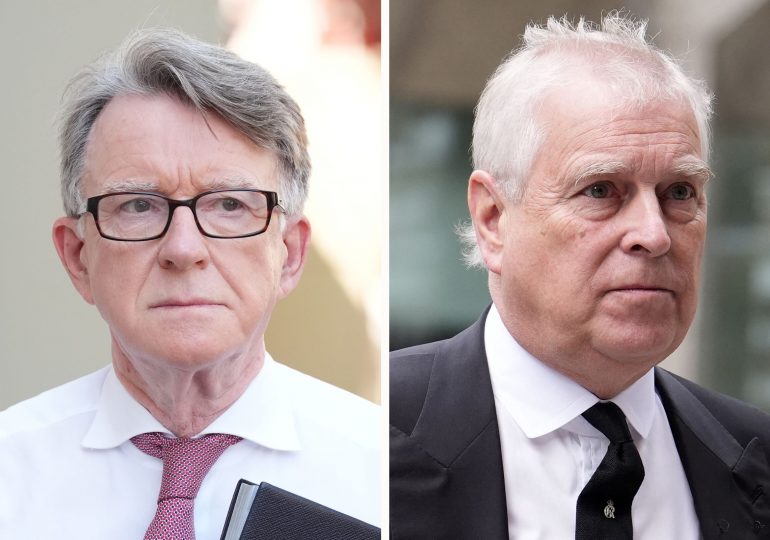
But news in the country over the past few days has been dominated by the way the fallout has spread to 10 Downing Street, the official residence of Britain’s Prime Minister Keir Starmer, who is struggling to quell a controversy centered on his former ambassador to Washington D.C., Peter Mandelson.
A major figure in Starmer’s ruling Labour Party, Mandelson was sacked as ambassador in September following disclosures about a closer than previously known relationship with Epstein, who died in his New York prison cell in 2019. The latest batch of emails go further, as it appears Mandelson might have leaked sensitive government information to Epstein in 2009. If proven to be true, it could result in him being prosecuted by British authorities.
That he was named ambassador at all, meanwhile, is threatening Starmer’s premiership. Previously forced to resign from ministerial positions in 1998 and then again in 2001, Mandelson’s relationship with Epstein was known when Starmer dispatched him to the U.S.
“The truth has to come out. That’s the only way we maintain our credibility and regain trust,” Bell Ribeiro-Addy, a lawmaker from Starmer’s Labour Party, tells TIME.
The controversy has spiralled into “one of the most significant scandals” the Labour Party has faced in recent history.
“MPs [Members of Parliament] are really disappointed that we have wasted this much political capital on keeping this one man [Mandelson] in the job. I think [the public] will feel betrayed by us for not doing what we say that we do, which is, believe women, and stand up for those who are the survivors of sexual abuse,” she adds.
At the heart of the latest scandal are disclosures connected to Mandelson’s time under former Prime Minister Gordon Brown from 2008-2010.
Serving as Business Secretary, he was a key figure during the financial crisis, privy to top secret economic plans and policies—some of which he may have passed on to the late sex offender, according to the latest batch of the Epstein files.
In one recently released email, for instance, he appeared to tell Epstein he would lobby other government officials in an effort to reduce a tax on bankers’ bonuses. In another, he appears to have forwarded an internal government report to Epstein which showed ways the U.K. might raise funds after the 2008 financial crisis.
Mandelson also appears to have tipped off Epstein that Brown would be resigning in 2010, and that the E.U. would announce a €500 billion to stem the Greek debt crisis.
“An initial review of the documents released in relation to Jeffrey Epstein by the U.S. Department of Justice has found that they contain likely market sensitive information surrounding the 2008 financial crash and official activities thereafter to stabilise the economy,” said a spokesperson for Starmer earlier this week. “Only people operating in an official capacity had access to this information in strict handling conditions to ensure it was not available to anyone who could potentially benefit from it financially.”
Beyond the sharing of confidential information, the Epstein files also appear to show financial transfers totalling $75,000 from the late sex offender to accounts linked to Mandelson or his partner, Reinaldo Avila da Silva. Mandelson has reportedly said that he doesn’t recall receiving the money and will need to look into whether the documents are legitimate.
TIME has contacted Mandelson for further comment.
Amid the accumulating accusations, the U.K.’s Metropolitan Police confirmed it has “launched an investigation into a 72-year-old man, a former government minister, for misconduct in public office offences.”
In an update on Friday afternoon, local time, police revealed two properties linked to Mandelson had been searched in relation to the probe. Mandelson has not yet “been arrested and enquiries are ongoing,” the police said.
While those inquiries unfold, the political toll is already mounting. Long regarded as a key architect of the Labour’s electoral comeback in the 90s, Mandelson has resigned from the party, saying that he wanted to avoid causing it “further embarrassment.”
And he’s also quit the House of Lords, relinquishing his powers as a lawmaker by leaving the upper chamber of the British Parliament. He does however retain the title of Lord—something that can only be taken away from him by the passing of a new law.
A shaken government
Starmer, who publicly apologized to Epstein’s victims on Thursday, has explained Mandelson’s appointment as ambassador in February 2025 by saying that he had “lied repeatedly” about his ties to Epstein. “I regret appointing him. If I knew then what I know now, he would never have been anywhere near government,” the Prime Minister said, attempting to distance himself—and his premiership—from the worsening scandal around Mandelson.
Yet as politicians from his own camp and that of the opposition Conservative Party clamour for answers, it is unclear whether he will succeed.
“It’s something that’s had the potential to engulf this government in a way that I don’t think any other scandal has in its very young two years,” Clive Lewis, another lawmaker from Starmer’s ruling Labour Party tells TIME. “Frankly, it’s disastrous.”
“I’d like to see those who have betrayed this country, betrayed our party, betrayed our movement, to face the full force of the legal system and the law,” says Lewis.
A splintered royal family
As the Mandelson scandal shook Parliament, meanwhile, tremors from the Epstein files once again reached the British royal family.
Documents released by the DOJ last week included a photograph of Andrew leaning over a woman on the floor. The woman’s face had been redacted and it’s unclear when or where the photographs were taken. The photograph has sparked renewed questions over Andrew’s relationship with Epstein and his own conduct.
Police are also reviewing a fresh allegation that Epstein sent a woman to Andrew at the Royal Lodge residence in Windsor in 2010.
“We are aware of reports about a woman said to have been taken to an address in Windsor in 2010 for sexual purposes,” a Thames Valley Police spokesperson told TIME on Wednesday. “We are assessing the information in line with our established procedures.”
Andrew’s relationship with Epstein, something which he said he did not regret after the sex offender’s death, has long been scrutinized. The royal was famously interviewed on BBC’s Newsnight in 2019 about the nature of the friendship.
Andrew was accused of sexual abuse himself by one of Epstein’s victims, the late Virginia Giuffre. He has repeatedly denied the allegations. In 2022, Andrew settled a sexual abuse lawsuit with Giuffre for an undisclosed amount.
A month before the settlement, Andrew was stripped of his key military titles and royal patronages. He was stripped of the remainder of his titles in late 2025, after additional allegations by Giuffre came to light in her posthumous memoir.
This week, Andrew’s younger brother Prince Edward was asked about the release of the new files during a summit in Dubai. Offering a rare royal comment, he said: “It’s really important, always, to remember the victims, and who are the victims in all of this? [There are] a lot of victims in this.”
Edward’s remarks are “significant” and “may well be the precursor to other members of the royal family making comments that we didn’t expect,” says royal commentator Richard Fitzwilliams.
“Bear in mind that various royal palaces have been mentioned in emails. It’s embarrassing, because when this occurred, he was a senior working royal,” Fitzwilliams adds. “It is another nail in the reputational coffin.”
In a notable escalation, Starmer has called on Andrew to testify in front of Congress over his links to Epstein, and other lawmakers are also demanding that the royal answer serious questions.
“It’s a reminder that no one, however powerful they are, should be above the law and no one should be allowed to evade proper justice,” says Richard Burgon, a Labour lawmaker.
In agreement, Labour’s Ribeiro-Addy notes: “There’s absolutely no excuse for anybody, regardless of their rank or their position, to have maintained relations with such a monster.”
TIME has reached out to Andrew’s representatives for comment.
Leave a comment