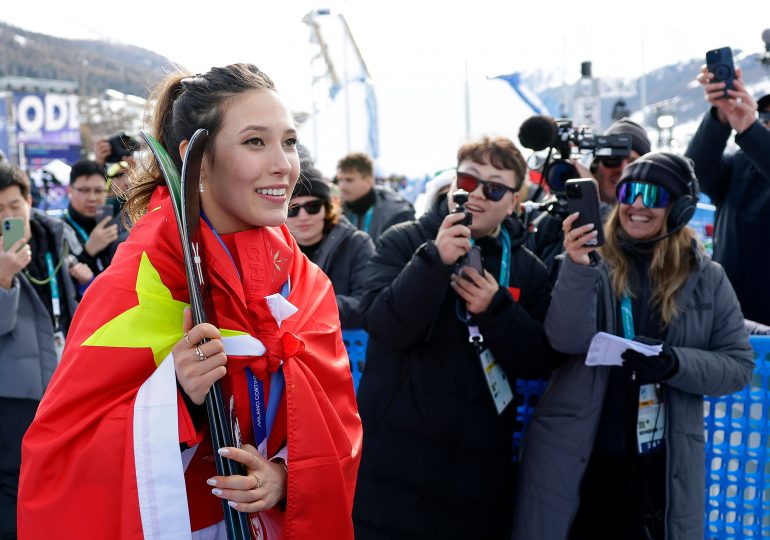
All that was missing in Eileen Gu’s Olympic mantle was a gold medal in the lone freeskiing event, slopestyle, that she didn’t win four years ago in Beijing. On Feb. 9, the third day of full Olympic competition, the American-born freestyle superstar who represents China very nearly got it in Livigno, Italy.
[time-brightcove not-tgx=”true”]
But she’ll have to settle for another slopestyle silver, as Switzerland’s Mathilde Gremaud landed an impressive series of jumps at the bottom of the course—and took advantage of Gu’s mishaps at the top—to win her second straight Olympic gold medal in the event. The two most dominant women in slopestyle delivered a thrilling theater for the fans at the Livigno Snow Park, and for a viewing audience around the world; Gremaud, now the only back-to-back slopestyle skiing winner in Olympic history, edged Gu by a mere .38 points in the judging.
While Gu won’t one-up her Beijing performance and become the first action-sports athlete to ever win three gold medals at a single Winter Olympics, she still has a strong chance to write Olympic history. Gu won gold in both big air and halfpipe freeskiing in Beijing. If she can repeat just one of those performances in Livigno, in the big air final on Feb. 16 or the halfpipe final on Feb. 21, she’d own three career Olympic golds. Shaun White is the only other winter action athlete with three golds at the Games, and he needed a dozen years to win that haul; Gu would do it in four.
Read More: ‘I Don’t Believe in Limits.’ How Eileen Gu Became Freestyle Skiing’s Biggest Star
Her day got off to a rather inauspicious start, as Gu crashed twice in warm-ups. But the Stanford international-relations major, who plans on returning to school as a junior after the Games, put those mistakes behind her and executed her plan. “There is this kind of trauma, like lingering sense of, I guess, fear or anxiety that follows crashes,” Gu said at the medalists’ press conference after the event. Gu said she had 20 minutes after the training to get her mind in the proper space. “I think both of the falls that I had were technical errors, not being mentally off,” she said. So Gu, far and away one of the more analytical Olympians, if not overall athletes, around, pinpointed what she did wrong and sought to make corrections. “I like to think that those crashes made me better in the contest, because I knew what to look out for and what to be better about, technically,” said Gu.
On her first run, she kept her skis on the rails and built up speed to allow aerial trickery on the bottom jumps. Gu executed back-to-back double corks—rotating twice off-axis in the air. On her final jump, she hung in the air for 2.44 seconds, which might not sound like much, but you try that on skis while spinning around. Gu spun left, spun right, and grabbed her skis, which the judges love. Her score, 86.58 out of 100, put her in first place by a mile. “That was, hands down, the best slopestyle run I’ve ever done,” said Gu.
As the top-scoring qualifier, Gremaud was the final competitor to take her first turn, following Gu. Gremaud scored 83.60, good for second place behind Gu. You didn’t have to be a slopestyle judge to figure out that one of these two skiers would almost certainly win the event. They aced the eye test.
In the Olympic slopestyle finals, the dozen skiers each get three runs: only the highest of the three scores counts. This is where Gu’s rail problems began. She slipped off the first rail in her second run, eliminating any chance for her to top her 86.58 score. Sensing an opening, Gremaud delivered a spectacular sequence: jumps of 1080 (three full 360-degree rotations while in the air), 1260 (three full 360-degree rotations, plus a 180), and 1260, back-to-back-to-back. Gremaud’s performance was “the most technical jump run ever done by a freeskiing woman, in competition or outside competition,” NBC freeskiing expert Tom Wallisch told TIME. “The best three-jump competition in terms of degree of difficulty a woman has ever landed. Her full run was amazing.” She could still only eke by Gu, 86.96 to 86.58, in the scoring, setting up a showdown for the third and final run.
With the tension building, Gu again went for it and again couldn’t get past the first rail. Gu said learned her trick for the first rail just last week. “So it’s kind of hit-or-miss still,” she said with a laugh. It’s called “The Disaster.” “Ironically, it was quite a disaster in run two and three.”
Big air qualifying starts on Feb. 14. In Beijing, Gu knew she’d have to try a mind-bending trick to pull out a victory, so against the advice of her mom and confidante, Yan, she tried something she’d never done before, even in practice: a double cork 1620, 4 1/2 spins in the air while rotating twice off axis. She let out a roar when she landed it. But on Monday, she dialed back big air expectations for these Olympics, hinting that she may prioritize her safety for the halfpipe event, in which she’s the clear favorite, near the end of the Games. “My theme for this Olympics is having nothing to prove,” she said. “So I’m not here because I have to be. I’m here because I want to be and I love this sport, and I love progressing, and I love being the best version of myself.”
Gu betrayed no hint of disappointment after slopestyle, even fielding a question that many athletes have been receiving—about their thoughts on U.S. immigration policies, high-profile incidents involving ICE agents, and President Trump criticizing American Olympians who feel conflicted representing their country in this moment—in an upbeat manner. Gu has experience with these sorts of inquiries unrelated to her athletic endeavors: her decision to represent China, instead of the U.S., has been the subject of intense blowback for her.
“I’m sorry that the headline that is eclipsing the Olympics has to be something so unrelated to the spirit of the Games,” says Gu. “This is one of very few remaining safe spaces that I think people can communicate and share culture and be fully themselves. Because even if you and I don’t speak the same language, we both know that it hurts when you fall and it feels good when you win, right? And that we all know how terrifying it is when you’re about to try a new trick and how ecstatic you are when you land it for the first time. That is a universal language. So it makes me sad to see that that is the headline right now, and as someone who’s been caught in the crossfire before, I feel sorry for the athletes. I hope that they can ski to their very best.”
Like most athletes here, Gu would prefer the focus remain on the field of play. “I’ve been through a lot in the last four years, and even beyond that, I’ve gone through things at 22 that I don’t think any person ever should have to deal with, be it from threats, vitriol, online hate. I mean, you name it,” said Gu. “But I get stronger, right? And that’s what’s so wonderful about being young. You adapt and you learn and you get stronger and better and better and better. As far as getting better in skiing, there was a period of time when I thought that I would never be better than how I was when I was 18. And so overcoming that and showcasing my very best skiing again today, under pressure when it counted at the Olympics is such a special experience. I have always said that if I can just inspire one young girl to start skiing, then that will be my mission accomplished. So hopefully, after seeing the level of women’s freeskiing today, that goal is accomplished. That is my gold medal for the day.”
Leave a comment