
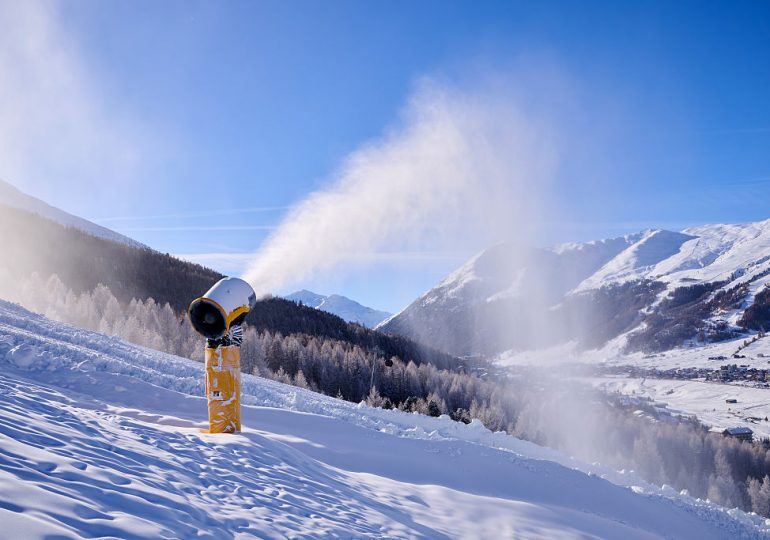
Just before the Winter Olympics kicked off, Cortina d’Ampezzo, the Dolomite town that will play host to a number of the Games’ alpine events, received a healthy dusting of fresh snow, easing earlier concerns about snow reliability after a warm start to the winter. But organizers have already produced over 56 million cubic feet of fake snow to create the conditions athletes expect.
[time-brightcove not-tgx=”true”]
It’s nothing new. Machine-made snow has been used by ski resorts for decades to combat unreliable weather conditions—for recreation and competitions alike. Around 60% of the world’s ski resorts now rely on snowmaking machines alongside natural snowfall, and in 2022, the Beijing Winter Olympics relied on almost 100% artificial snow.
As climate change makes winters warmer, the practice could become more widespread—but it often comes with a climate cost.
Just like natural snow, artificial snow is a mixture of snow and ice, but the process of creating it differs greatly from the snowflakes that form in the atmosphere.
“Machine-made snow involves the freezing of liquid water into rounded beads of ice that, when collected together on the ground, take on an appearance of natural snow,” says Noah Molotch, snow hydrology professor at the University of Colorado, Boulder.
Machines spray out a mixture of compressed air and water from a machine, a process that uses a lot of energy and water. A 2023 study found that, in Canada, producing 1.4 billion cubic feet of snow during an average winter requires an estimated 478,000 megawatt-hours (MWh) of electricity per year, resulting in 130,095 metric tons of associated carbon emissions—equivalent to the annual energy consumption of nearly 17,000 Canadian households—and an estimated 1.5 billion cubic feet of water—roughly 17,320 Olympic sized swimming pools.
It is estimated that the Games will need 84.8 million cubic feet of water—the equivalent of 380 Olympic swimming pools—for snowmaking alone, according to NPR. Where that water is sourced from is important, says Daniel Scott, professor of geography and environmental management at the University of Waterloo. “In many places in North America, and Cortina has them as well, we have purpose-built reservoirs in the mountain, where you capture spring runoff when there’s plentiful water, put it up on the hill as snow, and 80-90% of that melts back down into the same watershed the next year.”
The same can be said for energy. “If you’re using [electricity] from a grid that has a lot of fossil fuels in it, you’re contributing back to climate change, which is the very reason you have to use snow making in the first place, so the source of electricity really matters,” says Scott.
The easy solution to the practice’s energy drain, Scott says, is making sure that electricity is coming from renewable sources—a switch that snow towns everywhere from Quebec to the French Alps have already made. The International Olympic Committee has said that “most” of the energy used for snowmaking this year will be renewably sourced.
Scott notes that, in some cases, the practice can change the ecological balance of a region, causing, for example, delayed blooms, though the impact is often minor. “When you add to the natural snow pack it takes longer to melt,” he says. “There is some compaction and impact on the vegetation and the soils on the ski areas.”
Artificial snow though can help lower emissions overall, Scott says, by allowing people to ski closer to home.
“If you took snowmaking away from New England, there would be no ski industry in the Northeast. Those who would want to ski from Boston or New York, would get on an airplane and fly to Colorado or Utah or drive up to Quebec,” he says. “Every one of those options has a massively larger carbon footprint.”
But artificial snow, no matter how sustainably it’s produced, can’t solve the problems many snowy locales are facing as temperatures rise. A recent study found that, out of 93 potential host sites, only 52 would have reliable conditions for the Winter Olympics in the 2050s. Cortina d’Ampezzo now sees 41 fewer freezing days annually than when the Games were first held there in 1956. In order to produce machine-made snow, the atmospheric temperatures need to be relatively close to freezing temperatures.
It’s for this reason that the practice isn’t going to solve the issues that the Olympics and the winter sports industry more broadly will have to contend with in a warming world, says Molotch. “Artificial snow is not the silver bullet for addressing the issues related to climate change in the ski industry.”
Leave a comment