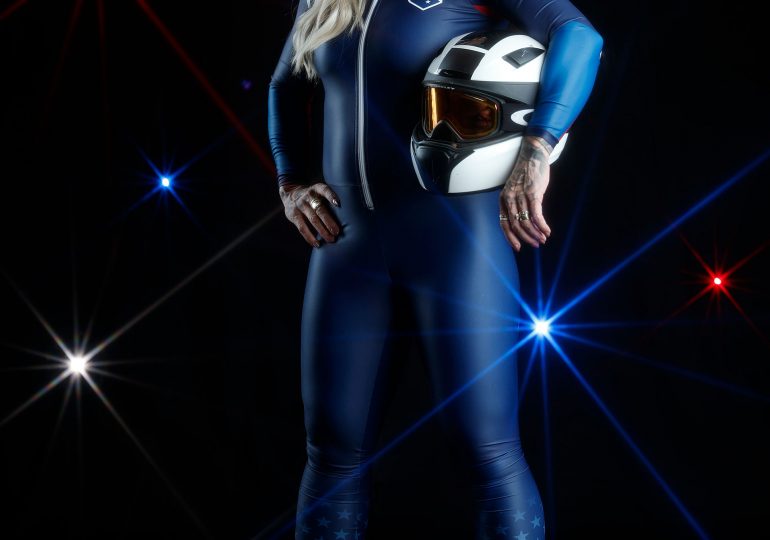
American bobsledder Kaillie Humphries has already won three Olympics gold medals in her standout career. Back-to-back wins for her birth country of Canada in the two-woman event in 2010 and 2014, plus another gold, after a contentious, stressful battle to switch national allegiances, for the United States, in the inaugural driver-only monobob event in Beijing. So as well as anyone, Humphries can paint a picture of an ideal Olympic run down the refrigerated track in Cortina d’Ampezzo, Italy, in February.
[time-brightcove not-tgx=”true”]
“The sled should look smooth,” says Humphries, 40, during an interview from San Diego, where she lives with her husband, former USA bobsledder Travis Armbruster, and their son, Aulden, who will turn 20 months old in mid-February. “It should look effortless. You shouldn’t see a lot of sideways movement. That’s usually a Kaillie Humphries special. Especially when the pressure gets big. I can drive the heck out of a sled better than anybody else in the entire world. So my goal is to be good enough at the start, then crush them in the driving on the way down.”
Humphries thought she might miss her chance to add to her Olympic legacy, as she moved forward with plans to start a family with Armbruster after Beijing. She had tried to get pregnant naturally prior to those Games, but in 2021 Humphries was diagnosed with stage IV endometriosis, an often painful condition in which tissue that is similar to the inner lining of the uterus grows outside the uterus.
Read More: When Erin Jackson Became an Olympic Speedskater, She Even Surprised Herself
Endometriosis can cause fertility struggles, so in the summer of 2022, Humphries began IVF treatments. Three transfers did not result in a baby, but in August 2023, with the qualification period for Milano Cortina fast approaching, she decided to keep trying. “It got to the point of, I’m going to continue down this path, and it may cost me a future Olympics,” she says.
A month later, she got pregnant. Humphries gave birth to Aulden in June 2024. While she missed the 2023-2024 World Cup bobsled season due to her pregnancy, Humphries had to return to the track just five months postpartum in order to protect her rankings and put herself in the strongest possible position to qualify for the 2026 Olympics. “I would have liked a little more time to bond with my son, to physically recover from giving birth,” she says. “On the recovery piece, we are devaluing what it takes to go through pregnancy, to go through the birth process. You’re pregnant for nine months, you give birth, it’s going to take at least a year to get back in shape. So I would like to see where women have a year to return after giving birth.”
She felt like a shell of her former self. “From a physical standpoint, was my body ready to compete at five months postpartum?” says Humphries. “No, not even close. You’re missing that whole core midsection, which in a power- and speed-based sport with g-forces, there is a big component there that I was lacking. Running, sprinting was extremely challenging for me. I was able to do it. But you’re not doing it well. You’re not performing. You’re surviving.”
Armbruster gave up his job as a personal trainer to hit the road with Humphries and their son during the 2024-2025 bobsled World Cup season, which had stops in Germany, Latvia, Austria, Switzerland, Norway, and Lake Placid, N.Y. Humphries was advised—mostly by men, she notes—against breastfeeding during her comeback. “Do I do what’s best for my son, because I believe that’s giving him breast milk, or do I do what’s best for my performance in my career?” she says. “And you don’t want to have to give up either. So you’re in this torn place all the time.”
Read More: ‘I Don’t Believe in Limits.’ How Eileen Gu Became Freestyle Skiing’s Biggest Star
Humphries put Aulden first. “He just keeps crying,” she says. “It didn’t matter how much I pumped, the boob was the only thing that was going to fix it.” Breastfeeding took its toll on her. “You’re exhausted,” she says. “Just the drain on your system. You only have so much battery life in your body every day.” Aulden’s periods of sleep regression also put Humphries in a difficult position. “I have to perform in two or three days, and I’m up every two or three hours, and I’m getting maybe four hours of sleep,” she says. “My competitors are 25, 28 years old, they’re having 8, 9, 10 hours of sleep uninterrupted. You feel guilty. And then there’s times when I’m at the bobsled track for six or seven hours and I haven’t seen my son, and I feel guilty as a mom that I don’t get to be with him every second of every day.”
All this strain, on both body and mind, made her finishes—fourth in the two-woman event and eighth in monobob at worlds in March 2025—quite impressive, even if, as a five-time world champion, she didn’t view them that way. “Being nine months postpartum, most people would be ecstatic with that,” says Humphries. “For me, it’s hard, because I expected to go out and win. Realistically, I knew I wasn’t in the shape to be able to do it.”
But she came into this World Cup season thinking she was on track to peak at the Olympics. Her results show she might be right. Humphries won a pair of two-woman events in December and January, and she won her first monobob as a mom on Jan. 17, in Altenberg, Germany. The next day, she finished second in the two-woman race, with Jasmine Jones, who will be Humphries’ brakewoman in Cortina.
She’s already the only woman with Olympic golds in both the two-woman and the monobob. Becoming the first to win both at the same Games now seems well within reach. “That’ll be a perfect mic-drop moment,” says Humphries.
Humphries has already earned a victory: entering these Games with no regrets. She is promising to take plenty of pictures of Aulden in Italy, so they can one day look back on these Games that they shared together. “There’s no way I would have ever been able to live with myself if I would have chosen sport over family,” she says. “There’s nothing that I would change, regardless of what the result is. I’m going out to try and win double gold. But it is really about the journey this Olympics, more than any other Olympics. It really is about the process and the planning of what it took us over these four years to get to this Games with Aulden. With IVF, with the hormones, with the injections. It’s the journey of us becoming a family and less about the results. And I’ve never had that before.”
Leave a comment