
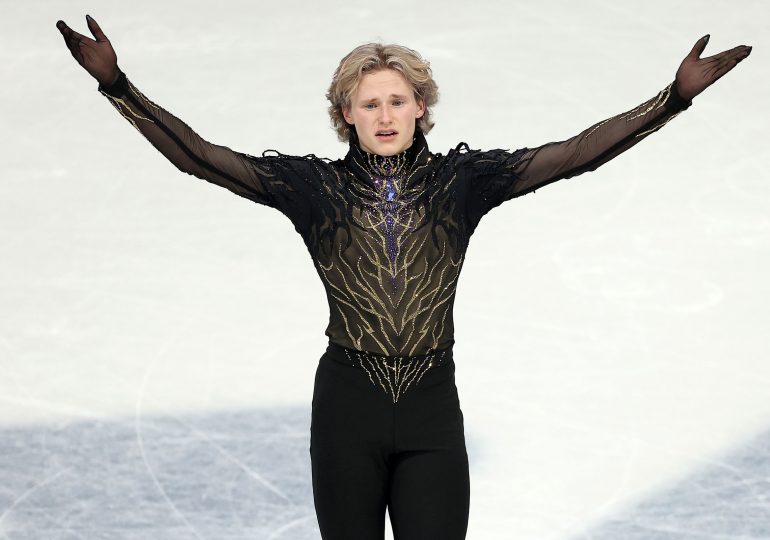
It’s been a bit of a whirlwind week for Ilia Malinin, who arrived at his first Olympics as the no-brainer winner of the men’s figure-skating event. The four-time U.S. champion has outscored his competitors by as much as 10, 30, or 40 points in the past. So essentially, he was untouchable, and the battle was for silver and bronze.
[time-brightcove not-tgx=”true”]
But in his first appearances on Olympic ice, Malinin showed some fallibility and faltered in the short program of the team event, finishing behind Japan’s Yuma Kagiyama. He won the free program segment in the team event, but wasn’t his usual dominant self. He seemed to have shaken off the nerves for the individual men’s event a couple of days later and finished in first, nearly six points ahead of Kagiyama. The gold was his to lose. All he had to do was skate the free program that had made history, with seven quad jumps, and he would be the indisputable champion.
After erupting in applause when he was introduced, the Milano Ice Skating Arena fell silent as Malinin took his starting position and his music —actually Malinin’s own voice in an opening spoken word section—began. He landed a clean quad flip to start the program and seemed to be on track to repeat his seven-quad performance from December. But it soon became clear that his victory was hardly a sure thing. The next jump was supposed to be the quad axel that only he has landed in competition, but he popped it in the air and only received points for a single axel. He seemed to brush off that mistake and landed a solid quad lutz, but then faltered on the planned quad loop and opened up again in the air, completing only two rotations.
Read more: U.S. Wins the First Figure Skating Event of the Milano Cortina Olympics
The mistakes began taking a toll. His next jump was a combination, starting with the quad lutz, but he fell on that jump and wasn’t able to complete the next two in the series, and received deductions for repeating the quad lutz (skaters can only perform solo jumps once but can repeat them if they combine them with other jumps). He attempted to make up points with another jump combination beginning with a quad, but fell again on the first jump after doubling it, for which the judges gave him under one point—likely a first for Malinin. In all, he fell on two jumps, which resulted in an automatic two-point deduction, and had lost too many points to get on the podium.
Instead, the surprise Olympic men’s champion is Mikhail Shaidorov from Kazakhstan, who landed five quad jumps to earn the gold—his country’s first in the event. “I just did my work,” he said after the event, adding that Malinin’s performance was “very surprising. He’s very important to figure skating; he’s the best skater in history.” After coming off the ice, Malinin, who ended up in 8th place, congratulated Shaidorov and told him, “You deserve it.” Japan’s Kagiyama earned silver, and his teammate, Shun Sato, whom Malinin had beaten in the free program of the team event, skated another powerful program for bronze. Malinin’s U.S. teammates, Andrew Torgashev and Maxim Naumov, whose parents were killed in a plane crash last January, both struggled with some of their jumps and finished 12th and 20th, respectively.
Stunned and at a loss to explain what had happened, Malinin said he “blew it” and acknowledged the impact of the pressure of competing at his first Olympics. “Especially going into that starting pose, I just felt like all the traumatic moments of my life really just started flooding my head, and there were just so many negative thoughts that flooded in there, and I just did not handle it,” he said. Normally, he tells himself during competitions that he has prepared for the event and that he should trust his body and his training. But it was hard to play those mind tricks in Milan, he said. “This whole day was going really solid, and I just thought that all I needed to do was go out there and trust the process that I’ve always been doing with every competition. But of course, it’s not like any other competition; it’s the Olympics, and I think people only realize the pressure and the nerves that actually happen from [experience]. So it was really just something that overwhelmed me and I just felt like I had no control.”
In addition to all the attention focused on him as a gold-medal favorite, Malinin skated the equivalent of two full competitions, with short and free programs, over six days. Team USA selected him to skate both portions of the men’s program in that event, and his clutch performance in the free pulled the U.S. ahead of Japan by one point, earning Malinin, and his teammates, gold.
He was expected to add a second gold to that tally, but will leave Milan without any hardware from the men’s event.
“It’s really difficult, there is this pressure from people who assumed that [Malinin] would probably get gold,” said Kagiyama, who repeated as Olympic silver medalist. “His performance, if I may comment, was a little bit unusual. But it really proves that this is really the Olympics; things like that happen.”
The experience is reminiscent of the 2018 Olympics in PyeongChang, when another heavy favorite for gold, Nathan Chen, faltered in the short program of the men’s event and finished 17th. He said he felt enormous pressure from being the favorite and that the tension continued to build until his competition. Chen was able to recover in the free program, completing five quad jumps, which was enough to bring him to fifth place overall.
In Malinin’s case, the nerves hit at the worst possible time. “I still haven’t been able to process what just happened,” he said. As he began skating, the only audible sound was the quiet push of his blades against the ice as he built momentum for his first jump. “That first quad and some of the [other] quads they felt really ideal,” he said. “So I definitely knew that I was prepared well enough. But it’s a lot to handle, a lot to process, so I honestly don’t know what actually happened in the moment. All I know is that it wasn’t my best skate and that it was definitely something I wasn’t expecting, and it’s done so I can’t go back and change it, even though I would love to do [that].”
Among the capacity crowd at the Milano Ice Skating Arena to watch what they assumed would be the crowning of another U.S. Olympic champion were Nathan Chen and summer Olympians Simone Biles and Frederick Richard. “Come on, Ilia, you’re still in it,” Richard said after Malinin popped his first jump. Richard and Malinin have bonded over their passion for backflips—Malinin managed to complete one toward the end of his program, although he received no points for it since it’s not a recognized element by the judges, and Richard has adopted the moniker “Frederick Flips” and owns the Guinness World Record for the most standing backflips over 24 hours. Together, they co-created National Backflip Day, on December 21 (12-21, which can be flipped numerically to reflect the same date), to celebrate sports and encourage safe, creative ways to flip.
Malinin met Richard at a gym over the summer and they shared tips. “We’re almost the same age, and he’s dominating his sport, and I’m working on dominating my sport, so we just relate to each other a lot—we’re both flipping and doing a lot of air sense in our sports,” Richard says. Malinin’s gymnastics background may also be helping his skating. “I don’t know skating enough, but the thing about gymnastics is that it gets you the balance, the air awareness, and the flexibility that you can transfer to any sport,” Richard says. “He’s honestly what we call a phenom. He twists faster than anybody else can twist; that’s why he’s the ‘Quad God.’”
Chen, who is also in Milan for the Games, had the opportunity to skate with Malinin when Malinin was younger and came with his father and coach, Olympian Roman Skorniakov, to Chen’s rink to work with Chen’s coach, Rafael Arutyunyan. (Arutyunyan is also in Milan supporting Malinin). “Obviously, his physique matches skating very well; he’s naturally very talented and he’s very twitchy and also his rotation is fantastic,” Chen says, referring to the twitch muscles needed to pull in quickly and complete four revolutions in the air. “So even if his takeoffs aren’t perfect, he’s still able to sneak out the landing, with the way that he’s able to snap his jumps.”
Chen also sees another useful characteristic in Malinin, which only another skater like him, who landed five quadruple jumps in winning his Olympic gold, can appreciate. “He’s also very fearless, and I think that’s a big component of being able to do quads,” he says. There’s no standard technique for mastering quad jumps, since every athlete’s body is different. “It’s really optimizing his leverage and torque to get the rotation based off of his own personal body as well,” says Chen. “Technique is not a one-size-fits-all kind of thing, so you have to optimize based off of what you’re able to do and how you’re able to get into the air.”
Malinin’s technique is generally the key to his consistency, says Paul Wylie, who won silver at the 1992 Olympics. “Coming from someone who only did a triple axel, it’s the air position and it’s the snap,” Wylie says. “That combination, with the timing, makes it so that you’re standing over your rotational axis, because if you fall out of that axis even a little bit, you’re going to lose the jump and it’s going to slow down and you don’t get around.”
While the full spectrum of what Malinin is capable of on the ice wasn’t on display in Milan, he’s already thinking ahead and ready to put this experience behind him. “From here it’s just regrouping and figure out what to do next and going from there,” he said. At 21 years old, it likely won’t be the last we see of Malinin at the Olympics, and one competition won’t diminish the impact he is having in evolving the sport of men’s figure skating. “He will be the greatest of all time,” says Richard.
Leave a comment