Mexican security forces have killed the country’s most-wanted drug kingpin using U.S. intelligence.
The military raid in the town of Tapalpa in the western state of Jalisco on Sunday took down Nemesio Rubén Oseguera Cervantes, also known as “El Mencho,” according to Mexico’s defense ministry. The operation marked a major escalation by the Mexican government amid President Donald Trump’s monthslong campaign to pressure it to more aggressively fight drug cartels in its country.
[time-brightcove not-tgx=”true”]
The killing has sparked a surge of violence in parts of Mexico controlled by cartels. Mexican President Claudia Sheinbaum Pardo called for people to “stay informed and calm.”
Here’s what to know about the operation and how it used U.S. intelligence.
Who was “El Mencho”?
Oseguera, 59, led the Jalisco New Generation Cartel (CJNG), one of Mexico’s most powerful drug cartels, although he was a shadowy figure who avoided public attention.
Hailing from the state of Michoacán, Oseguera grew up in poverty and immigrated illegally to California in the 1980s, before being deported to Mexico in the early 1990s. There, he became a police officer but eventually left the police to join the Milenio Cartel.
In 2009, following the arrests and deaths of several of Milenio Cartel’s leaders, Oseguera co-founded CJNG. The cartel is one of the major traffickers of cocaine, methamphetamine, and fentanyl to the U.S. It has a presence in almost all 50 U.S. states and is as powerful as its rival the Mexican Sinaloa cartel, according to the U.S. Drug Enforcement Administration.
According to the U.S. Treasury Department, the group has also moved into other illicit activities, including fuel theft and crude-oil smuggling. In 2020, members of CJNG carried out an assassination attempt on Mexican Security Minister Omar Garcia Harfuch, then Mexico City’s Secretary of Public Security, using grenades and high-powered rifles.
Oseguera has been indicted several times in the U.S. for drug trafficking since 2017. In December 2024, the U.S. State Department raised the reward for information leading to his arrest or conviction to $15 million. It described him as a “fugitive.”
Last year, the Trump Administration also designated CJNG, as well as several other drug cartels, a foreign terrorist organization. The move opened the door for the U.S. military to be more involved in targeting drug cartels, which has raised legal concerns around potentially circumventing due process and international law, and for financial institutions to be held more liable for possible links to the cartel.
In a Sunday post on X, U.S. Deputy Secretary of State Christopher Landau called Oseguera “one of the bloodiest and most ruthless drug kingpins.”
“This is a great development for Mexico, the US, Latin America, and the world. The good guys are stronger than the bad guys,” Landau said of the operation.
What do we know about the operation?
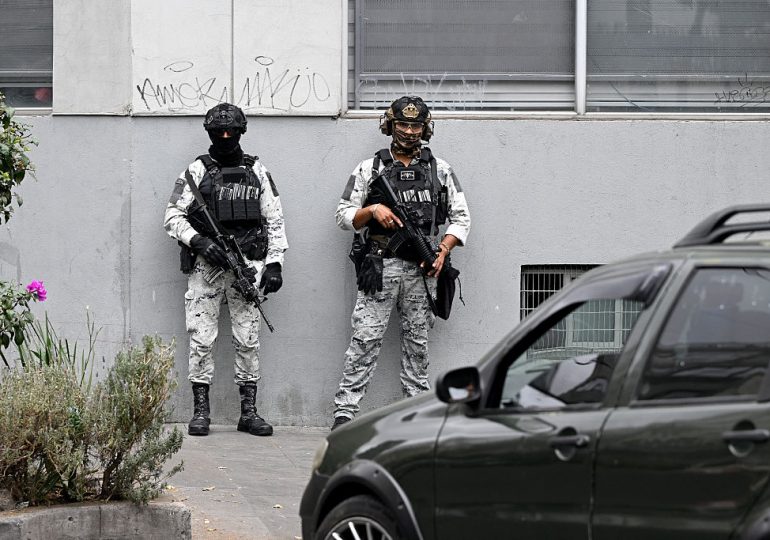
During the operation, which involved the Mexican Air Force and Mexican National Guard’s Immediate Reaction Special Force, Mexican military personnel were attacked and in defending themselves killed four members of CJNG and seriously injured three others, including Oseguera, who later died, according to the Secretariat of National Defense in Mexico. The Mexican military detained two other members of CJNG and seized armored vehicles and weaponry, including “rocket launchers capable of shooting down aircraft and destroying armored vehicles.”
What was the U.S.’s role?
White House Press Secretary Karoline Leavitt said the U.S. provided “intelligence support” to the Mexican government to “assist” in the operation that “elimated” the cartel leader.
Mexico’s defense ministry said that American authorities provided “complementary information” that assisted with the execution of the operation. A Mexican official told Reuters that the operation was designed and executed by the Mexican government and that no U.S. military personnel were physically involved.
A former U.S. official told Reuters that the U.S. had provided the Mexican government with a target package with information on Oseguera compiled by U.S. law enforcement and intelligence agencies.
Reuters also reported that the Joint Interagency Task Force-Counter Cartel, a new task force involving multiple U.S. government agencies, was involved in the raid. The task force was launched in January in order to “identify, disrupt, and dismantle cartel operations posing a threat to the United States along the U.S.-Mexico border,” according to its website. It aimed to map out drug cartel networks along the U.S.-Mexico border, U.S. officials told Reuters.
The Trump Administration has used its designation of drug cartels as foreign terrorist organizations to justify escalating its war on drugs. Its campaign has included more than 40 strikes on alleged drug boats in the Caribbean and Pacific which have killed nearly 150 people, despite legal concerns over the extrajudicial nature of the killings and the fact that foreign governments and the families of some of those killed have insisted that they were fishermen, not “narco-terrorists.”
The Trump Administration has also sought to pressure the Mexican government to ramp up efforts to crack down on cartels, including through imposing tariffs on Mexican goods. The Mexican government has deployed around 10,000 National Guard and Army personnel to its border with the U.S. to tackle drug smuggling and reduce migration. Mexico has also turned over close to 100 alleged criminal gang members to U.S. authorities.
Sheinbaum has also cracked down on Mexican officials with ties to criminal groups. Earlier this month, Mexican authorities arrested Diego Rivera, the mayor of the municipality of Tequila, along with three other local officials, over their alleged involvement in an extortion scheme in collusion with CJNG.
What has happened after?
In the aftermath of El Mencho’s killing, criminal groups have reportedly reacted with violence in apparent revenge attacks. In the Jalisco capital of Guadalajara, which is a host city for the 2026 FIFA World Cup that begins in June, a reporter shared a video of several men, suspected to be members of CJNG, appearing to set a gas station on fire. Local news outlets Reforma and Milenio also reported that there were gunfire and gang fights in several areas of Jalisco and that suspected cartel members were burning cars and trucks to blockade roads.
Photos showed burnt down vehicles. In Puerto Vallarta, another city in Jalisco that is popular with tourists, Reforma posted a video showing smoke rising from explosions across the city. Mexico’s Security Cabinet said that four road blockades are ongoing in Jalisco as of Sunday evening.
The U.S. Embassy in Mexico issued an alert urging Americans to “shelter in place” in Jalisco, Baja California, Quintana Roo, and areas of Guanajuato, Guerrero, Michoacan, Oaxaca, Nuevo Leon, and Tamaulipas. The embassy noted that roadblocks have impacted airline operations, while taxis and rideshares have been suspended in Puerto Vallarta. Mexican air carriers Controladora Vuela Compania de Aviacion SAB and Grupo Viva Aerobus SAB, as well as Air Canada, temporarily suspended operations in Puerto Vallarta.
Some businesses have also suspended operations. Videos posted on social media and reports appeared to show supermarkets, pharmacies and other stores set on fire. Mexico’s Security Cabinet said around 20 state-owned banks were damaged. Soccer league Liga BBVA MX announced that it would postpone games scheduled for Sunday evening in Guadalajara and the state of Querétaro.Jalisco Gov. Pablo Lemus Navarro told residents to stay home and suspended public activities, transport, and schools as the state remains under a “code red.” The state government offices will operate as per normal, he said. Hospitals in Jalisco are also operating as normal, according to the Security Cabinet.
Leave a comment