
On the evening of Sept. 4, 1977, around a dozen members of the Baader-Meinhof Gang, or the Red Army Faction (RAF), a violent leftist group, gathered in a sixth floor apartment in Junkersdorf, an unexceptional suburb of Cologne in West Germany. The operatives, mostly men and women in their late twenties, sat in a circle in the spartan safe house with a single, small light and no furniture. They used an upturned dustbin lid as a communal ashtray and smoked heavily as they talked. Some of them had gone underground months earlier; others had spent years on the run from the police.
[time-brightcove not-tgx=”true”]
The RAF was founded by Andreas Baader, a former art student with a penchant for fast cars and loudmouthed boasting, and Gudrun Ensslin, an intelligent and capable former literature student. Both had embraced radical activism in West Berlin, where they fell in love. The pair were eventually joined by Ulrike Mienhof, a prominent and talented left-wing journalist, who produced much of the group’s propaganda.
Through the 1970s and into the 1980s, the RAF robbed banks, bombed U.S. military bases, murdered judges, businessmen and policemen across West Germany in the name of fighting what it saw as an “imperialist, capitalist, and fascist” regime. After a first wave of violence, Baader, Ensslin, and Meinhoff were arrested in 1972 and imprisoned in Stammheim high security prison in Stuttgart. In 1976, four years into her imprisonment, Meinhof killed herself in her jail cell.
The operatives in the Cologne apartment had gathered there after a courier had arrived with a message, an ultimatum from Baader and Ennslin, who were still in Stammheim prison: free us from prison or face expulsion from the group. The RAF leaders also threatened to act on their own if the Cologne operatives failed to extricate them from prison. Guns had already been smuggled into the Stammheim prison and hidden in the cells of the RAF leaders. The weapons could be used in a final desperate bid to win freedom or, as likely, in a final act of spectacular suicide that would deny the “fascist (West German) regime” its victory and inspire followers for decades to come.
On Sept. 5, 1977, the morning after Baader and Ennslin delivered their ultimatum, a member of the Red Army Faction shoved an empty pram into the path of Hanns Martin Schleyer’s car on a suburban Cologne street, forcing it to an abrupt halt. Schleyer, a prominent industrialist, was a former high-ranking Nazi administrator. The RAF operatives opened fire and killed the driver and three police bodyguards. Schleyer was bundled into a waiting Volkswagen minibus, injected with a sedative, and transported to what the militants called a “people’s prison”—a cupboard in yet another safehouse.
The terrorist group demanded the release of its leaders. But unlike in many previous such crises, the German government refused to make any concessions. As the weeks dragged, the RAF turned to a fringe Palestinian militant group, then based in Baghdad, for help. The result was a hijacking of a Lufthansa jet with hundreds of passengers in Mallorca, Spain, which, after multiple stops over several days, was finally flown to Mogadishu, Somalia. The crisis ended after specialist West German police commandos stormed the plane, killed all but one of the attackers, and freed the passengers. On hearing the news, Ensslin and Baader committed suicide in their cells and the RAF operatives murdered Schleyer, whose body was found in France.
The RAF, whose attacks brought about the biggest political test of West German democracy since the Second World War, would never recover. Though desultory violence by remaining members of the group continued for years, the autumn of 1977 marked the climax of the violent campaigns of extremist left wing groups in the country. A few years later, The Guardian’s correspondent in West Germany described a new “atmosphere of peace and relaxation.” The report ran with the headline: “The Terror That Died More With a Whimper Than a Bang.”
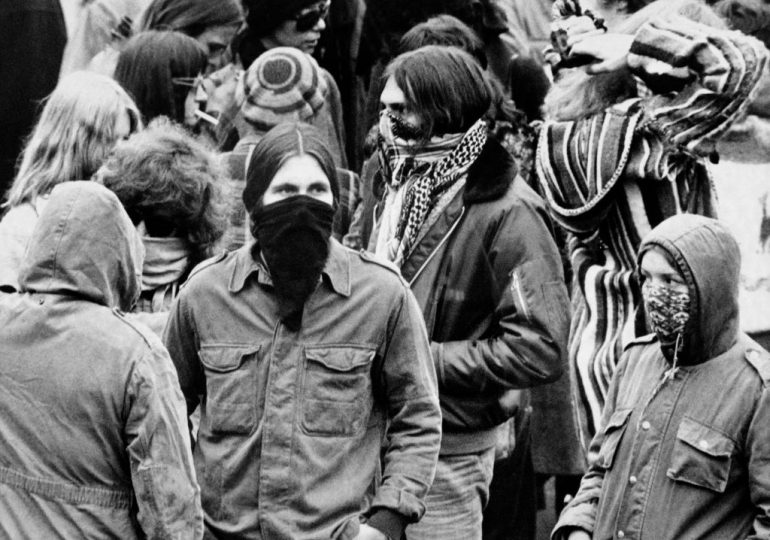
The stories of those who turned to terrorism in the late 1960s and 1970s, and the rise and fall of that wave of violence holds important lessons for our times. Left wing terrorist violence emerged in West Germany after the protests and confrontations of 1967 and 1968, with counterparts in the United States, Japan, and elsewhere. Members of these groups had all been part of a broader tide of largely non-violent contestation that, it rapidly became clear, had failed to achieve the wholesale “revolutionary” transformation of global economics, society and politics they sought. So they decided to continue their efforts by other means.
In the early years of the RAF’s war on the West German state, the group enjoyed sympathy, mainly among the educated, relatively prosperous and highly politicized. A poll in 1971 found that 40% of the respondents agreed that the RAF’s violence was “political,” 18% approved of its motives, and 6% said they would shelter a member of the group for a night. But that support vanished rapidly after its violent attacks, making the RAF and similar groups more vulnerable. Meinhof was arrested after being betrayed by a young teacher who had been convinced to host her for a night but had second thoughts. By the later years of the decade, West Germany’s authorities developed a range of new tools, some of dubious legality, that dramatically increased their counterterrorism capabilities, and ranks of the militants began to thin.
One reason was the failure of the militants to build an authentic popular constituency. This was true both in western Europe and the U.S., and created a significant gulf between the militants and those they claimed to represent. A second reason was genuine revulsion at the violence of the extremist groups as the decade progressed.
The most important reason that radical leftwing violence ebbed in West Germany and across the developed world by the 1980s was that many of the demands of those who had taken to the streets in the late 1960s were being addressed. There was more funding for higher education, less restrictive laws, lower voting ages, better reproductive rights for women and easier divorces, while icons of popular culture gained far greater prominence and influence as stuffy hierarchies disintegrated. Liberal democratic systems, for all their faults, functioned.
There were many protests in western Europe in the early 1980s—calling for nuclear disarmament, better environmental protection and much else—but few demands for “revolution.” And if there was still much terrorism too, most was motivated by narrow concerns: autonomy or independence for particular communities, localized nationalism or specific causes like animal rights. Almost no one still believed that bombs and bullets on the streets of Berlin, Paris, London or Rome could bring about a wholesale transformation of a country, let alone the world.
The stories of the extremists who hijacked the 1970s demonstrate quite clearly that terrorism is never simply a product of state sponsorship or a case of individuals being mad, bad or misled. Its rise and decline is always a consequence of broader circumstances that either encourage or undermine the attraction of such tactics. This makes terrorism a political and social activity that is intimately linked to the broader historical context, and so not a “cancer” that can be cut out but a condition that can be, at least in part, cured.
Leave a comment