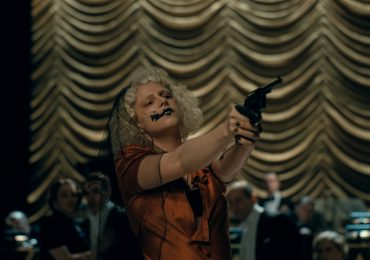
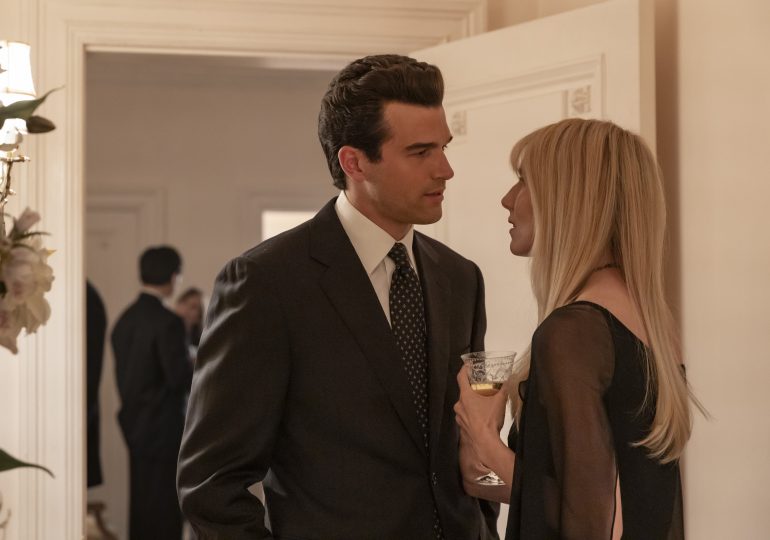
Love Story: John F. Kennedy Jr. & Carolyn Bessette Kennedy has an unexpected villain. Along with the paparazzi who stalked the photogenic couple until the day they died, the FX drama singles out JFK Jr.’s longtime girlfriend Daryl Hannah for a virulent strain of scorn. In the meanest scene where she appears, Daryl (Dree Hemingway) shows up uninvited at Jackie O’s (Naomi Watts) wake, after months of estrangement. “I know how much she meant to you,” she says to John. And then, in the same breath: “Is there a coat check?” Later, she corners him, claiming that mourners keep bugging her about where the two of them stand. “People are asking you about our relationship status at my mother’s wake?” he scoffs, justifiably incredulous. When John goes out onto the apartment’s terrace to greet a crowd of his mother’s admirers on the street below, Daryl suddenly appears at his side. She grabs his hand. He drops hers to wave.
[time-brightcove not-tgx=”true”]
The character doesn’t get much screen time, but when we see her, she is almost always doing something objectionable. In one scene, John comes home from a work event to find Daryl standing on her head in his industrial-chic living room—in a groan-inducingly obvious representation of the performative contortions she’ll resort to in order to get what she wants—as friends snort cocaine. In another, Love Story all but says that, for her, marrying a Kennedy was a path to permanent fame and fortune. “We’ve talked about how I feel like work has been kinda drying up for me,” she tells John. “Maybe that’s just the universe making space for us.”
This depiction struck me as gratuitously nasty on the part of creator Connor Hines and executive producer Ryan Murphy, and I’m not the only critic who felt that way. “What’s [Murphy’s] beef with Daryl Hannah, who comes across as a certifiable ditz?” wondered a former writer for JFK Jr.’s George magazine, pointing out that her boss was, in reality, “preternaturally attracted to smart strong women.” The sheer volume of backlash to the character affirms that Love Story’s portrait isn’t just cruel to Hannah. It’s also lazy writing.
Now, Hannah has gone on the record to dispute her portrayal. In a New York Times opinion column published on Friday, the actress writes:
The character “Daryl Hannah” portrayed in the series is not even a remotely accurate representation of my life, my conduct or my relationship with John. The actions and behaviors attributed to me are untrue. I have never used cocaine in my life or hosted cocaine-fueled parties. I have never pressured anyone into marriage. I have never desecrated any family heirloom or intruded upon anyone’s private memorial. I have never planted any story in the press. I never compared Jacqueline Onassis’ death to a dog’s. It’s appalling to me that I even have to defend myself against a television show. These are not creative embellishments of personality. They are assertions about conduct—and they are false.
Assuming this is even mostly true, Hannah has a right to be mad. Regardless of the few moments when Hines implies that John’s avoidance helps fuel Daryl’s bad behavior, giving a villain edit to a living person who didn’t sign any reality-TV waiver is just unkind. An introductory disclaimer stating that “certain depictions of people and events have been dramatized or fictionalized for storytelling purposes” may have legal weight, but the ethical violation remains.
The show’s viewers should be annoyed, too. Not because Love Story might stray from the truth—as any docudrama must, to some extent, do—but because its cartoonish depiction of the character is an insult to our collective intelligence. Were Hines and Murphy worried that if they didn’t make JFK Jr.’s ex a monster, we wouldn’t get why those two didn’t live happily ever after? As Hannah notes, playing bad Daryl against good Carolyn repeats a misogynistic trope in which women must always be in competition. She quotes one of the show’s producers, Nina Jacobson, who told Gold Derby: “Given how much we’re rooting for John and Carolyn, Daryl Hannah occupies a space where she’s an adversary to what you want narratively in the story.”
It’s a telling statement—one that reveals the show’s depiction of Hannah as, first and foremost, a failure of imagination. Couples break up for an infinite number of reasons, few of which boil down to one partner’s irredeemable rottenness. Even within Love Story, we see glimpses of more interesting and nuanced explanations Hines could’ve run with, from mismatched priorities to careers on opposite coasts to Jackie’s hesitancy to relinquish her beloved son.
Some of TV’s best love stories have ended with two relatively likable characters splitting up. When Cheers’ fervently shipped Sam (Ted Danson) and Diane (Shelley Long) finally went their separate ways, it was because he mustered the maturity to let her chase her dreams. There was still plenty of love between Better Call Saul’s Jimmy (Bob Odenkirk) and Kim (Rhea Seehorn) when it became clear that their paths in life were not compatible. A partner doesn’t have to be an antagonist to be wrong for our hero; think of how many decent-enough human beings Insecure’s Issa (Issa Rae) and Lawrence (Jay Ellis), a longtime couple who break up in the series’ first season, had to date to find their way back to each other. What unites these three shows, which are otherwise quite different, is psychologically astute character development. As in the real world, they’re populated by personalities that don’t neatly divide along a good-evil binary but are, instead, flawed yet lovable—to some other lovably flawed character, at least.
Love Story, like so many Murphy projects, is too focused on revising historical narratives to care about crafting complex characters, much less about who its flattening hurts. What’s ironic is that this work of revisionism tries so hard to redeem Bessette Kennedy—who was torn apart by the press, with reports of drug use and “bitchy” behavior—that it ends up trashing, in similar terms, a woman who is still alive to sustain the reputational damage. If the show has a point, it’s that mass-media surveillance warps beyond recognition the famous lives it purports to document. And that, when you think about it, sounds a lot like what Love Story has done to Hannah.
Leave a comment