Early one morning, on a recent work trip to Los Angeles, I stepped out of my hotel and took a deep breath of fresh air. The San Gabriel Mountains were sharp against a clear winter sky. That simple pleasure is a luxury: clean air, a visible horizon, sunlight that doesn’t require a layer of sunscreen. Just a generation ago, Los Angeles was the smog capital of the world.
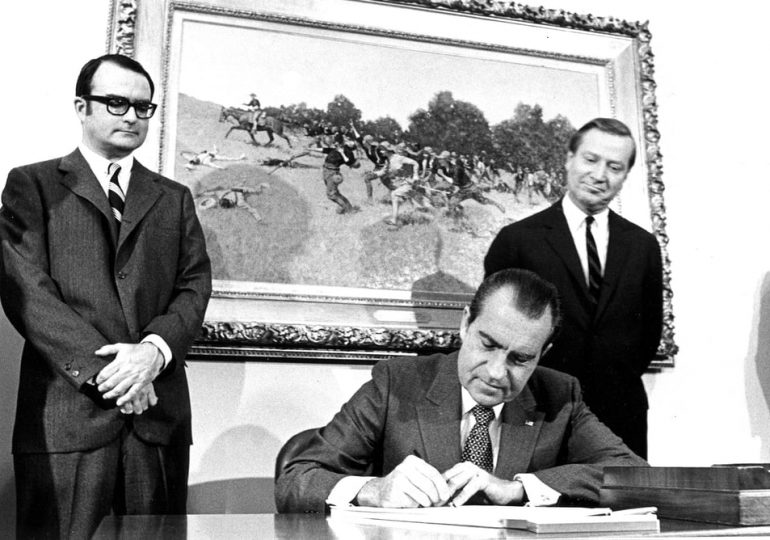
The reason it isn’t today can, in part, be traced back to a Republican president, Richard Nixon, who signed the Clean Air Act in 1970. In fact, three of the most serious environmental crises the United States has faced in the last century—urban smog, the hole in the ozone layer, and acid rain—were addressed under Republican leadership.
Which is why the announcement made last month that the Trump administration was revoking the EPA’s 2009 Endangerment Finding (the legal foundation for regulating greenhouse gas emissions) is so jarring. The revocation of the Endangerment Finding is not just a policy shift. It is a departure from what it once meant to be conservative in America.
The decision was heralded as the largest deregulatory action in U.S. history. But what it truly represents is a rejection of responsibility, a break with the rural communities most vulnerable to climate impacts, and a surrender of the conservative identity that built America’s environmental legacy.
That legacy stretches back to Nixon and the Clean Air Act, President Ronald Reagan backing the Montreal Protocol in 1987, and President George H.W. Bush amending the Clean Air Act in 1990 to create a market-based cap-and-trade system for sulfur dioxide—an innovation later used in California under Republican Governor Arnold Schwarzenegger to regulate greenhouse gases.
And this is not just a recent priority; for more than 150 years, stewardship was a defining conservative virtue. In 1864, President Abraham Lincoln signed the Yosemite Grant Act in the middle of the Civil War. In 1872, President Ulysses S. Grant established Yellowstone as the nation’s first national park. President Theodore Roosevelt protected approximately 230 million acres of public land and created the U.S. Forest Service.
These were not small victories. They were global, structural, civilization-level wins. And they were achieved because conservative leaders believed in stewardship, responsibility, and the idea that protecting Americans from harm was a core function of government.
In today’s world, the stakes could not be higher. The misinformation and distraction surrounding climate change have pushed the issue to the margins of national debate, even as the communities most exposed to its consequences are the ones who helped elect this administration.
Climate change is not an abstract threat to conservative America. It strikes at the heart of the priorities Republicans say they care most about.
Take immigration. As equatorial regions grow hotter and drier, climate-driven migration will accelerate. Pressures at the southern border, already a defining political issue, will intensify as millions are pushed north by forces no wall can stop.
Or look at rural and agricultural economies. The United States is getting hotter, drier, and more volatile. Across much of the Midwest and South, the crops that anchor red-state economies—corn, soy, wheat, and cotton—are already experiencing regional yield losses from intensifying heat and drought. At the same time, the administration’s war on clean energy has stalled billions of dollars in investment in the very states that stood to benefit most. In 2025 alone, more than 24,000 jobs and nearly $20 billion in clean‑energy projects in Republican districts were canceled or abandoned.
And then there is America’s long‑term competitiveness. China is not waiting for us to get our politics sorted out. They are building the world’s first “electrostate,” using clean‑energy dominance the way we once used oil. They didn’t invent the strategy; they borrowed ours. The difference is that China is executing it while we debate whether the problem even exists. When a 100% tariff turns a $15,000 BYD electric vehicle into a $30,000 car, Americans don’t see the scale of China’s lead, but the rest of the world does.
For a century and a half, conservatives treated the American landscape as a trust: something to be tended, improved, and passed on. That trust is now in jeopardy. Not because the problems are too big, but because the movement that once solved them has been manipulated.
The path forward is not to reinvent conservatism, but to remember it. To return to the ethic that built our parks, cleaned the skies, and proved that environmental stewardship is not a partisan project but a patriotic one.
The future will belong to the nations that lead the clean-energy era. It should be America. And it can be, if conservatives reclaim the tradition that once made them the country’s greatest stewards.
Leave a comment