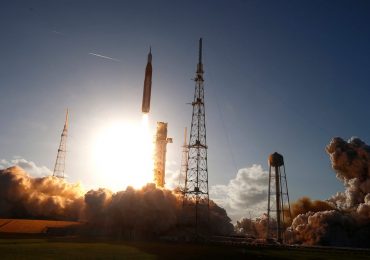
The quiet Florida evening was no match for the 8.8 million lb. of thrust that erupted from the base of NASA’s Space Launch System (SLS) moon rocket. At 6:35 p.m. ET this evening, its engines lit on pad 39B at NASA’s Kennedy Space Center, as onlookers on the grounds and up and down the Florida space coast whooped and cheered. The dimming blue sky exploded into a xenon-light white.
The ground and the air shook with a hard vibration not felt since the launch of the old Saturn V, during the Apollo era, when veteran newsman Walter Cronkite had to leap to his feet and hold up the window in his CBS press booth to prevent it from crashing inward.
The SLS did not so much lift from its pad as vault from it, carrying its four-person Artemis II crew—International Space Station veterans Reid Wiseman, Victor Glover, and Christina Koch, and space rookie Jeremy Hansen of the Canadian Space Agency—on a 10-day journey around the far side of the moon and back that will take them farther from Earth than any person has ever ventured.
“Good luck,” said one man in the crowd to another, as they hugged and slapped backs in the terminal minutes before the launch—as if they were flying themselves. “We’re on our way,” cheered another scrum of people—again, as if they were along for the journey. And so they were—and so we all were.
What is the history of NASA moon missions?
The last time human beings headed moonward was on the Apollo 17 flight that launched Dec. 7, 1972—before any of the Artemis II crew members were born. Today’s crew will not land on the moon—they won’t even orbit the moon. But they will, five days from now, whip around the lunar far side, on a shakedown mission test-flying the Orion spacecraft. This is essential preparatory work for achieving NASA’s bigger lunar goals. Next year there will be another test flight in low Earth orbit during the flight of Artemis III, followed by up to two moon landings by Artemis IV and V in 2028, and annual landings thereafter.
Unlike the Apollo program, Artemis aims not just for the so-called flags-and-footprints model of short, one- to three-day stays on the moon, but for a long-term presence at a long-term moon base in the south lunar pole, where deposits of ice can provide drinkable water, breathable oxygen, and oxygen-hydrogen rocket fuel. Very much like the Apollo program, Artemis finds itself in a closely watched moon race, not with the old Soviet Union this time, but with China, which has announced its intention to have astronauts on the moon by 2030.
The U.S. is not going it alone this time, however. While Apollo was an entirely American enterprise, Artemis flies under the flag of 60 countries, signatories to the Artemis Accords, an international pact whose members vow to support the peaceful exploration of space and contribute money, modules, and astronauts to the Artemis cause.
“It just shows the relationship we have around the world,” says Congressman Mike Haridopolos (R, Fla) who represents the congressional district that includes the Kennedy Space Center. “It shows who people want to be aligned with. They want to be aligned with the United States.” In 2021, China and Russia agreed to a collaboration of their own, pledging to establish an International Lunar Research Station (ILRS), by 2035.
The Kennedy Space Center was buzzing today in the run-up to the Artemis II launch in ways it hadn’t since the earliest days of the shuttle program or, further back, the Mercury, Gemini, and Apollo missions. Over 900 journalists from 18 different countries were credentialed, and the press center was standing room only more than 10 hours before launch. Representatives of multiple launch and hardware-service providers, including Boeing, Lockheed Martin, Northrop Grumman, and Airbus were present as well. And there was a team from the European Space Agency, which provided Orion’s service module, the aft portion of the Orion ship, including the spacecraft’s main engine.
In the final hour before liftoff, the press center largely emptied out, as the reporters gathered on the space center lawn, near NASA’s iconic countdown clock, joining the 400,000 spectators who crowded the local causeways and beaches more than a full day before liftoff. The launch, when it came, did not disappoint, with the spacecraft taking its leave of the pad, leaving a white contrail behind.
How long will Artemis II take to get to the moon?
Liftoff may have been 54 years in the making and the painstaking countdown two days in the ticking, but the mission of Artemis II will play out in a sprint. Just two minutes after the SLS left the pad, when the rocket stack was 29 miles up, the solid rocket boosters, which provide 7.2 million of the 8.8 million pounds of liftoff thrust, burned out and separated. The four core stage engines carried the SLS for another six minutes, until they burned out as well and separated. The interim cryogenic propulsion stage (ICPS)—the SLS’s second stage—provided the final kick to get the crew into space. Barely 10 minutes after the engines first lit—less time than it would take the liftoff spectators to walk from the press site to the giant, nearby Vehicle Assembly Building—Artemis II was in a lopsided orbit, with a low point, or perigee, of 115 miles and a high point, or apogee, of 1,400 miles.
Speeding along at 17,500 miles per hour—or 4.9 miles per second—the ship needs just 90 minutes to complete one full, egg-shaped orbit of the Earth. At that point, the ICPS fired again, raising Artemis II’s orbit to 1,500 miles by 46,000 miles—a high-point that takes the spacecraft about a sixth of the way to the moon. That’s a big earthly circuit, and it will not be until the evening of Thursday, April 2, about 24 hours after liftoff, that the moon-bound crew will take their next major step, jettisoning the ICPS and relying on Orion’s smaller on-board engine to light for the maneuver known as translunar injection (TLI)—the rocket punch that hurls the spacecraft out to the moon.
Escape velocity—or the speed Artemis II will achieve to free itself of the orbital pull of the Earth—is 24,500 miles per hour, or 11 miles every second. If the ship could keep that speed up, it would reach the moon in just eight hours. But a trip away from Earth into space is a trip uphill, with planetary gravity steadily pulling the ship backwards until it has slowed to just 3,400 mph. It is only when the ship is about 41,000 miles from the moon—and about 200,000 miles from home—that the steadily increasing gravitational pull of the moon will take over from the steadily decreasing gravitational pull of the Earth, and begin causing the spacecraft to accelerate. Ultimately, it will not be until day six of the mission—Monday, April 6—that the Artemis II crew will reach the neighborhood of the moon, approaching from the western lunar hemisphere and coming as close as 4,000 miles from the ancient surface of the ancient world.
Here, physics comes into play in a lifesaving way. There is a reason that TLI increases the spacecraft’s velocity to 24,500 mph, as opposed to 25,000 or higher, which would make for a quicker translunar trip. At the slightly slower speed, Earthly gravity still exerts enough influence over the ship so that if its guidance system went awry or its engine couldn’t fire, it would remain on a so-called free-return trajectory—with the moon’s gravity palming the spacecraft as it whips around the lunar farside and flinging it straight back to Earth like a second baseman turning a double play to first. At an escape velocity of 25,000 mph or higher, the spacecraft would pull itself off of this trajectory, with the moon still flinging the ship back in the direction of Earth, but at too great a speed for it to intercept the planet. Instead, Artemis II would fly wide of its earthly target and vanish into space. It is during this controlled trip around the lunar farside that Artemis II will set its human distance record, passing 4,700 miles behind the moon, easily breaking the previous 158-mile mark set by the crippled Apollo 13 spacecraft during its lunar journey in 1970.
The homeward trip will take in excess of 96 hours, with Artemis II reaching Earth on Friday, April 10. That homecoming could be harrowing. Plunging toward the planet under the growing influence of Earthly gravity, the spacecraft will reach a reentry speed of 25,000, calling for some fancy flying. Spacecraft orbiting the Earth, moving at their standard 17,500 mph, reenter the atmosphere by effectively tapping the breaks of their thrusters or retrorockets, slowing their speed just enough to cause them to fall out of orbit, easing themselves into the exosphere and below. Spacecraft returning from the moon, moving much faster, crash into the atmosphere instead; if a ship tried to fly a straight route to the ground, heat and gravitational energy would pull it apart. Instead, it flies a so-called skip-entry path, roller-coastering into the atmosphere, then up and back into space, then in again, slowing bleeding off heat and gravitational energy along the way. This will ease the spacecraft down to the surface, ultimately allowing it to settle into the waters of the Pacific Ocean at a gentle 15 mph.
What are the living conditions like aboard Orion for Artemis II?
The four Artemis II astronauts are making their journey to the moon in a Cadillac of a ship. The Apollo spacecraft that carried three men at a time to the moon in the 1960s and ‘70s measured 12 ft., 10 in. at its base and provided 210 cubic ft. of habitable volume. The Orion spacecraft has a base diameter of 16.5 ft., and while it carries 25% more astronauts, it provides 50% more habitable volume, at 331 cubic ft. Not only does this give the astronauts more elbow room, it also frees them from having to sleep in their launch seats, instead allowing for sleeping hammocks tethered to the ship’s interior walls, ceiling, and docking tunnel.
Sanitation is significantly improved too. To deal with bodily wastes, Apollo astronauts had to rely on an unspeakable arrangement of funnels, drainage tubes, disposable bags, disposable wipes, and antibiotic pellets. Artemis crews enjoy the most earthly of conveniences—a toilet. With a door for privacy, the $23 million appliance, which took six years to develop, uses a suction system in place of gravity, and separates liquid waste, which is vented overboard—forming a spangle of frosty particles that the celebrated Mercury, Gemini, and Apollo astronaut Wally Schirra referred to as the “constellation Urion”—and solid waste, which is sanitarily stored on board.
The ship has six windows to Apollo’s five, and vastly more computer muscle. The Artemis II crew will be relying on computers that process data 20,000 times faster than Apollo’s and pack 128,000 times more memory. And while the Mercury, Gemini, Apollo, and shuttle spacecraft got all of their power from on-board batteries and fuel cells, Orion avails itself of the regenerative power of solar arrays.
Like the International Space Station, Orion is also equipped with exercise equipment that allows astronauts to practice rowing and resistance training—essential for missions that can last up to 21 days. The Artemis II crew will be testing the equipment, not just to determine that it works as advertised, but that the steady motion of an energetically moving astronaut doesn’t disturb the stability of the ship.
“We want to make sure we don’t upset the solar arrays with the exercise,” says Debbie Korth, deputy program manager of the Orion program.
Korth’s office is going to be busy in the next few years, building the spacecraft needed to meet NASA’s ambitious flight cadence. No fewer than five Orion capsules are currently in development—and those five ships can be stretched to more than five missions, since Orions are at least partly reusable. “We have a lot of hardware in the pipeline,” Korth says. “We are looking at how we can accelerate some of that to meet the [launch demands].”
What is the purpose of the Artemis II mission?
Artemis II will not just be a test of the spacecraft and flight protocols that will be needed to advance the goals of the Artemis program, it will also do some hard science. Spelunking astronauts aboard the six Apollo lunar landings brought back 842 lbs. of moon rocks which are still being studied half a century later, but all of those rocks came from the moon’s near-side equatorial region, which represents some of the moon’s youngest terrain, refreshed by lava flows perhaps three billion years ago. The lunar south pole is far older, with surface materials dating past four billion years back. Artemis II will not fly over the south pole but its crew members will practice remote observation techniques that future crews can use to take the moon’s geological measure both from above and from the surface.
“We actually have 10 lunar science objectives for the mission,” says Artemis II lunar science lead Kelsey Taylor. “One is imagery taken with the Orion vehicle cameras that are mounted external to the vehicle, but the other three are crew-driven data sets. So it’s crew descriptions [of what they see] which actually is our highest priority data set.”
Taylor points to Apollo 17’s Harrison Schmitt, now 90—with whom she has consulted in preparation for the Artemis missions—who famously spotted orange lunar soil that turned out to be spheroids of glass produced by fire-fountain volcanoes. It was human eyes, not robotic equipment, that made that discovery.
There are a lot of miles—685,000 of them—that the Artemis II crew will cover on their outbound and inbound journey over the next 10 days, but the most transcendent moment will come at just past the midpoint, when the spacecraft is at its most remote distance beyond the far side of the moon. The astronauts will have their cameras at the ready. In 1968, Apollo 8’s Bill Anders made photographic history with his famous earthrise image—a picture of the living earth rising over the desiccated moon, which is credited with helping to inspire the environmental movement. Four years later, Schmitt captured the celebrated blue marble picture, a full disk portrait of the receding Earth. Artemis II will be far enough from the moon that the crew will be able to capture a first-ever picture of the complete disk of the moon and the complete disk of the Earth in the same frame. The Earth and the moon have been paired for over four billion years; Artemis II will bring them closer.