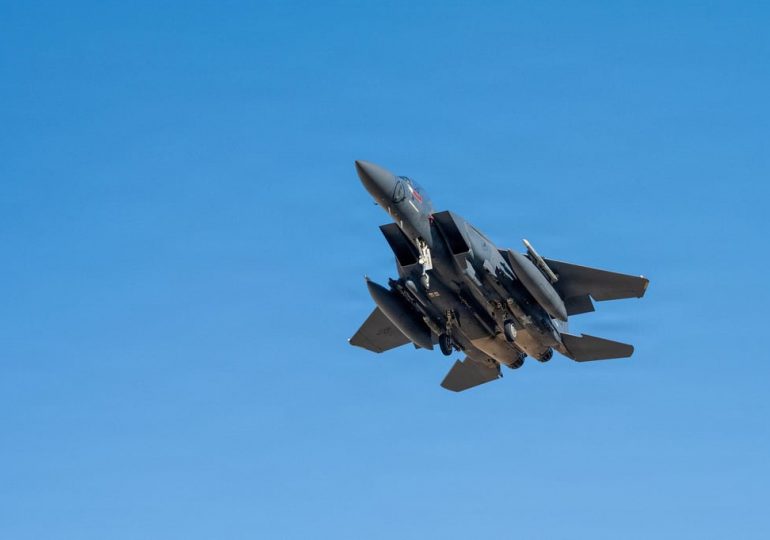
A U.S. Air Force F-15E Strike Eagle aircraft takes off for a mission supporting Operation Epic Fury during the Iran war at an undisclosed location, March 9, 2026. —Air Force/Reuters
A U.S. fighter jet crashed inside Iran on Friday, setting off a race between U.S. efforts to rescue the two-person crew and Iranian officials encouraging their citizens on the ground to find them first.
One crew member from the two-person F-15E jet was rescued by U.S. forces and the search continues for the other crew member, according to Axios and CBS news, citing unnamed U.S. officials.
President Trump has been briefed on the crash, White House Press Secretary Karoline Leavitt said in a statement. U.S. officials have told media outlets that the plane was shot down, but the exact circumstances of the crash are unclear. The Pentagon has not yet confirmed whether the fighter jet was shot down or the exact status of those onboard.
The crash comes at a moment of political pressure for President Donald Trump, who is facing high gas prices, a stock market downturn, and declining approval ratings tied to his war with Iran. In a prime-time address Wednesday night, Trump said he planned to continue attacking Iran for two or three more weeks to further debilitate its ballistic missile program and set back its ability to develop a nuclear weapon.
Defense Secretary Pete Hegseth has insisted in recent days that the U.S. has achieved enough air superiority over Iran that its planes were able to bomb the country at will. If it is confirmed that Iran shot down the plane, the incident would underscore that Iran can still retaliate even under intense U.S. bombardment.
Iran claims it shot down U.S. fighter jet
In a statement published on the semi-official Tasnim News Agency on Friday morning, the Islamic Revolutionary Guards (IRGC) claimed that it had shot down an American “fighter jet in the central sky of Iran by the new advanced aerospace defense system of the Guards.” The statement mistakenly claimed that the downed fighter jet was an F-35, but did not specify when or where it had been shot down or crashed.
“This fighter jet has been completely destroyed and crashed… because the fighter jet disintegrated, there is no information about the fate of the pilot,” the statement added.
Images of the wreckage shared by Iranian state media and analyzed by aviation experts indicate the aircraft was a U.S. Air Force F-15E.
The IRGC has repeatedly made false claims of shooting down U.S. fighter jets, but this was the first time it published images on one of its X accounts showing what it said was a fighter jet’s ejector seat, reportedly found by locals.
Shortly afterward, reports from semi-official Iranian news agencies showed widespread air activity by U.S. planes and helicopters in the mountainous southwestern province called Chaharmahal and Bakhtiari as well as the province of Kohgiluyeh and Boyer-Ahmad. Video showed what appeared to be HC-130 aircraft and HH-60 Black Hawk helicopters performing search and rescue operations in the two provinces, at times flying extremely low.
Those types of aircraft are used by Air Force Special Warfare Pararescue units, elite groups of special operations forces trained to fly into enemy territory to rescue downed pilots and crew. The reports originating inside Iran, which are not directly accessible in the U.S., were independently verified by TIME.
The low-altitude flights in broad daylight prompted concerns among locals that an airborne military operation by U.S. troops might be taking place. Videos circulated online by semi-official news agencies showed locals shooting at the aircraft with rifles and hunting guns.
Iran shifts from shoot-on-sight to capture orders for U.S. crew
Iranian officials initially instructed anyone in the vicinity of the crash to shoot any American pilot or crew on sight. Local state TV first published a bulletin from the local police requesting locals “to target pilot or pilots on sight,” however the bulletin was quickly amended to “inform the police and authorities on sight.”
Later, the official instructions shifted once again, telling locals there would be a reward for the capture of any American military members they may find, likely to try to use a U.S. service member as a bargaining chip in negotiations over ending the war. Official messages offered “a valuable reward to anybody who arrests and hands over the enemy pilot or pilots alive.”
While the official reward offered by the authorities was not disclosed, local merchants and industrialists were quick to offer amounts ranging from $60,000-$100,000 to anyone who would hand in the U.S. crew. Provincial officials quickly issued communiques, requesting inhabitants “to search for the downed enemy fighter pilot,” promising that “the person or persons who succeed in arresting or killing the hostile enemy forces will be specially commended by the provincial governor.”
The counties that Iranian officials wanted searched are in the sparsely populated section of the Zagros Mountains, where the average elevation is over 2,000 metres above sea level.
Iranian authorities were quick to seize on the downing to score a propaganda win. The speaker of the Iranian parliament, Mohammad Bagher Ghalibaf—part of the leadership Trump has recently described as “more reasonable”—taunted the U.S. on X. He wrote: “this brilliant no-strategy war they started has now been downgraded from ‘regime change’ to ‘Hey! Can anyone find our pilots? Please?’”
Three F-15s were mistakenly shot down by the U.S. ally Kuwait in early March. The pilots of those planes were able to eject safely.
Since the start of Epic Fury, the name the Trump administration gave to the operations against Iran, 13 American service members have been killed. Six died in the crash of an air refueling plane in Iraq. Seven died from incoming Iranian attacks.
Leave a comment