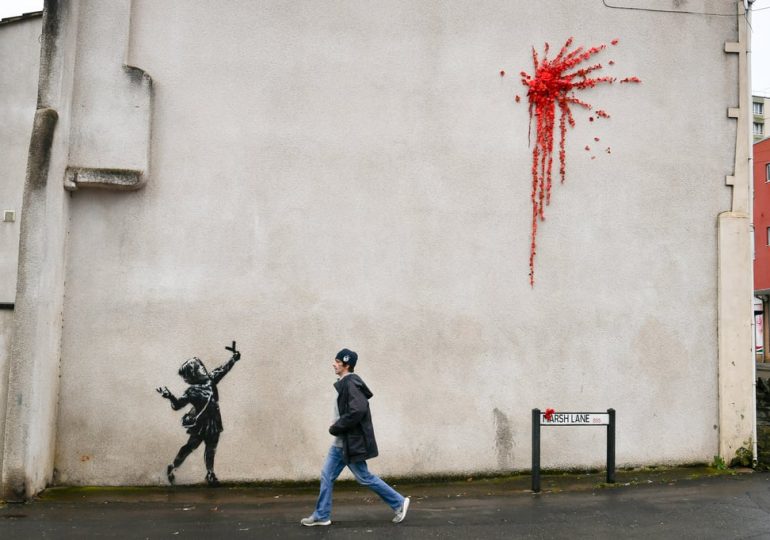
A work of art by Banksy in Bristol, England on Feb. 13, 2020. —Ben Birchall—PA Images via Getty Images
There is a persistent assumption in contemporary culture that admiration creates a form of entitlement: if we value a work, we should be able to know the person who made it.
This assumption surfaces in discussions surrounding artists such as Banksy and Elena Ferrante, both of whom have chosen to remain anonymous despite extraordinary global recognition. Their refusal to disclose their identities has generated sustained curiosity and, in some cases, organized efforts to uncover who they “really” are.
Beneath that curiosity lies a belief that access to the artist will deepen our understanding of the work. That belief rests on the assumption that public knowledge of a person meaningfully corresponds to who that person actually is.
In practice, this correspondence is tenuous. Public figures do not exist in an unmediated state; they exist through representations that are shaped, edited, and selectively revealed. Interviews, profiles, and public appearances all contribute to an image that may feel coherent but is nonetheless constructed. Even in moments that appear candid, what is being presented is a version of the self that has been calibrated for visibility. The idea that this construction provides reliable insight into the work is difficult to justify.
Anonymity interrupts this dynamic by removing the artist as an interpretive shortcut. In the absence of biographical context, the work must stand on its own terms. Audiences cannot rely on familiar frameworks to guide their understanding. Instead, they are required to engage directly with what is present: the structure of the text, the composition of the image, and the internal logic of the work.
This shift does not diminish meaning; it reassigns responsibility and places greater weight on the encounter between the work and its audience.
The work of Elena Ferrante illustrates this effect with particular clarity. Ferrante has consistently resisted efforts to link her fiction to her personal identity. This refusal has not eliminated attempts at identification, but it has limited the extent to which the novels can be interpreted through external information. As a result, her work remains open to interpretation in ways that are not easily resolved by reference to the author’s life. The absence of a confirmed biography preserves the ambiguity of the work and allows it to operate across a broader range of meanings.
A similar dynamic is contained in the work of Banksy, whose anonymity is not incidental but integral to the reception of his art. The absence of a fixed identity allows the work to circulate without being anchored to a singular authorial persona. It appears in public space without introduction—often without permission—and its meaning is generated through context, placement, and visual language rather than through the biography of the artist.
While the market has inevitably attached financial value to Banksy’s work, the anonymity of its maker complicates the relationship between authorship and authority.
This question is no longer limited to a small number of exceptional figures. In the current media environment, authorship itself is becoming increasingly elusive. The rise of generative artificial intelligence has introduced forms of cultural production in which the identity of the maker is distributed across systems, tools, and users. Technologies such as Midjourney and ChatGPT produce images and texts shaped by prompts, training data, and iterative refinement rather than by a singular author.
In these contexts, the question of who made the work becomes difficult to answer in conventional terms, yet the work continues to be evaluated, circulated, and interpreted. The absence of a reliable author does not prevent engagement; it centers the role of the viewer or reader in constructing meaning.
Read more: When Virality Is The Message: The New Age of AI Propaganda
At the same time, contemporary internet culture has normalized forms of authorship that are deliberately opaque. Writers publish widely read essays on platforms such as Substack under pseudonyms. Visual culture is shaped by anonymous or collective accounts on Instagram and TikTok, where influence is often detached from fixed identity. Meme creators, digital artists, and commentators routinely operate without definitive attribution, yet their work circulates with significant cultural impact.
Seen in this context, the anonymity of figures like Banksy and Elena Ferrante appears less exceptional. It reflects a broader shift in how authorship is understood and how meaning is produced.
The desire to uncover their identities can be understood as part of a lingering attachment to older models of authorship, in which meaning is grounded in origin and grounded in biography. Biography provides a framework within which the work can be situated and explained. When that framework is unavailable, interpretation becomes less certain.
Yet this uncertainty can also be understood as a condition that invites more active engagement. Without the influence of biography, the work is not reduced to a set of explanatory coordinates and remains open to interpretation in a more expansive sense.
Biographical knowledge can also constrain interpretation in consequential ways. When the life of the artist is well known, there is a tendency to read the work as an extension or reflection of that life. Details within the work are mapped onto known events or experiences and meaning is derived from those associations. While this approach can provide insight, it can also narrow the field of interpretation by emphasizing certain readings over others. The work becomes a document of the artist’s life rather than an independent work in its own right.
Anonymity resists this form of reduction. Withholding an author’s identity prevents the work from being easily subsumed into a biographical narrative. This does not mean that the work exists without context, but that its context must be constructed differently, through attention to form and content rather than through personal history. In this sense, anonymity preserves the autonomy of the work, allowing it to exceed the boundaries of the individual who created it.
There is also a broader cultural dimension to this question. Contemporary systems of media and publicity increasingly conflate visibility with value, reinforcing the idea that recognition depends on being seen and known. Within this framework, anonymity appears suspect because it resists the mechanisms through which cultural legitimacy is typically established. To remain unknown is to decline participation in a system that treats personal identity as a component of branding. In this context, anonymity functions as both a creative choice and a philosophical position.
At the same time, anonymity should not be treated as inherently virtuous or universally applicable. There are circumstances in which knowledge of an artist’s identity provides essential insight, particularly when the work engages directly with specific historical or political conditions. The argument is not that all artists should remain anonymous, but that anonymity should be recognized as a legitimate position. It is one way, among many, of structuring the relationship between a creator and their work.
The question, then, is not whether we are capable of discovering who Banksy and Elena Ferrante are, but whether such discovery is necessary. To insist on revelation is to assume that understanding art depends on access to the person behind the work. Anonymity offers an alternative model, in which meaning is generated through experience. It does not erase the artist, but it repositions them, shifting the emphasis from identity to the work itself.
What anonymity reveals is not the absence of the artist, but the limits of our assumptions about knowledge. It reminds us that art is not simply an extension of the self, but a site of meaning that can stand independently of the person who produced it.
In an era increasingly defined not only by exposure but by distributed and ambiguous authorship, this distinction is easy to overlook. It may also be increasingly necessary to recover.
Leave a comment