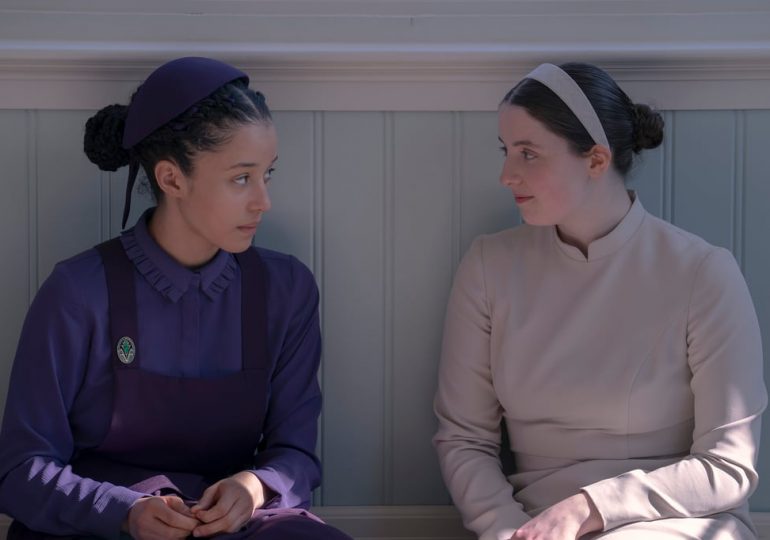
Chase Infiniti, left, and Lucy Halliday in The Testaments —Russ Martin—Disney
This article contains mild spoilers for the first three episodes of The Testaments.
Hollywood has decided that, in dystopian times, hope for the future looks like Chase Infiniti. First in One Battle After Another and now in The Testaments, Hulu’s sequel series to The Handmaid’s Tale, the rapidly rising 25-year-old star plays a teenager who must carry on a long fight for freedom and justice that her parents’ generation has been unable to win. Young, female, biracial, beautiful, Infiniti is at once a radiant presence and someone whose very identity makes her anathema to the worst people in the world. She has the kind of fresh, wide-eyed face that would have gazed out from Seventeen magazine covers and Noxzema commercials in the 1990s. That vulnerability allows her to credibly play characters almost a decade her junior. But she can also embody the fierce courage and keen intelligence of fictional female revolutionaries past, from Jennifer Lawrence’s Katniss Everdeen to, yes, Elisabeth Moss’s June Osborne.
Often presented in closeup, Moss’s face—a mask of feral determination—was the key visual motif of The Handmaid’s Tale. Faces are also integral to The Testaments, a loose adaptation of the 2019 sequel to Margaret Atwood’s 1985 masterpiece, whose first three episodes are now streaming. Infiniti’s open expression and the youthful flush of co-star Lucy Halliday contrast with the furrowed mug of Ann Dowd’s Aunt Lydia; innocence, meet experience. It might surprise those who know the novels or the original series that creator Bruce Miller, who also helmed its predecessor, has taken this follow-up in a conspicuously young-adult direction. The choice yields a brighter, richer, more varied and nuanced story in which coming-of-age tropes mingle with Gileadean bleakness to reveal new facets of a state premised on male supremacy. While many of the problems that afflicted The Handmaid’s Tale as it dragged on persist, and the need for consistency between the series introduces more, I was surprised at how well it all worked.
With the exception of women deemed so useless, they’re exiled to the Colonies to mop up toxic waste until it kills them, Handmaids like June—fertile but ungodly women kept as sex slaves and walking wombs by barren elites—comprise the lowest female caste in the warped mirror of America that is Gilead. While The Testaments, too, is set within the separate women’s sphere of this hyperpatriarchal theocracy, its main characters sit at the top of that class system. They are daughters of the state’s ruling Commanders, coddled in vast wings of their fathers’ mansions and taught embroidery, flower arranging, and how to host the perfect tea party. (Not on the syllabus for these or any girls in Gilead, aside from the few training to be their shepherds, the Aunts: literacy.) Dubbed Plums for their purple uniforms, these teens are the products of a fertility cult that not only rapes Handmaids and forces them to carry the pregnancies that result, but also stole other parents’ children as it seized power. At a school run by the indefatigable Aunt Lydia, they are essentially just waiting to start menstruating. Within months of menarche, they will be married off to Commanders, many of whom appear to be older than their fathers.
The Testaments: Aunt Lydia’s school and its students —Russ Martin—Disney
Infiniti’s Agnes MacKenzie is part of this rarefied cohort, a resplendent Plum ripening right on schedule. Scorned by a cold stepmother, Paula (Amy Seimetz), who is anxious to marry her off, she uses her palatial dollhouse and dolls made to resemble the residents of her life-sized home to act out matricidal fantasies. But her rebellious streak rarely gets her into trouble, because she is doted on by her unusually indulgent Commander dad (Nate Corddry) and because she remains a true believer in Gilead dogma. This will change over the course of the season. As Handmaid’s Tale viewers already know, Agnes—née Hannah—is the biological daughter of June, the one she repeatedly risked her life and so many others to try to rescue. Not that Agnes remembers her real parents. For those of us who may also have forgotten (or given up on the show), the first clue that the characters are connected is her candid voiceover, narrated sometime in a freer future and laced with the same gleeful profanity that peppered June’s own internal monologue.
What gives The Testaments a YA feel—and viewers some relief from the parade of suffering that was The Handmaid’s Tale—is the school setting, where Agnes’s circle of friends isn’t so different from the typical teen-drama sisterhood. She has an especially close bond with Becka (Mattea Conforti), the first of the group to get her period but the least excited about marriage. Shunammite (Rowan Blanchard) is the queen bee, brash and bossy and far less sophisticated than she pretends to be. (These girls are so sheltered, they’re shocked at the discovery that some men have hairy stomachs.) Sweet, awkward Hulda (Isolde Ardies) is often the target of her ribbing. Pubescent power dynamics aside, the girls are ferociously devoted to one another.
They inhabit a world that, on its surface, couldn’t be more different from the shadowy waking nightmares endured by Handmaids. Even though glancing at a member of the opposite sex can get a young woman slut-shamed, they manage to nurse crushes. Agnes moons over Garth (Brad Alexander), a Guardian with boy-band curls who is part of her family’s security detail but doesn’t rank high enough to merit a marriage match. Production design by Martha Sparrow echoes that of girlhood classics like Sofia Coppola’s Marie Antoinette; Bridgerton, another coming-of-age chronicle told through the marriage market, is another clear reference point. The Plums’ princessy bedrooms sprawl across whole wings. Sunbeams stream in through windows. Manicured gardens surround their houses and school. Interiors are decorated in frosting pastels. As one outsider puts it: “Gilead was so beautiful, sometimes I could forget where I was.”
From left: Lucy Halliday, Isolde Ardies, Rowan Blanchard, Ellen Olivia, and Charlie Carrick in The Testaments —Steve Wilkie—Disney
That visitor is the show’s second point-of-view character, Daisy (Halliday). Freshly arrived from Toronto, she is a so-called Pearl Girl—an unfortunate teen imported from abroad by missionaries who promise a stable, purposeful life in Gilead, where their potentially fruitful wombs will surely be put to use. As her designated mentor, Agnes, introduces her (and us) to the austere norms of the school and the society it helps uphold, we get increasingly substantial glimpses into her life back in Canada. In the final scene of the premiere, a flashback sees Daisy cross paths with June at the vintage store her parents own; Moss, an executive producer of The Testaments, had been coy in pre-air interviews about whether she’d appear on screen.
The third episode of the series further fills in Daisy’s backstory. Unbeknownst to the girl, her parents were part of the Mayday underground, fighting in secret to take down Gilead. She only learned the truth after the rogue nation assassinated them and she wound up in June’s care. Determined to avenge them, she allowed Mayday to disguise her as a street kid so she would be recruited as a Pearl Girl. Now she’s a secret agent, risking her life to infiltrate the training ground for elite womanhood; Garth turns out to be her handler. Four years after the liberation of Boston in the final season of The Handmaid’s Tale, the war rages on, and the corpses of executed Mayday spies hang from overpasses as a warning to their co-conspirators. This rankles Daisy. But she is as courageous as June and helps awaken that spirit in Agnes.
The Handmaid’s Tale series began as a timely and mostly faithful Atwood adaptation but fell apart as soon as it exhausted that story at the end of its first season. Initially striking in its horror, the metaphor of supposedly pious Christian couples raping fallen women—that is, just about anyone known to have had sex out of wedlock—and stealing their babies devolved into torture porn, repeated in almost every episode. In fact, the act of watching it eventually felt like a form of self-inflicted torture. Even when the state-sponsored sadomasochism receded into the background, June and her allies and oppressors kept going around in circles. She escaped Gilead and then, inexplicably, returned. Villains atoned, only to revert to their old ways. June and Serena Joy (Yvonne Strahowski), the Wife who once held her down while Serena’s Commander husband violated her, kept reconciling, then betrayed each other again. This did not come across as a One-Battle-esque cycle in which freedom fighters take three steps forward and two back, making painfully slow progress towards a better world. It seemed much more likely to be a streaming service prolonging the run of its flagship original series by recycling plot points.
Chase Infiniti, left, and Maria Conforti in The Testaments —Steve Wilkie—Disney
I gave up on the show midway through its third season and had to force myself to finish it before screening The Testaments. What I found upon revisiting it were some convincing moral arguments—above all, that the only way to absolve oneself of complicity with a hateful and bloodthirsty regime is by putting your life on the line to fight it. But amid so much wheel-spinning filler, the show gave us symbols where there could have been multifaceted characters, grandstanding speeches where there could’ve been thoughtful dialogue, plays for real-world relevance through plots that didn’t quite make sense in context. (Amid a global fertility crisis, would Canadians really be as hostile to the influx from Gilead of female refugees of childbearing age as some in the U.S. are to all immigrants? The Handmaid’s Tale also ignored the racial aspects of xenophobia, a frequent blind spot.) Far from Atwood’s regular woman moved to rebellion by intolerable circumstances, June became a superhero and a savior, too righteous to fail; in later episodes, she even appropriated the Bible-quoting tendencies of the Gilead faithful, as if to avoid any accusations that the show was making all forms of Christianity the enemy.
While it’s wise to stray substantially from its source material, The Testaments does get a bit tangled in some hard-to-reconcile differences between the book and later seasons of the Hulu series. The reintegration of Aunt Lydia, who was very publicly on June’s side by the end of The Handmaid’s Tale, into Gilead’s leadership is especially hard to believe. With Miller staying on as showrunner, the show also retains much of its predecessor’s cringe factor. Daisy—also an adoptee—is, at one point, compared to Harry Potter. (Thought experiment: Where would you place J.K, Rowling in Gilead?) The Resistance-pandering crescendoes in narration like this groaner: “Even though it seemed like Gilead happened overnight, there were signs of what was coming. Candidates running for office had said things openly—about women, about gays. But they still were elected. People thought they were speaking in hyperbole. Now, women can’t have jobs or phones or read books. And gay people? Well, you know what happened to them.”
Yet these elements seem less condescending in the context of YA storytelling, a genre that allows for some didactic flourishes. The stylistic trappings of teen drama effectively counteract the overwhelming heaviness of every single sight and sound and storyline in The Handmaid’s Tale, as well. Instead of ironically deploying retro female empowerment anthems like that show did (Lesley Gore’s “You Don’t Own Me,” Kate Bush’s “This Woman’s Work”), this soundtrack invokes youthful daydreaming with, well, Blondie’s “Dreaming” and “Dreams” by the Cranberries.
Chase Infiniti, left, and Ann Dowd (and a statue of Ann Dowd) in The Testaments —Russ Martin—Disney
Although they do still exist in its Gilead, Handmaids are nowhere to be found in The Testaments. Maybe Miller realized that six seasons’ worth of red cloaks, white bonnets, and ritualized torture was more than enough. But violence against women—psychological, physical, specifically sexual abuse—still manifests here in myriad forms, as it inevitably will in a totalitarian patriarchy. One of the MacKenzies’ servants had her tongue cut out by a previous master. Left alone with teenage girls and the means to sedate them, a dentist takes advantage. At balls that approximate what Bridgerton might be like if the charming debutantes were matched with white-haired monsters instead of handsome, age-appropriate nobles, Commanders spike their prospective Wives’ drinks. And as part of their initiation into the ruling class, Plums are made complicit in Gilead’s barbaric justice system, cheering for the corporal punishment of disobedient classmates and the men of low status caught salivating (or worse) over them.
The more time we spend with the most privileged members of this society’s oppressed gender as they come to realize that the fairytale they were born into is actually Bluebeard, the more the moral ambiguity of their station reveals itself. The Plums’ layered reality allows room for pleasures native to the teen-drama genre—friendship, gossip, fantasy, romance—even as the show explores how Gilead systematically restricts and perverts the joys of girlhood. It’s in this complexity that, by the end of a debut season that leaves many storylines intriguingly unresolved, The Testaments finds something The Handmaid’s Tale never had: room to grow.
Leave a comment