
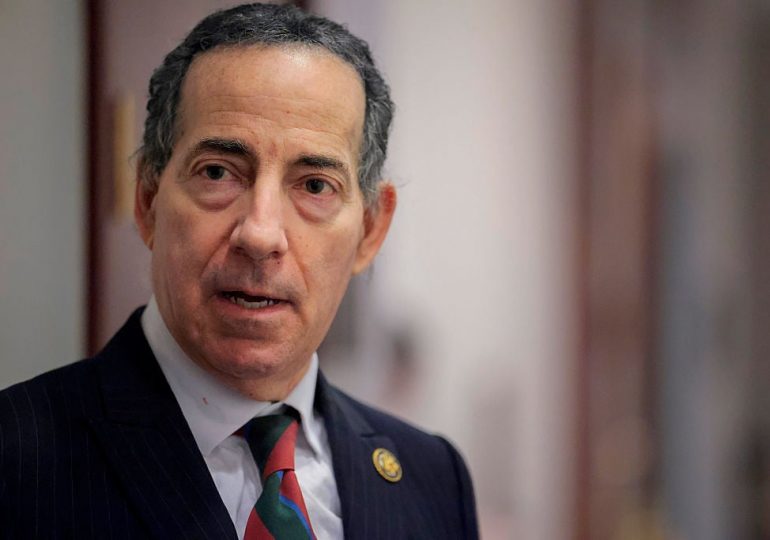
Rep. Jamie Raskin, a constitutional law expert, is set to brief House Democrats on the mechanics of the 25th Amendment and impeachment —Heather Diehl—Getty Images
Congressman Jamie Raskin knows as well as anyone in Washington the promise and perils of impeachment. As the lead manager in the second impeachment trial of Donald Trump, the Maryland Democrat spent days prosecuting a case that ultimately collapsed against the hard arithmetic of a Senate acquittal.
Now, with Democrats once again confronting calls to try to remove Trump from office after his recent threat to wipe out the Iranian civilization, Raskin was asked by party leaders to talk the caucus through the range of options available to address presidential conduct before they reach a consensus position.
In an interview with TIME ahead of that 3 p.m. briefing, Raskin says he plans to walk colleagues through the constitutional pathways available in moments of presidential crisis, including impeachment and the 25th Amendment, while underscoring the political constraints around both options.
“There’s obviously tremendous anxiety in the country about the deranged conduct and behavior of the President,” Raskin says, while stressing that Democrats remain in the minority. “For people to say we should just go ahead and impeach him simply denies this political reality. There is not a single Republican who has called for impeachment or indicated to us interest in impeachment at this point.”
The renewed debate has exposed a familiar tension inside the party. In the wake of Trump’s remarks about Iran, dozens of Democrats have publicly floated impeachment or invoking the 25th Amendment. Yet party leaders are showing little appetite for pursuing either route before the midterm elections, fearing a futile fight could drain momentum from a campaign centered on high costs and corruption.
Read More: Calls to Impeach Trump Collide With Reluctant Democratic Leadership
Raskin, a constitutional law professor and attorney, has long argued that Congress should prepare for moments like this. Nearly a decade ago, he proposed creating an independent commission authorized under Section 4 of the 25th Amendment to assess presidential fitness if a cabinet proves unwilling to act. The Amendment allows the Vice President, together with either the cabinet or such a congressionally created body, to declare a President unable to discharge the duties of the office, though it has never been used in that way. Even so, Raskin emphasizes that no mechanism is foolproof. “The framers had no concept of nuclear weapons and what a president could do with them,” he says. “And I don’t think they ever anticipated that somebody would act in the ways that Donald Trump has been acting in office.”
Raskin notes that he does not plan to sway members in any direction during Friday’s caucus-wide call. “I’m not really advocating for this or that solution,” he says. “I’m really just trying to explain the constitutional design.”
This interview transcript has been lightly edited for clarity.
TIME: You’re speaking with the caucus tomorrow. Can you preview to me what your message is to Democrats about the path forward on impeachment or the 25th Amendment?
Raskin: I’ve been invited by the leadership to address the caucus in my capacity as a constitutional law professor and as the ranking member on the Judiciary Committee. In other words, I’m not really advocating for this or that solution at this point. I’m really just trying to explain the constitutional design with respect to crises caused by presidential misconduct or unfitness. A lot of people have been through the impeachment process. But of course, we have dozens of colleagues who’ve arrived since that happened, and they haven’t been through that. And no one has been through a 25th Amendment process. So it’s my attempt to try to explain to the caucus what the constitutional architecture is.
I know that for nearly a decade, you’ve proposed that Congress create an independent commission on presidential capacity that would effectively allow Congress to declare the president unfit to serve. Do you plan to talk to Democrats about getting behind that proposal, given that it’s unlikely you can convince the Vice President and the majority of the cabinet to invoke the 25th?
Yes, in the course of explaining the structure of the 25th amendment, I’m definitely getting into that… We’re zeroing in on Section 4 of the 25th Amendment, which says that the Vice President and a majority of the cabinet can determine that the President is unable to discharge the duties of the office and transfer power to the Vice President, or the Vice President and the majority of a body established by Congress can determine presidential inability to meet the duties of the office.
So that body has never been set up by the Congress since the 25th Amendment was enacted back in 1967. My proposal has been to establish that body in case of an emergency, so that there’s both the possibility of the cabinet acting, or if the cabinet is too much under the spell and control of the President, the body could act. Of course, the Vice President needs to be a willing partner in that as well. So none of this is a panacea.
I think that the caucus, like a huge part of America, was angst ridden and panicked by the President’s fulminations about committing war crimes and potentially genocide in the war. And so people want to know, what are the constitutional safeguards for a situation like this? And they are not perfectly addressed to a situation like the one that we are in. For one thing, the framers had no concept of nuclear weapons and what a president could do with them. And I don’t think they ever anticipated that somebody would act in the ways that Donald Trump has been acting in office.
In your perspective, what do you hope the party does? Do you think impeachment makes the most sense at the moment, or is that not the best strategy to you?
So look, I have no doubt in my mind that this President has committed a dozen or more impeachable offenses. Going to war without a congressional declaration of war is an offense against the Constitution of immense gravity. That is one that pops to mind. This is a President who is engaged in tens or hundreds of millions of dollars of deals with foreign governments in blatant violation of the Foreign Emoluments Clause. And there was explicit conversation among founders about how violations of the Emoluments Clause constitute impeachable offenses. So I’ve got no doubt in my mind that there are what appear to be impeachable offenses that this President could be charged with.
But the President having committed those offenses does not mean that we have the means to engage in the impeachment process. I mean, people have been asking for impeachment ever since Trump created DOGE and violated the rights of tens of thousands of federal workers, and that in itself, is another offense of immense gravity against the Constitution. But we are in the minority in the House, and we are in the minority in the Senate. So for people to say we should just go ahead and impeach him, simply denies this political reality. There is not a single Republican who has called for impeachment or indicated to us interest in impeachment at this point.
And so my general perspective is that impeachment is not a legal or judicial question by constitutional design. The framers of the Constitution discussed making it a question for the courtroom, and they decided not to do that. They thought it should be vested in the House of Representatives to bring Articles of Impeachment like a grand jury or a prosecutor would, and then up to the Senate to sit as a court of jurors and judges to decide upon the matter. Well, that means that the question of impeachment is inherently a mixed question of law and politics. It’s a legal question to determine whether a president has been committing treason, bribery or other high crimes and misdemeanors, and it is a political question to figure out where the alleged offenses of the president fit into the general public agenda and schedule—because we are members of Congress who have to pass budgets and have to try and deal with questions of war and peace, and need to address all of the needs of our constituents. So impeachment is something that has to be integrated into the overall legislative schedule, and that is the case if you’re in the majority.
If you’re in the minority, you also have to ask the additional question of whether you can find any members of the majority to act in a constitutionally patriotic way. So you know, there are a whole series of complicated legal and political and constitutional questions that need to be addressed. And we’re dealing most recently with a crisis that occurred just a few days ago.
You know the realities of impeachment better than anyone, because you led the second impeachment trial of Trump. Do you feel like those efforts at the time backfired politically on Democrats, and what did you learn from those impeachment efforts?
No. I mean, I learned a whole book of things, and I wrote a book that was partially about it, called Unthinkable if you want to get into more depth. But look, impeachment cannot be a political taboo for anybody. That is a surrender of a basic constitutional responsibility we have. At the same time, we have to recognize that impeachment is not a panacea in the constitution for what ails us, and the constitution cannot be a fetish either. It shouldn’t be a taboo. It’s got to be part of what constitutionally conscientious members are thinking about in the face of extraordinary misconduct and offenses taking place by the President of the United States.
How has the President’s Easter comments about wiping out the whole civilization of Iran changed the conversation on impeachment and 25th Amendment?
Undoubtedly, in the sense that a lot more people are talking about the 25th Amendment, a lot more people are talking about impeachment, a lot more people are trying to scrutinize the Constitution to see whether there are answers to a lot of the questions that bedevil us right now. We’re just getting back into session after the two week recess when the Republicans refused to come back earlier to discuss all of these things. And so I’m just opening up the conversation by setting forth or by setting the constitutional table, essentially.
What do you think voters want to see from Democrats in Congress in terms of holding Trump accountable? When you speak to constituents and voters, what are you hearing about how Democrats should be holding the President accountable?
Well, our constituents want us to be attending to the common good. We need to be delivering on health care to our people. We need to be promoting the rule of law for the country. We need to be preserving the peace and national security. In normal times, the President would be doing the President’s job, which is taking care that the laws are faithfully executed. This President has been trampling the rule of law from day one. So do people want us to be holding the President accountable to his proper constitutional responsibilities? Absolutely. But more importantly, the people want us to be seeing that the laws that we pass are implemented faithfully by the President. So we need to hold the whole Administration accountable for its lawlessness and its corruption, and that’s part of our basic responsibility. There’s obviously tremendous anxiety in the country about the deranged conduct and behavior of the President, and we have to figure out, using the tools available to us, how to respond.
Leave a comment