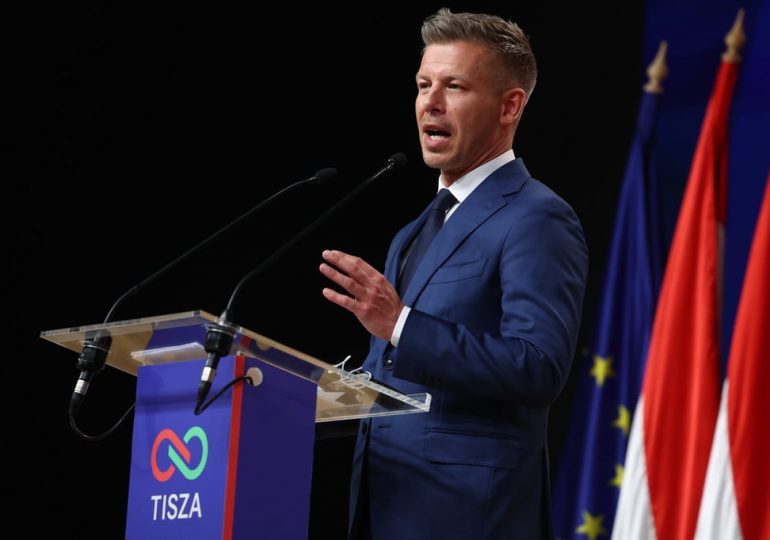
Peter Magyar, leader of the pro-European conservative Tisza Party and Hungary’s Prime Minister-elect, delivers a speech in Budapest, Hungary, on April 13, 2026. —Jakub Porzycki—Getty Images
Peter Magyar, leader of the Tisza Party, carried out a landslide defeat against Viktor Orbán in Hungary’s national election, ending the Prime Minister’s 16-year rule.
“We won not small but big—very, very big,” Magyar told a crowd of cheering supporters, celebrating the fact he toppled Orbán’s Fidesz Party by gaining 138 of 199 seats. “Together we changed the Orbán regime, together we liberated Hungary, we took our homeland back.”
He pledged to spend the next four years striving for a “free, European, functioning, and humane Hungary.”
Orbán—who had received a strong endorsement from U.S. President Donald Trump and was joined on the campaign trail by Vice President J.D. Vance in Hungary last week—referred to the results as “painful” when he conceded Sunday night.
Experts previously told TIME that Hungary’s struggling economy was one of the key reasons Orbán’s party struggled in the polls leading up to the election.
As a prominent figure among the global MAGA right, Orbán aligned closely with Trump and Russia, and has often stymied European Union efforts to support Ukraine.
Magyar was a former ally of Orban’s, but splintered away with the center-right, pro-European Union Tisza Party.
His success has been celebrated by many European leaders, who welcome it as a new dawn for Hungary-E.U. relations.
“Hungary has chosen Europe. Europe has always chosen Hungary. A country reclaims its European path. The Union grows stronger,” said European Commission president Ursula von der Leyen.
Polish Prime Minister Donald Tusk posted a video of himself on the phone with Magyar, during which he told the Hungarian lawmaker: “I think I am happier than you.” He captioned the video with the words “Welcome back to Europe!” alongside Polish and Hungarian flags.
“Today, Europe wins and European values win,” said Spanish Prime Minister Pedro Sánchez, while British Prime Minister Keir Starmer referred to the victory as “an historic moment, not only for Hungary, but for European democracy.”
Democratic leaders in the U.S. also reacted enthusiastically to Magyar’s win.
Former President Barack Obama referred to the results as “ a victory for democracy, not just in Europe, but around the world.”
Senate Minority Leader Chuck Schumer framed the landslide triumph as a warning to Trump ahead of the upcoming U.S. midterms.
“Pay attention, Donald Trump. Wannabe dictators wear out their welcome. November 2026 can’t come soon enough,” he warned.
As Magyar seeks to be sworn in as Prime Minister as early as May 5, here’s what to know about the man who ended Orbán’s 16-year rule.
President Donald Trump greets Prime Minister of Hungary Victor Orbán as he arrives at the White House on Nov. 7, 2025. —Roberto Schmidt—Getty Images
Magyar began his political career as part of Orbán’s Fidesz Party
Born in Budapest on March 16, 1981, Magyar studied law and humanities at Pázmány Péter Catholic University.
The 45-year-old spent the large part of his political career in Orbán’s Fidesz Party, which he joined in the early 00s.
Magyar’s political breakthrough is closely tied to the 2024 “pardon scandal,” which forced the resignation of Hungarian President Katalin Novák and led to the departure of Justice Minister Judit Varga, Magyar’s former wife.
Magyar accused the government of using her as a scapegoat and said Orbán had turned Hungary into a system benefiting political allies and family members.
“I have been living in this system, in this circle, for a very long time,” Magyar said during a high-profile interview with the independent Hungarian outlet Partizán when discussing his resignation from Orbán’s government.
He was described as an “Orbán regime insider” prior to the political breakup.
Following the fallout, Magyar became chairman of the Tisza Party and a member of the European Parliament in 2024.
Magyar campaigned on a platform of anti-Orbán and anti-corruption
Magyar’s campaign centered on opposition to Orbán’s government, which he repeatedly described as corrupt.
“Let us say that nothing can continue as it has been for the last 30 years. There is a moral, political, and economic crisis in Hungary,” he said when unveiling his campaign proposals. “Trust in the entire political elite that has been in power for 30 years has been shaken.”
His party platform emphasized a “zero tolerance towards corruption,” arguing that “systemic corruption is rampant.” Magyar endorsed an anti-corruption programme, incentivizing members of the public to go online and report fraudulent behaviour by government officials in an anonymous capacity.
On the eve of the election, Magyar accused the Fidesz Party of relying on “scaremongering and lies.”
Magyar often described the government as the “Orbán mafia” and vowed to correct this once in office.
“Those at the very top already know that their power and their unchecked looting is coming to an end. They know the clock is ticking,” he said on March 27.
“A Tisza government will uncover every case. It will review every contract. We will trace every financial transaction,” he added. “We will know exactly where the money came from, who it passed through, and where it ended up.”
An E.U.-flag hangs beside Hungarian flags as Peter Magyar prepares to deliver a speech in Budapest, Hungary, on April 13, 2026. —Attila Kisbenedek—Getty Images
Magyar is pro-E.U. and aims to fix the splintered relationship between Hungary and Europe
Magyar’s victory signals a shift in Hungary’s direction after years of friction with the European Union under Orbán, who often blocked votes supporting Ukraine and broader European initiatives.
Tisza’s platform emphasizes that Hungary “chooses Europe,” with plans to rebuild trust with allies and strengthen its position within the E.U. and NATO.
Magyar has also pledged to reduce Hungary’s reliance on Russian energy by 2035, marking a potential shift away from the country’s closer ties with Moscow.
“I think that Tisza will have an overwhelming electoral victory, because even Fidesz voters do not want our country to be a Russian puppet state, a colony, an assembly plant, instead of belonging to Europe,” he told AP in early April.
At the same time, the party signaled continuity on some border policies, supporting the retention of the southern border fence and rejecting E.U. migration quotas.
“Today, the Hungarian people said yes to Europe, they said yes to a free Hungary, they said yes to representing them, to helping them, to putting the country in order, because this is what a Hungarian government, the task of every Hungarian government is,” Magyar said during his victory speech along the Danube River in Budapest.
What has Magyar previously said about Trump?
In a social media post comparing Orbán and Trump, Magyar cast the U.S. President in a more favorable light than his former rival.
“Donald Trump has never been afraid to stand up for open, straightforward debates with his political opponents. Viktor Orbán hasn’t dared to do this for 20 years,” Magyar said in November 2025. “You can love him or hate him, but Trump is a born leader.”
Magyar also congratulated Trump on his 2024 Presidential election victory over the Democratic candidate, former Vice President Kamala Harris.
“America has decided. Congratulations to President Donald Trump, as well as to the newly elected members of the Senate and the House of Representatives!” he said. “The Tisza Party is ready to work together with the new American Administration to further develop the relations between our countries.”
In an interview with a Hungarian publication earlier this year, Magyar struck a more measured tone when asked about forming a friendship with Trump similar to Orbán’s.
“I don’t think that such personal friendships are needed in diplomacy and between country leaders, but rather pragmatism, representation of national interests, compromises, alliance systems, allies,” he said.
Leave a comment