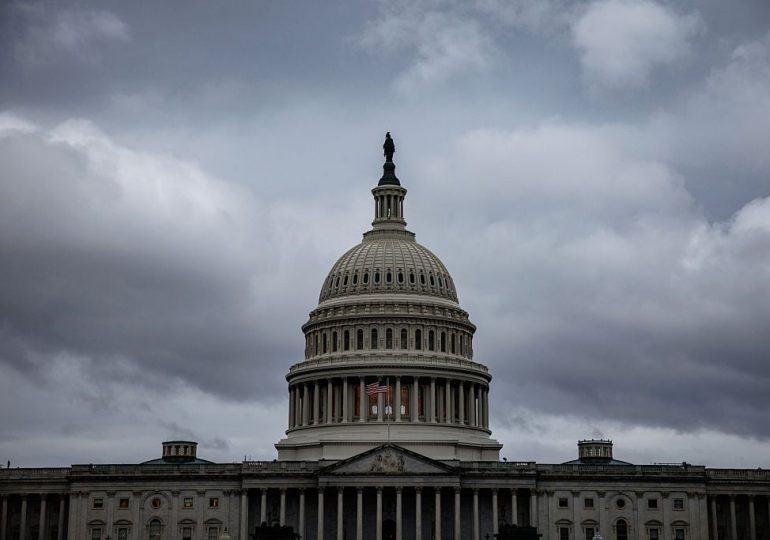
The U.S. Capitol building is seen in Washington, D.C., on March 27, 2026. —Samuel Corum—Getty Images
Two members of the House resigned on Tuesday, adding more vacancies to the narrowly divided chamber ahead of the midterms. What will happen to their seats next is up in the air.
Democratic Rep. Eric Swalwell of California said in a post on X on Monday that he planned to step down from his role, after multiple allegations of sexual misconduct surfaced against him. He continued to deny the allegations, but said that it is “wrong for my constituents to have me distracted from my duties.”
A day earlier, he ended his California gubernatorial campaign, upending an intense and crowded race in which he was previously considered to be the Democratic frontrunner.
About an hour after Swalwell announced that he would resign, Republican Rep. Tony Gonzales of Texas said in a post on X that he would retire from office.
Gonzales has been accused of coercing a member of his staff into having a sexual relationship with him. He initially denied having any sexual relationship with the staffer, who died by suicide in September. But last month, he admitted to having an affair with her. Soon after, he said that he was ending his reelection bid, but pledged to continue his term in the House. Another former staffer alleged that Gonzales sent her sexually explicit text messages in 2020, The San Antonio Express-News reported last week.
Both Swalwell and Gonzales had faced growing calls to resign from office before their announcements. The House Ethics Committee had launched investigations into both Congressmen.
Read more: Where the California Governor Race Stands After Swalwell’s Exit
Both lawmakers officially stepped down on Tuesday. But it’s uncertain at this point when—and by whom—their seats will be filled.
Governors typically call special elections to replace House members who leave office before their term ends. But with the election in November less than seven months away, neither California Gov. Gavin Newsom nor Texas Gov. Greg Abbott will be required by state law to do so before then—and it’s not yet clear whether either intends to.
California law gives the Governor 14 days after a vacancy opens in the House to call a special election, which usually must be held between 126 and 140 days after that announcement. But the timeline can be extended to 200 days to “consolidate” the election with another—and with the Nov. 3 election currently just over 200 days away, that means Newsom could opt not to call a special election in this instance.
Newsom’s office said that it is reviewing the situation and will announce a decision once Swalwell’s seat is officially vacant.
Texas law in most cases requires the Governor to schedule a special election to fill a House vacancy on the “first uniform election date” to fall at least 36 days after the election is ordered. But the last of those dates before the fall midterms is now less than 36 days away, meaning that Gonzales’ seat would just be filled in November—unless Abbott decides to call an emergency special election. Such a move wouldn’t be without precedent: Abbott called such an election in 2018, after Republican Rep. Blake Farenthold resigned on April 6 that year.
Abbott’s office did not immediately respond to a request for comment.
The current makeup of the House could play into what the Governors decide to do next. Republicans hold a majority in the House, but it is razor thin; with Swalwell and Gonzales officially stepping down, the President’s party currently occupies 216 seats and Democrats 213. Three other seats are vacant and one is held by an Independent—Rep. Kevin Kiley of California—who left the GOP last month but has continued to caucus with the party. One of those vacancies, left by former Rep. Marjorie Taylor Greene after she resigned in January, is being filled by Republican Clay Fuller, who won a special runoff election last week. He is expected to be sworn into office on Tuesday, which would bring the party’s seats in the House back up to 217. Special elections are set to be held to fill the others in April and August.
As far as the partisan split in the lower chamber, Swalwell and Gonzales’ dual departures offset one another. But if the former Congressmen’s seats aren’t filled at the same time, that could impact the divide—even if only for a short period of time.
Democrats have thrived in special elections over the past year, winning multiple races by significant margins and overperforming the party’s 2024 numbers in several races they ultimately lost. Republicans’ seats—and their majorities in the House and Senate—could also be at risk in the general election, which will be pivotal for both political parties. Democrats are cautiously optimistic about their chances to gain some Congressional seats, especially in the House, which they hope to reclaim. And historically, the President’s party tends to lose seats in midterm elections.
Both Swalwell and Gonzales’ seats, though, are likely to remain in the hands of their respective parties; The Cook Political Report categorizes Swalwell’s seat as “solid” for Democrats, among the safest races in this year’s midterms, and rates Gonzales’ seat as “likely” for Republicans, just one step down from “solid.”
Leave a comment