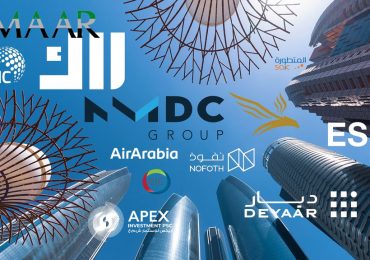
The Gulf Cooperation Council countries (Bahrain, Kuwait, Oman, Qatar, Saudi Arabia, United Arab Emirates) have long been at the center of global trade and logistics due to their location and their role in producing and exporting oil. In recent years, many companies in the region have been buoyed by the influx of global business deals and trillion-dollar sovereign wealth funds. To identify the fastest growing companies in the Gulf, TIME partnered with Statista to assess companies on growth performance, financial stability, and stock performance, with the top 250 companies ranked on “Arabia’s Growth Leaders of 2026.”
Methodology: How TIME and Statista Determined Arabia’s Growth Leaders of 2026
The top three industries represented in the list are Banking & Financial Services, followed by Insurance, Healthcare & Social Services, then Real Estate. The top company on the list is conglomerate and investment firm International Holding Company (IHC), whose revenue grew from 7.047 million AED in 2020 to 92.658 million AED in 2024, and its stock price grew from 29 AED to 405 AED during the same period. IHC is one of the handful of companies controlling global capital flow in the UAE, with the Financial Times reporting that it influences a wide range of industries in Abu Dhabi spanning electricity, property development, hospitals, billboards, driving schools, and even chicken farms.
Two IHC subsidiaries also show up on the list, Alpha Dhabi Holdings (no. 78) and Multiply Group (no. 46). In turn, Alpha Dhabi has a stake in Aldar Properties (no. 18) and a joint venture with ADNOC Drilling (no. 74). Multiply Group has a majority stake in Emirates Driving Company (no. 45) and invested in Dubai Electricity & Water Authority (no. 210) during its IPO. IHC is notably 61.2% owned by Royal Group, a private investment firm owned by Sheikh Tahnoon, and has historically been opaque to independent bank research and credit agencies; critics question whether the rapid growth signals blurred lines between royal and state assets, as Sheikh Tahnoon, brother of UAE’s president, is the national security advisor and chairs two of Abu Dhabi’s sovereign wealth funds, including ADQ. ADQ and IHC have previously merged their assets in real estate and hospitality as well as participated in a joint venture together with Modon (no. 20), signaling consolidations of economic power that some say could crowd out competition from other independent private entities. Around 45% of the companies on TIME and Statista’s list have direct, partial, or historical links to state governments, sovereign entities, or ties to royal families.
While oil is still a big part of the Gulf’s economy, representing a majority of its exports, the inflow of capital has also propped up many domestic industries, like healthcare, real estate, and infrastructure, according to Jeffries, in alignment with the dominant industries on this list. In healthcare, the Gulf has become a sought after destination for medical tourism. Dallah Healthcare (no. 40) and Dr. Sulaiman Al Habib Medical Group (no. 58), have both received Global Healthcare Accreditation for medical travel services. In its 2024 sustainability report, Dallah Healthcare stated that it “has been playing a pivotal role in the growth of medical tourism in Saudi Arabia, aligning with the Kingdom’s Vision 2030 of diversifying the economy and enhancing healthcare services. Dr. Sulaiman Al Habib’s website states that it offers “high-quality treatments at a fraction of the cost compared to western countries” and has medical tourism packages that include “end-to-end services from airport transfers, accommodation, treatment, to post-operative care.” In real estate, luxury developer RAK Properties (no. 6) posted record sales last year, debuting projects like Giorgio Armani-branded beach villas and the Gulf’s first casino, with a full year revenue of 1.84 billion AED, up 31% from 2024. Emaar Properties (no. 9), the developer of Burj Khalifa, also saw its highest ever property sales in 2025, driven by demand for premium residential housing. See the full list of companies shaping the modern Gulf below.
Leave a comment