
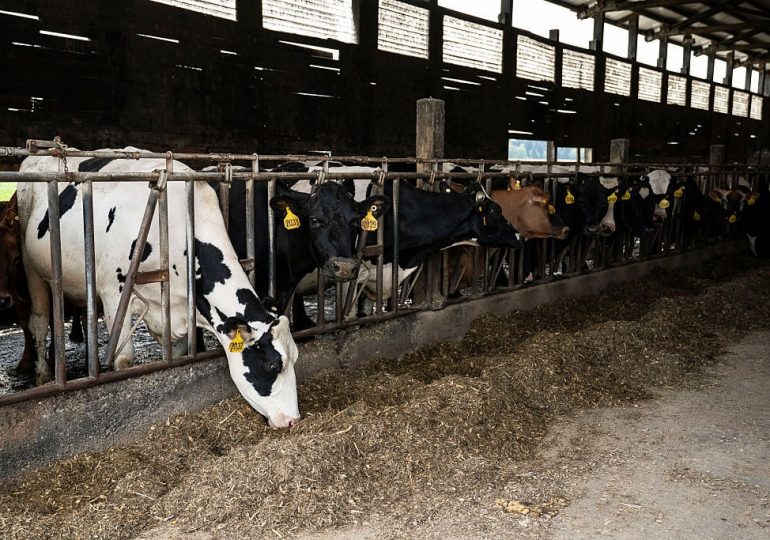
Cows at a dairy farm in Mount Vernon, Washington, US, on April 20, 2026. —David Ryder—Getty Images
Meat and dairy production are among the biggest contributors to global emissions. And many companies are increasingly aware of their climate impacts—and eager to take action. But according to new research released today, the majority of the sustainability claims and commitments made by meat and dairy companies can be considered greenwashing.
The production of meat for human and animal consumption is responsible for 57% of total global food production emissions, while the global dairy sector alone contributes to 4% of global emissions. The world’s top five emitting companies—JBS, Marfrig, Tyson, Minerva, and Cargill—were responsible for an estimated 496 million tonnes of greenhouse gases in 2023, more than reported for Chevron, Shell, or BP.
“Meat and dairy companies are under a lot of scrutiny and pressure to speak about the environment,” says Jennifer Jacquet, professor of environmental science and policy at the University of Miami, and one of the study’s authors.
Read more: What Happens When Diners Are Shown Climate Warning Labels on Meat Dishes
The researchers, whose study was published in the peer-reviewed journal PLOS Climate, examined 1,233 environmental claims made by 33 of the biggest meat and dairy companies between 2021-2024, pulled from publicly available sustainability reports and websites. They used a greenwashing assessment framework developed by researchers in 2022, and found that 98% of claims examined fall under the category of greenwashing—misleading statements that boost the appearance of a company’s sustainability efforts in the eyes of the public.
Many of the statements were overly vague or unverifiable future projections. Only 356 (29%) of the claims were backed by supporting evidence from sources like government bodies or trade organizations, and scholarly scientific evidence was provided to support only three of these claims, two of which were climate-related.
While 17 of the companies included in the study have made net-zero commitments—compared to just 4 in 2020—the commitments appear to heavily rely on carbon offsetting, which involves funding projects that compensate for emissions, rather than decarbonization, which would directly address the source of emissions.
While it’s a promising sign that more meat and dairy companies are considering their emissions impact, they need to be doing more, says Maya Bach, the study’s lead author. “What we see here is that they are scratching at the surface, sharing pilot projects or initiatives that yes, reduce emissions, but not at the scale or the scope that we need in order to make a meaningful impact.”
In some instances, according to the study, companies announced ambitious climate initiatives, though they were often at a small scale. One company announced it would launch a “regenerative agriculture pilot” on 24 farms—which represented just 0.0019% of its operations. Other examples noted by the researchers include companies citing small changes that are limited in impact, like providing microwaves in the cafeteria to encourage employees to bring their own lunch or reducing their plastic use by making the packaging tape narrower.
While it might seem inconsequential, publishing misleading claims impacts public perception of a company. “It affects the way consumers see their products,” says Jacquet. “It affects what politicians think they need to do to regulate—if they think the companies are solving the problem already, they may be less keen to regulate the industries.”
Major changes need to be made to significantly reduce the emissions impact of producing meat and dairy. The global livestock industry alone is one of the world’s highest emitting sectors, estimated to be responsible for between 12% and 19% of total human-caused greenhouse gas emissions. Most of the industries’ climate impacts come from methane, which cattle and other livestock burp up as part of their digestive process. Methane, which traps 86 times more heat than carbon dioxide over a 20 year time frame, accounts for more than half of meat and dairy’s climate pollution.
Despite the climate impact of meat consumption, it’s only growing in popularity around the world. One 2018 study found that, if there are no changes to policy or behavior, global meat consumption is predicted to be 60-70% higher by 2050.
That’s why, harmless as they might seem, the companies need to be held accountable for any misleading claims, the study authors argue. “These indicators of greenwashing that we’re seeing, encourages and allows [companies] to continue to delay action needed to meet climate goals,” says Bach. “There’s growing public interest in sustainability efforts, and efforts can shape how a company is perceived. So it’s important to pull back the screen, so to speak, and see whether their actions match their words.”
Leave a comment