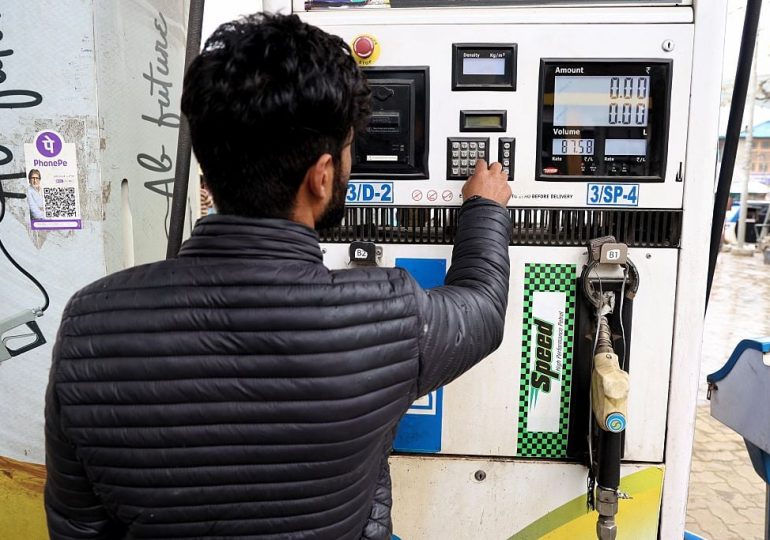
An employee works at a petrol pump station in Baramulla, Jammu and Kashmir, India, on April 8, 2026. —Nasir Kachroo—NurPhoto/Getty Images
The International Monetary Fund has warned that the world may be headed for a global recession if energy and supply disruptions due to the U.S. and Israeli war with Iran drag on.
“A longer or broader conflict, worsening geopolitical fragmentation, a reassessment of expectations surrounding artificial‑intelligence‑driven productivity, or renewed trade tensions could significantly weaken growth and destabilize financial markets,” the IMF said in a new report on Tuesday.
The IMF cut its growth outlook to 3.1% real GDP growth for 2026, down 0.2 percentage points from its forecast in January. But even the lower forecast is based on its most optimistic scenario in which conflict is short-lived and oil prices average $82 a barrel across this year.
If oil prices on average hover around $100 a barrel, as they have in recent weeks due to war-driven disruptions, the IMF forecasts global growth to fall to 2.5% this year. In January, the IMF forecasted oil prices to average $62 a barrel this year.
In the worst case scenario, in which supply disruptions persist into next year, the IMF predicts global growth to fall to around 2%. According to the IMF, this would mean “a close call for a global recession.” Growth has only fallen short of 2% four times since 1980, the IMF said.
In all three scenarios, headline inflation is expected to rise. In the most severe, global inflation is expected to top 6%.
“Despite major trade disruptions and policy uncertainty, last year ended on an upbeat note,” Chief Economist Pierre-Olivier Gourinchas said during a press briefing at the IMF’s annual spring meetings. “The private sector adapted to a changing business environment, helped by lower-than-announced U.S. tariffs, fiscal support in some countries, favorable financial conditions, and a tech boom.”
“Now, war in the Middle East has halted this momentum. The closing of the Strait of Hormuz and serious damage to critical energy facilities in the Middle East raised the prospect of a major energy crisis, should a durable solution not be found soon,” Gourinchas said.
Iran militarized the Strait of Hormuz, a narrow waterway through which a fifth of the world’s oil trade flows, after the U.S. and Israel launched their attacks on Feb. 28. Iran also retaliated against the U.S. and Israel by attacking energy facilities across the Middle East, which is a major producer of the world’s oil and gas, while Israel attacked energy sites in Iran. As shipping through the strait dwindled, oil and gas prices surged to more than $100 a barrel and have remained high. Supplies of diesel, jet fuel, fertilizer, aluminum, and helium have also been disrupted, which has meant increasing costs for a wide range of products, from food to technology to plastic packaging.
Although the U.S. and Iran agreed to a two-week cease-fire, temporarily halting military attacks, traffic through the Strait of Hormuz has continued to be restricted. After marathon talks aimed at a more definitive end to the war failed over the weekend, President Donald Trump announced a U.S. naval blockade of Iranian ports, a move that Iranian officials have said could be considered a cease-fire violation. At the same time, the Strait of Hormuz has remained a sticking point in negotiations. Iran has sought to institutionalize its control of the strait possibly through a toll system after the conflict ends. Trump, for his part, has suggested the U.S. could charge its own fees for transit through the strait.
Meanwhile, Israel’s continued attacks on Lebanon, which have killed more than 2,000 people since March 2, and Gaza could also be a thorn in negotiations, as Iran previously insisted that any cease-fire apply to the rest of the region.
The IMF also reduced its growth outlook for the U.S. by 0.1 percentage point from its January forecast to 2.3%. Americans have already seen higher prices at the pump due to war-driven disruptions. Investors have also been rattled, with markets whipsawed by oil shocks and geopolitical uncertainty.
The IMF expects slower economic growth of 1.1% for the eurozone, where many countries are still reeling from elevated energy prices after Russia’s 2022 invasion of Ukraine.
Emerging markets are likely to be disproportionately affected by energy shocks and a tougher global funding environment, according to the IMF. These economies tend to have greater exposure to supply disruptions as they rely heavily on energy imports and have fewer economic buffers to absorb such shocks.
Around the world, especially in Asia where many countries depend heavily on Middle Eastern supplies, governments have scrambled to implement short-term measures and subsidies in order to address shortages in fuel and other commodities and rising inflation. From Bangkok to Bangladesh, households have been squeezed by the energy shock, with people queuing for scarce cooking gas and struggling to keep up with surging fuel costs.
Tighter financial conditions could also lead to lower demand while firms may lay off workers or slow hiring, the IMF warned.
“Price caps, subsidies and similar interventions are popular, but they distort prices,” said Gourinchas. “Where support for the most vulnerable is needed, targeted and temporary measures should be deployed consistent with medium term plans to rebuild fiscal buffers and avoiding stimulating demand where inflation is rising.”
India, which imports most of its crude oil and liquefied petroleum gas, has also been hit hard by supply disruptions. The country also depends on imported natural gas feedstocks for fertilizer production, critical for its agriculture sector, and on shipping routes through the Strait of Hormuz for its exports. Still, thanks in part to robust domestic demand and public investment, India is expected to remain one of the world’s fastest growing major economies, with the IMF projecting growth of around 6.5%, a slight upgrade from its January forecast.
Gourinchas said that quicker uptake of renewable energy could provide more resilience to energy shocks down the line. China, which is a major buyer of Middle Eastern and Iranian crude, has been partly shielded from the energy shock by its shift toward renewable energy over the years, including widespread adoption of electric vehicles. The IMF expects China’s economy to grow 4.4% this year, down 0.1 percentage point from its January forecast. Despite being in a relatively stronger position to sustain energy imports from Russia and Iran, the country faces persistent structural pressures including a weak property market and shrinking workforce.
Economic prospects in the Middle East and Central Asia have been hit particularly hard, as war-driven disruptions to key energy and commodity exports alongside declines in sectors like tourism drag 2026 growth down to 1.9%, a two-percentage-point downgrade. Several economies are projected to contract, including Iran, Qatar, Iraq, Kuwait, and Bahrain. If the conflict ends sooner rather than later, and energy production and shipping are normalized, growth for the region could rebound next year, according to the IMF.And as Treasury Secretary Scott Bessent suggested on Tuesday that Trump’s tariffs could be reinstated as early as July, the possibility of renewed trade tensions could inject fresh volatility into markets, offering little in the way of relief to the world.
Leave a comment