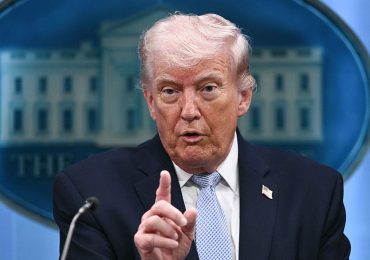
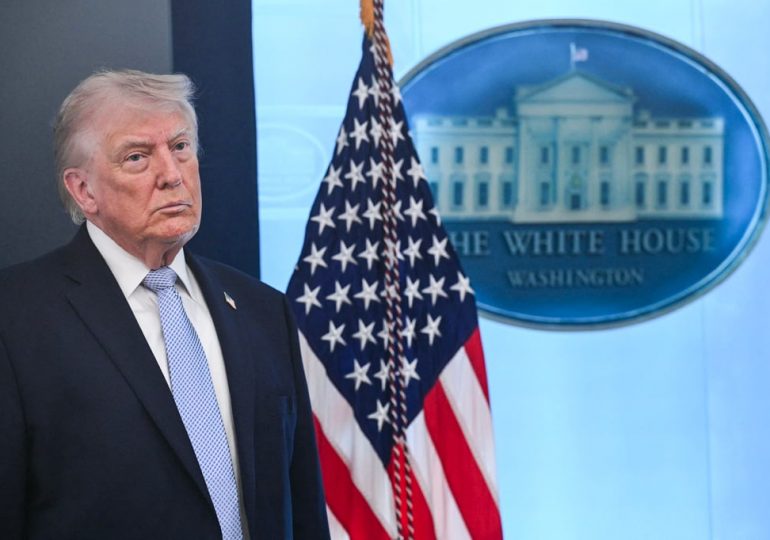
U.S. President Donald Trump looks on during a press conference about the conflict in Iran at the White House on April 6, 2026. —Saul Loeb—Getty Images
Iran said Monday that “no decision has been made” on whether its officials will attend a second round of peace talks alongside U.S. envoys in Pakistan after Tehran accused Washington of violating the cease-fire by seizing an Iranian ship.
Esmail Baghaei, spokesperson for the Iranian Foreign Ministry, said there are “no plans for the next round of negotiations” and emphasized that Iran will be “prioritizing national interests and benefits” as it considers its next steps.
Iranian President Masoud Pezeshkian urged the need for diplomacy in his own remarks Monday morning, but signaled an underlying distrust of U.S. negotiators.
“War benefits no one, and while standing firm against threats, every rational and diplomatic path should be used to reduce tensions. At the same time, distrust of the enemy and vigilance in interactions are undeniable necessities,” he said, according to state media.
As such, the second round of peace talks, set to take place in Islamabad, Pakistan, remain uncertain, with only the U.S. delegation—once again led by Vice President J.D. Vance—confirmed to attend. Vance is set to arrive in Pakistan late Monday alongside special envoy Steve Witkoff and Trump’s son-in-law Jared Kushner.
The already fragile two-week cease-fire, set to expire in the early hours of Wednesday in Iran, also hangs in the balance as Tehran threatened to retaliate after the U.S. seized an Iranian cargo ship that attempted to bypass President Donald Trump’s blockade in the Strait of Hormuz, a vital waterway through which roughly a fifth of the global oil supply passes.
Trump said the U.S. Navy intercepted the ship in the Gulf of Oman on Sunday and “stopped them right in their tracks by blowing a hole in the engine room,” adding that the U.S. now has “custody” of the vessel.
U.S. Central Command (CENTCOM) said Monday that American forces have directed 27 vessels to turn around or return to an Iranian port since the start of the U.S. blockade on April 13.
Vice President J.D. Vance speaks as Jared Kushner and special dnvoy Steve Witkoff listen during a news conference after a meeting with representatives from Iran in Islamabad, Pakistan, on April 12, 2026. —Jacquelyn Martin–Pool/Getty Images
Tehran and Washington accuse each other of violating cease-fire
Iran has accused the U.S. of violating the cease-fire through its continued blockade of Iranian ports in the Strait of Hormuz and its subsequent seizing of an Iranian ship—a move Iran’s joint military command described as an act of piracy.
Mohammad Reza Aref, the first Vice President of Iran, on Sunday said that while the military blockade continues, Iran will continue to apply economic pressure worldwide via the restriction of naval navigation.
“The choice is clear: Either a free oil market for all or the risk of significant costs for everyone,” he said. “Stability in global fuel prices depends on a guaranteed and lasting end to the economic and military pressure against Iran and its allies.”
Baghaei referred to the blockade as “not only a violation of [the] Pakistani-mediated cease-fire but also both unlawful and criminal.”
He expanded on Monday, arguing further violations of the cease-fire have taken place in relation to Lebanon.
Baghaei’s remarks came as the Israeli military said Monday it will continue to maintain their military positions in southern Lebanon and issued evacuation warnings in several areas.
Trump announced a 10-day cease-fire agreement between Israel and Lebanon last week after continued strikes in Lebanon threatened to derail broader negotiations between the U.S. and Iran. It took effect at 5 p.m. E.T. on April 16 and despite accusations of violations, as of Monday morning, reports suggest that the agreement is largely holding.
Meanwhile, Trump has accused Tehran of violating the U.S.-Iran cease-fire, stating that Iranian forces fired bullets in the Strait of Hormuz over the weekend.
In the wake of the latest clash, Trump renewed his threat to target Iranian infrastructure.
“We’re offering a very fair and reasonable deal, and I hope they take it because, if they don’t, the United States is going to knock out every single power plant, and every single bridge, in Iran,” he warned.
Baghaei dismissed the threats, insisting “the Islamic Republic of Iran does not accept any deadline or ultimatum to secure its national interests.”
Oil prices surge again after U.S. seizes Iranian ship
After the U.S. seized an Iranian ship over the weekend, and with the conflict over the Strait of Hormuz showing no signs of abating, oil prices have once again surged.
Early trading on Monday saw Brent crude rise to around $95 per barrel, a 5% jump from the close of Friday.
Tehran’s restrictions over the Strait of Hormuz following the initial U.S.-Israeli strikes against Iran on Feb. 28, and the continued uncertainty around maritime access, have caused major instability to the global market.
The full and toll-free reopening of the Strait of Hormuz remains a key priority among European leaders, who previously resisted Trump’s calls to send warships to the waterway.
British Prime Minister Keir Starmer and French President Emmanuel Macron on Friday led an international summit in Paris aimed at supporting freedom of navigation in the Strait.
The leaders have since confirmed they will establish a defensive multinational mission to protect merchant vessels and conduct mine clearance operations.
However, per a statement shared after the summit, this will only be enacted “as soon as conditions permit following a sustainable cease-fire agreement” as the mission will be “strictly defensive.”
Chinese President Xi Jinping, meanwhile, called on Monday for “an immediate and comprehensive” cease-fire to ensure normal passage via the key trade passage.
Leave a comment