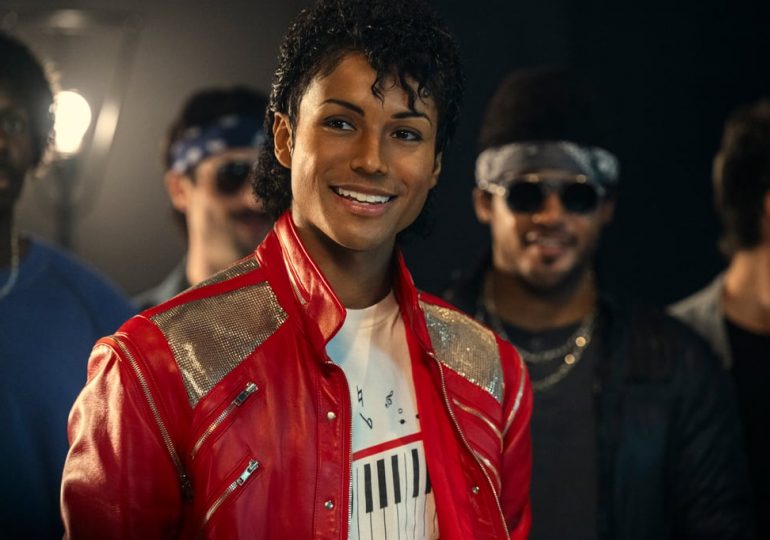
Jaafar Jackson playing his uncle, Michael Jackson —Courtesy of Lionsgate
If you knew nothing about Michael Jackson—if you had no clue about his almost unfathomable gifts as an entertainer or his troubled legacy—Antoine Fuqua’s workmanlike biopic Michael would be a fine and satisfying movie. There’s lots of triumph over adversity, and a few eureka moments showing a very young performer learning to flex his formidable powers. The film ends on an up note, with Jackson—played by Michael’s nephew, Jaafar Jackson, doing an admirable job of channeling his uncle’s charisma—performing before an arena of adoring fans in London in 1988. It’s not that any of these vignettes are inaccurate. It’s just that they fall so far short of the complete picture that they barely capture the essence of Michael Jackson: he was an entertainer who brought intense joy to others even as he could barely feel it himself.
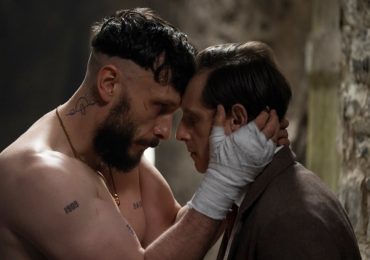
The earliest scenes in Michael are the most exuberant, and the most affecting. It’s wintertime in Gary, Ind., 1966. Tiny Michael, played by Juliano Valdi, gazes from the window of his family’s small home, watching kids playing in the snow. His father Joseph (Colman Domingo, his features rendered indistinguishable by blobby prosthetics) barks at him to rejoin his brothers: the boys who would become the Jackson 5 are lined up like loyal soldiers, ready to rehearse the performance their father has engineered for them. Young Michael has little confidence and goes through the motions of performance, not so much dancing as jiggling in place. Joseph berates him. The boys’ mother Katherine (Nia Long) gazes sympathetically from the sidelines but doesn’t dare speak up. Later, in response to some minor infraction, Joseph cracks his belt across little Michael’s butt. It hurts—probably a lot—and Michael cries. These early scenes are unpleasant to watch. They’re also the ones that feel the least burnished and most truthful.
The rest of Michael, which was written by John Logan, focuses largely on the fraught father-son dynamic, as if highlighting one elephant in the room will draw our attention away from another. The Jackson 5 become stars, but Michael, by age 10 arguably one of his era’s great soul singers, is clearly the anchor. The film deals with his intense loneliness: Once he and his brothers earn some money, he starts buying outlandish pets: a snake, a llama, a giraffe, a chimp named Bubbles. He tells his mother, plaintively, that they’re not pets, they’re friends.
The Jackson 5 as portrayed in ‘Michael’ —Courtesy of Lionsgate
All the while, young Michael strives to wriggle out from under his father’s meaty thumb. When the Jacksons are signed to Motown Records, Michael astounds Berry Gordy (Larenz Tate) with his version of Smokey Robinson’s “Who’s Lovin’ You.” The sound—it’s Michael’s voice we hear on the soundtrack—resonates like an ancient missive of heartache, rather than a song emanating from a 10-year-old kid. Later, as a young man, he’ll try with varying degrees of success to grab more freedom to make his solo album, Off the Wall, and later the mega-seller Thriller. Joseph’s sour, angry face is, paradoxically, the movie’s guiding star: he controls the narrative as he controlled his son’s life.
Did Jackson ever really free himself? The movie, made with the blessing of Jackson’s estate, doesn’t go anywhere near the allegations of sexual abuse later filed against the performer. (Reportedly, an earlier finale did but was reshot for legal reasons.) That’s a no-fly zone for many diehard Jackson fans too: to even suggest that he was a troubled guy who brought trouble to others incites their wrath. But to deny Jackson’s complexity only flattens his genius—as well as his kindness and fragility—into something manageable, explainable. In the end, Michael does the same. No one could survive being Michael Jackson—not even Michael Jackson. In death, as in life, he deserves much better than family and friends who’ll milk him for all he’s worth.
Leave a comment