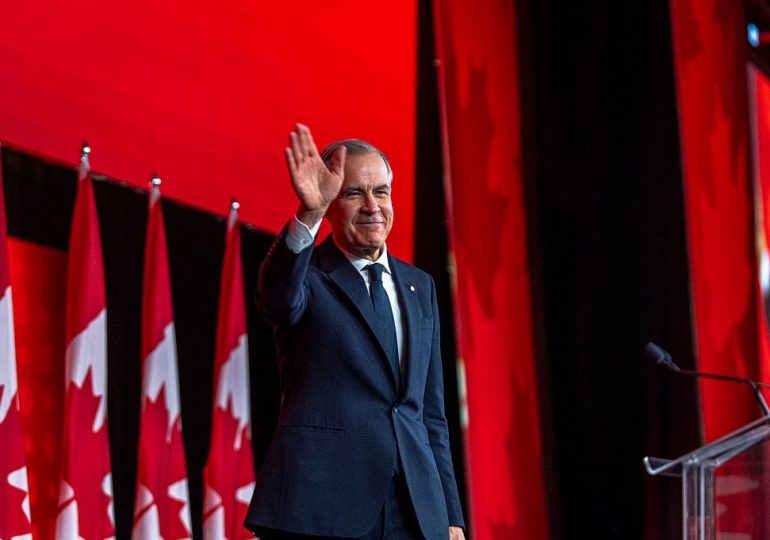
Canadian Prime Minister Mark Carney leaves the stage after speaking during the 2026 Liberal National Convention in Montreal, Canada, on April 11, 2026. —Andrej Ivanov—AFP/Getty Images
Canadian Prime Minister Mark Carney won three byelections Monday night, giving him a majority government and a free hand to further remake the government he inherited from Justin Trudeau.
Candidates from Carney’s Liberal Party won with large majorities, as expected, in two Toronto districts, known as “ridings,” vacated by Trudeau ministers. They also squeaked by in a hard-fought campaign in the suburban Montreal community of Terrebonne, where 25-year-old Haitian-born Tatiana Auguste won the normally separatist riding for the second time, after having a one-vote 2025 victory overturned in the Supreme Court.
The two Toronto ridings were sure to vote Liberal, but the victory in Montreal showed that the Alberta banker with stilted French is able to appeal to French-speaking voters who normally vote for parties that want Quebec to separate.
The result reflected voters’ confidence in a leader whose ascension looked unlikely in 2025. Thanks to the unpopularity of U.S. President Donald Trump and a swell of support at the Canadian polls, Carney seems to be headed from triumph to triumph, demonstrating the same assurance as a politician that he showed as a banker.
The rise of Mark Carney
Carney became prime minister 13 months ago in a Liberal leadership race after finance minister Chrystia Freeland resigned suddenly, kicking off a caucus revolt that forced Trudeau out. At that time, the opposition Conservatives enjoyed a huge lead in the polls and Carney—a rookie with no retail political experience—looked like he would oversee a brief interregnum before handing power to Conservative Pierre Poilievre.
Enter Donald Trump. The U.S. president threatened to use economic force to make Canada the 51st state, and Carney was able to harness the nationalistic reaction to Trump’s braggadocio, promising to keep his elbows up — an expression borrowed from legendary hockey player Gordie Howe, who was famous for leaving opposing players crumpled in the corners.
Carney, who had played hockey for Harvard and Oxford before rising through the ranks at Goldman Sachs and running the central banks in both Canada and the United Kingdom, presented himself as the crisis manager the country needed to manage Trump. The Conservatives swiftly lost their 20-point lead.
On election night a year ago, Carney won a mandate but fell three seats short of a majority government in the 343-seat House of Commons, which meant opposition MPs could slow down legislation, tie up the government in committee, and theoretically, force an election at will.
Now Carney has closed the gap. He started by enticing five opposition MPs to cross the floor to join his party, revealing them one by one like a game show host, to cheers from his supporters and accusations of underhanded practices from the Conservatives.
Prime Minister Carney now enjoys a three-seat margin in the House of Commons, so he no longer has to worry about opposition politicians forcing an election—not that they look inclined to do so. Since becoming prime minister, he has steadily become more popular. And his popularity has been consistently reflected in the polls.
Even the people who don’t plan to vote for Carney like him. “When you look at the voting intentions, that’s one thing, but his personal numbers … he has favorables everywhere, including in places that don’t vote for him, Alberta and the Prairies,” Philippe J. Fournier, a Montreal polling aggregator, tells me.
For baby boomers and members of the silent generation, Carney is often considered a national savior. Legendary folk singer Joni Mitchell called Carney a “blessing” last month while receiving a Juno lifetime achievement award. To Canadians of her era, Carney looks uniquely well-suited to run the country and manage Trump, whose tariffs have cost tens of thousands of manufacturing jobs.
Younger Canadians—who are more likely to struggle with housing and the cost of living—are less enamored, but Carney has made gains there as well. His position was strengthened in January, when he delivered a well-received speech at the World Economic Forum in Davos, warning against complacency in the face of the U.S.-led “rupture” in the world order, urging middle powers to “act together because if we’re not at the table, we’re on the menu.”
The standing ovation he received helped convince Canadians that Carney knows what he is doing, which has reduced the polarization that intensified as Trudeau and Poilievre squared off.
Carney’s path
Carney has clearly studied the forces that made Canadian voters sour on his predecessor, Trudeau, and is forging a new path ahead.
By the time Trudeau was forced out of office, the oil-producing Prairie provinces were so miserable with his climate policies that a separatist movement sprang up in Alberta. And in the aftermath of COVID, Trudeau had also allowed massive numbers of temporary foreign workers and foreign students to arrive, stretching to the breaking point the longstanding Canadian consensus over the desirability of immigration.
Carney changed the tone immediately. His first act as prime minister was to cancel a consumer carbon tax that was hated in the West, and he is actively talking about new pipeline projects to get more landlocked Alberta crude to tidewater. The Prime Minister tightened immigration rules, made significant trade deals with China and India, countries that Trudeau had managed to separately alienate.
He is borrowing heavily—which Canada can afford, at least for a while—and promising to build “Canada strong,” with nation-building infrastructure projects: ports, roads, and a $90-billion high-speed rail network from Quebec City to Toronto.
Carney has significantly increased military spending—reaching 2% of GDP this spring for the first time since the fall of the Berlin Wall—something that is only possible, and popular, because Canadians have been convinced it is no longer safe to hide under Uncle Sam’s coattails.
That new military spending will include a new fleet of submarines—from either South Korea or Germany—and may include Swedish fighter jets, rather than American F-35s, part of an effort to disentangle Canada from tight security co-operation with the Americans.
At a Liberal policy convention in Montreal on the weekend, Carney promised cheering delegates that the days of Canada “sending 70 cents of every dollar to the U.S. are over. “He was also cheered when he referenced the grassroots boycott of American wine, spirits, and tourism destinations. “It started quietly, people choosing a wine from the Okanagan over one from California … a family planning a vacation to Prince Edward Island instead of booking flights to Florida.”
Carney briefly name-checked Trudeau in his speech, but the former prime minister was a no-show at the convention. He did make two video appearances: a brief greeting he sent to welcome convention goers to Montreal, and a video posted online by his girlfriend, pop star Katy Perry, of the two of them enjoying the Coachella Festival in California.
Despite Trudeau’s glitz and glam, few Liberals at the convention were thinking about him. Carney, a centrist technocrat with clumsy French, has managed to win support from Quebec separatists, small-c conservatives, and urban progressives, all united by their fear of Trump.
Some left-leaning Liberals worry he is making the tent too big by inviting in so many Tory floor crossers, but it is hard to find a Canadian who thinks anybody else is better equipped to handle the moment. The Liberal Party of Canada has a long history of centrist brokerage politics, shifting left and right with the political winds, paying careful attention to regional coalition politics and rallying around the Maple Leaf when necessary. Carney’s first year as Prime Minister perfectly encapsulates this legacy.
So long as the United States looks like an unreliable economic and security partner, Carney’s formula for political success is as stable as could be.
Leave a comment