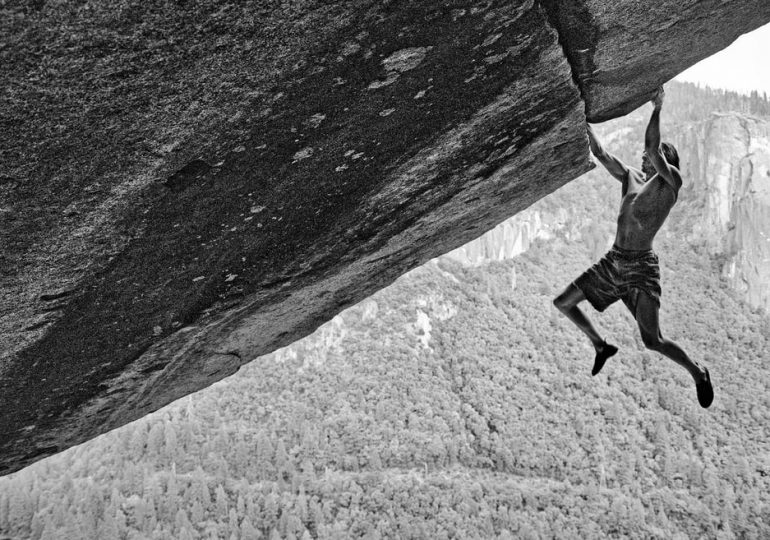
Dean Potter as shown in ‘The Dark Wizard’ —Dean Fidelman/HBO
On the evening of May 16, 2015, Dean Potter and fellow climber Graham Hunt stood atop Taft Point, a granite overlook thousands of feet above Yosemite Valley. Below them, the valley floor stretched into shadow. Far beneath the jump point was a narrow notch in a ridgeline, the kind of gap wingsuit flyers attempt to thread at speeds often exceeding 100 miles per hour. The margin for error was vanishingly small; so was the time they would have to correct it.
The men jumped. For roughly 15 seconds, Potter, then 43, and Hunt, 29, moved through open air in wingsuits, their bodies held aloft by fabric webbing stretched between their arms and legs. Then both struck the rock wall; neither deployed a parachute.
Both men died immediately upon impact. Hunt, a Yosemite local and Potter’s regular flying partner, had been regarded by those who knew him as a gifted wingsuit flyer, though during his five years in the sport, he remained largely outside the spotlight, known mostly within the Valley’s tight circles. But Potter’s death in many ways had been foreshadowed for years, not simply by the nature of wingsuit flying, among the most dangerous things a person can do, but by the logic Potter spent much of his life pursuing. He was a climber, highliner, and BASE jumper drawn to the place where fear and exaltation began to blur. That tension sits at the center of HBO’s four-part documentary series about him, The Dark Wizard, premiering April 14.
Directed by Emmy-winning filmmakers Peter Mortimer and Nick Rosen (The Alpinist), the docuseries revisits the life of one of the most visionary and controversial climbers of his generation, drawing on decades of archival footage, intimate interviews with friends and loved ones, and Potter’s own journals to build a portrait far more complicated than the legend that surrounded him—not just of an athlete who changed climbing, but of a man who helped redefine the sport’s relationship to risk and possibility.
For decades, Potter moved through the climbing world as both icon and provocation. He scaled giant walls, crossed highlines suspended between cliffs, and pioneered disciplines so new they scarcely had names. To outsiders, many of those feats seemed impossible; even within climbing, they often bordered on the unthinkable. He was admired for his imagination, feared for his intensity, and marked by an emotional volatility observed by close friends.
“I don’t think people really knew anything about Dean’s mental health struggles, and the specifics of what he was going through: how they really dragged him down at times and limited him, but also empowered him to do big things,” Rosen says. “His demons were both kind of positive and negative for him.”
King of the valley
Potter in a still from ‘The Dark Wizard’ —Andy Anderson/HBO
Potter was born in 1972 at Fort Leavenworth, Kan., the son of an Army officer and a yoga teacher. His family moved frequently during his childhood before eventually settling in New Hampshire. As a teenager, he spotted a metal spike lodged high in a cliff face and climbed toward it to investigate, only to find himself hundreds of feet above the ground with no clear way down. It was, by accident, his first free solo climb.
He never really stopped climbing after that. By the early ’90s, he had arrived in Yosemite Valley, living out of Camp 4—a climbers’ campground—surviving on scraps and sleeping in caves to dodge the park’s two-week camping limit. He threw himself into the communal culture that revolved around long days on the rock and living with very little. Yosemite was already sacred ground in climbing, a place where ambition met with plentiful granite. Potter did not just want to belong there; he wanted to expand what was imaginable there.
What followed was one of the most restless and inventive careers the sport had ever seen. In 1998, Potter speed-soloed Half Dome in a style so aggressive it had no real precedent—climbing fast and alone, without a rope, on one of the most recognizable rock faces in the world. The ascent didn’t just set a record; it introduced a new way of thinking about big-wall soloing that climbers are still building on today. Over the following years, he helped set and reset the speed records on El Capitan’s Nose route, a granite wall many climbers considered the sport’s most storied prize.
But Potter did not stop at climbing. He walked highlines—slender ropes stretched between cliff faces at dizzying heights—without the safety leash other practitioners considered standard. He invented FreeBASE, a discipline in which a climber free-solos a wall of at least 1,000 feet with a parachute as a last resort, collapsing the distance between mastery and catastrophe. He always called climbing, highlining, and wingsuit flying his “arts”—not sports, not stunts, but forms of expression as deliberate and considered as anything made in a studio. That framing was not affectation. Potter worked as a performance artist who happened to use granite and open sky as his medium. He funded his own filming, Mortimer says, because he always saw himself that way.
That instinct for self-mythologizing had a volatile edge. In 2006, he free-soloed Delicate Arch in Utah’s Arches National Park—taking advantage of a disputed loophole in park rules and drawing backlash from park officials and some climbers. Patagonia, his longtime sponsor, dropped him. Potter kept going. He was also, by then, running a cat-and-mouse game with Yosemite’s park rangers over his illegal BASE jumps—leaping from cliffs under cover of darkness, sometimes wearing a mask to avoid identification, treating the park’s rules as an unavoidable antagonist to be overcome. He needed something to rage against, and the federal government’s dominion over his cathedral provided it.
In 2009, a wingsuit BASE jump off Switzerland’s Eiger kept him airborne for nearly three minutes—at the time, a world record for duration. Two years later, he returned to the Eiger and set the world record for the longest wingsuit BASE jump, covering 4.7 miles in just over three minutes. For a stretch, he stood as arguably the most famous climber on earth.
A new competitor
Then Alex Honnold arrived. Quieter, more methodical, and possessed of a preternatural calm that stood in sharp contrast to Potter’s emotional turbulence, Honnold began doing the kinds of things Potter had pioneered—big-wall solos, audacious free climbs—with a matter-of-fact efficiency that made them look, if anything, more terrifying. As Honnold emerged, Potter appeared to experience the moment as an unspoken rivalry over who might become the first to free solo a full route on El Capitan’s 3,000-foot face, the sport’s ultimate prize. That competition cut Potter deeply, not just athletically but existentially—Honnold wasn’t only excelling in his arena, he was reframing it, showing that the same order of boldness Potter had always treated as the exclusive province of internal struggle could coexist with something closer to serenity.
Fame alone does not explain the hold Potter had on people. At six-foot-five, he was striking and physically imposing, capable of unusual stillness and sudden storms. That self-possession helped build the Potter mystique. So did the nickname that followed him: the “Dark Wizard.” It suggested sorcery and menace, power edged with something uncontrollable. Friends and peers often described him in similarly split terms: hilarious, insightful, and magnetic one minute, brooding and abrasive the next. The same intensity that made him such an original athlete could also make him difficult to be around.
The story behind the film
A still from ‘The Dark Wizard’ —Heinz Zak/HBO
Mortimer and Rosen did not approach Potter as distant observers. Rosen still remembers the first time he saw him, about 20 years ago, when he and Mortimer drove into Yosemite Valley as new collaborators. “Pete had already established himself as a filmmaker in the climbing world, but I was the new guy,” Rosen recalls. “We pull in and there is this crew of grungy muscle-bound locals, the Stone Monkeys, and looming over everyone was Dean, saying nothing but obviously in charge. … He looked at me and was unimpressed.” The next decade was a process of earning Potter’s trust and being gradually admitted into his world.
They filmed with him for years; some of the archival material in The Dark Wizard was footage they shot themselves. Potter slept in Mortimer’s basement when he passed through Colorado. They knew his public image intimately because they helped document parts of it. Potter was one of many figures in their 2014 documentary Valley Uprising, and his feats were captured across several installments of Reel Rock’s film series. Potter had also tried to tell his own story, premiering a feature called The Aerialist at several film festivals—a film showcasing his feats. But when Potter died in 2015, Mortimer and Rosen immediately sensed the fullest version of his story still had not been told.
“There was this big, large, amazing story to tell about Dean and his life,” Mortimer says. “It was just a question of when it was the right time to tell it.”
About five years later, they approached Potter’s sister Elizabeth. What they were asking for was not minor. They wanted access to his journals, footage he funded himself, and the freedom to tell a story that moved beyond celebration into more difficult terrain: his mental health struggles, the psychodrama within his inner circle, the strain of loving a man who often seemed to treat death as the medium for his art.
“We really wanted to tell a really honest, unvarnished story,” Rosen says.
That honesty depended on Elizabeth’s willingness to allow it. When she granted that access, the filmmakers quickly realized Potter’s life could not be compressed into a feature documentary without sanding away what made it strange and affecting. They initially pitched HBO five episodes; the project landed at four. Even so, the format allows room for the story to gather and viewers to sit with Potter, both the symbol and the person.
The series traces a life that moved in waves. The early Yosemite years were defined by hunger and invention: a young climber remaking what the sport thought possible, finding in the Valley both a home and a stage. Fame followed, and with it a growing mythology that Potter both cultivated and struggled beneath. As his accomplishments grew more extreme, so did the instability: the freakouts before major feats, the alienation of people close to him. Then, late in his life, a relationship with Jen Rapp brought a period of relative calm. The series’ fourth episode captures a softer, more grounded Potter, who seemed to have found something climbing alone could not provide. In May 2015, Potter and Hunt drove to Taft Point and did not come back.
Uncovering Potter’s true motivations
Potter in the docuseries —Eric Perlman/HBO
One of the strongest revelations in The Dark Wizard is how incomplete Potter’s public image was, even to people who knew him. The archival footage captured the public Dean, the visionary and athlete, but the journals revealed a more fragile private self, one even some people close to him had not fully seen.
“The biggest thing I kind of learned about Dean was his vulnerable side,” Mortimer says. “He always came across as just so self-assured and strong, the alpha.” What surprised him, the filmmaker says, was the “self-doubt” and “how deeply he wrestled with what he was doing and why he was doing it.”
That vulnerability changes the meaning of Potter’s feats. They no longer read simply as acts of fearlessness, but as experiences that gave him something ordinary life often did not. The accomplishment was never the whole point; it was the release that followed.
Mortimer and Rosen became especially interested in what earlier climbing films trimmed away. They wanted the footage before the feat: the whispered audio between climber and cameraman, the panic before a major jump or solo, the moments when strain entered the frame.
“When you understand what he went through, and then you see the transformation in his personality after he would complete these things, it makes you understand the ‘why’ for him,” Mortimer says. “You see him after, and he’s floating on air.”
What risk could not quiet
Potter on a tightrope —Dean Fidelman/HBO
The series approaches Potter’s mental health with caution and care. Friends who participated speak candidly about what they witnessed: periods of deep darkness, then elevation, then collapse again. Some believed he wrestled with something more cyclical than depression alone. Potter was never formally diagnosed, and Mortimer and Rosen chose not to profess what they could not prove.
“We weren’t going to call out specifically what he was going through, because it never had an actual diagnosis,” Rosen says.
That restraint makes the series stronger. The Dark Wizard does not flatten Potter into a case study or suggest that a diagnosis could neatly explain him. It traces what those around him observed and what the record suggests: a life marked by dramatic swings in mood, a restless and often punishing intensity, and a pattern in which his greatest feats seemed deeply entangled with periods of visible struggle.
The result is a portrait of Potter as a man whose relationship to danger was not merely athletic. The series never claims to solve him. It simply makes clear how much of his public brilliance existed alongside private instability, and how difficult it could be for the people around him to separate one from the other.
Yosemite as destiny
Nor can any of that be separated from Yosemite. In The Dark Wizard, the park is more than a setting: it is stage, cathedral, battleground, and home.
“The king of Yosemite is the king of the world in climbing,” Mortimer says. For a time, Potter occupied that role. He was physically commanding, artistically ambitious, defiantly countercultural, and willing to risk more than almost anyone. Yosemite was where he became himself in the fullest public sense.
It was also where he was eventually displaced. When Honnold emerged around 2008, the contrast between the two men’s approach to their sport became hard to ignore. Honnold not only excelled in Potter’s arena, he demonstrated the same boldness without the same visible turbulence. The center of gravity had shifted.
Still, Yosemite remained Potter’s deepest attachment; he lived in the Valley for 22 years, until his death. He raged against the park’s rules even as he was spiritually bound to the place: its cliffs, the immense and indifferent scale of it. “There’s something really poetic about him coming to fruition there, and then him passing there,” Mortimer says. “He’ll live on forever there.”
That symmetry is difficult to shake. Potter arrived in Yosemite as an unknown and became a legend; he died there too, but the park that made him also ended his story.
A complicated legacy
Potter flying in a wingsuit —Kammerlander/HBO
Where Potter fits in climbing history depends partly on which version of him one emphasizes. His influence is undeniable. Elite climbers still treat some of his boulder problems as rites of passage. Highliners regard him as one of the sport’s foundational figures. His experiments with FreeBASE helped expand what climbing and flight could mean together.
But The Dark Wizard is after something broader than technical influence. Potter belonged to a particular moment before climbing was absorbed into Olympic legitimacy and boutique gyms, when the sport still felt less codified. He represented a rougher ethos, driven by counterculture, obsession, and a hunger for experience that resisted easy measurement.
Mortimer sees that as central to Potter’s enduring pull. “It was this real generational moment and something that is kind of lost,” he says. Records were part of the equation. But he also seemed to want more: release, mastery, or reprieve. That hunger was never innocent. It cost him relationships and finally, his life. But it was real, and it was his.
What The Dark Wizard finally offers is not a full explanation of Potter, because none fully exists. But it restores his difficult scale: the sweetness alongside the swagger, the self-doubt beneath the bravado, the instability braided into the brilliance.
In the end, the series draws its mournful force not from the extremity of what Potter did, but from the question of what those feats gave him. It begins with a man stepping into open air from Taft Point and widens into the story of a life spent trying to turn falling into flight. For a while, Potter seemed to pull it off. The tragedy is that he could never stay there.
Leave a comment