
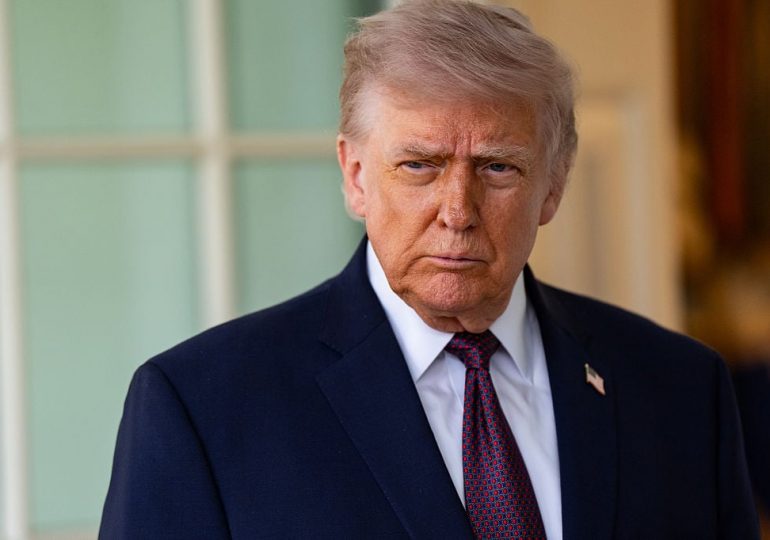
President Donald Trump speaks to members of the media outside the Oval Office at the White House in Washington, D.C., on April 13, 2026. —Salwan Georges – Bloomberg via Getty Images
President Donald Trump has said that he believes the war with Iran is “very close to over” after suggesting that negotiations with Iran will resume this week.
In an interview with Fox News broadcast on Wednesday, the President claimed that the conflict with Iran could soon come to an end, while also justifying his decision to launch joint strikes with Israel on Feb. 28 and the war that has followed.
“If I didn’t do that, you would have Iran with a nuclear weapon, and if they had a nuclear weapon, you would be calling everybody over there ‘sir’, and you don’t want to do that,” he said in the interview with Fox.
Read more: Officials Considering Second Round of U.S.-Iran Talks As Sticking Points Remain
Trump also gave a potential timeframe for reaching an agreement with Iran during a separate interview the same day. When asked if a deal could be reached ahead of the visit of King Charles III to the White House on April 27, the President said: “They’re [Iran] beaten up pretty bad. It’s very possible,” in a phone interview with Sky News.
In his interview with Fox, Trump said: “If I pulled up stakes right now, it would take them 20 years to rebuild that country, and we’re not finished,” claiming that Iran wants “to make a deal very badly” following failed negotiations between the U.S. and Iran in Pakistan over the weekend.
Independent analysts have challenged that assessment. Daniel Byman, director of the Warfare, Irregular Threats, and Terrorism Program at the Center for Strategic and International Studies, wrote earlier this month that although Iran’s conventional capabilities have been degraded, “its strategy has been to endure, impose costs, and shift the conflict’s center of gravity outward, and it is achieving meaningful success.”
Why Iran-U.S. peace negotiations failed
Negotiations this weekend in Pakistan between Iran and the U.S. aimed at ending the war ultimately failed, with the U.S. represented by Vice President J.D. Vance, special envoy Steve Witkoff, and Trump’s son-in-law Jared Kushner.
One of the key points of disagreement at the talks in Pakistan—an ally of both Iran and the U.S.—was Iran’s refusal to give up its right to a peaceful program, something which Trump pinpointed as the main failure of the talks on Sunday. Iran’s desire to continue controlling traffic through the Strait of Hormuz after the conflict ends through tolls has also proved a sticking point.
Despite Trump’s claim that Iran wants a deal, the Islamic Republic has maintained that significant work remains to reach an agreement. Foreign ministry spokesperson Esmaeil Baghaei said on Wednesday that during talks in Islamabad, Iran had expressed its views “on various issues including nuclear, sanctions relief, and compensation.”
Speaking during a press conference, Baghaei said that “One of the issues that the American side still insists on is the nuclear issue,” adding that the U.S. position “is not acceptable to Iran and must still be discussed.”
The spokesperson continued that the cease-fire agreement did, in fact, include a pause in fighting in Lebanon between Hezbollah and Israeli forces, which has not materialized.
The President had already hinted earlier on Tuesday that talks would resume this week.
“Something could be happening over the next two days, and we’re more inclined to go there,” he told the New York Post about further talks in Islamabad. “It’s more likely, you know why? Because the field marshal is doing a great job,” said Trump in reference to Pakistan’s army chief Asim Munir, whom the President has previously described as his “favorite field marshal.”
United Nations Secretary General António Guterres also said Tuesday that it is “highly probable that these talks will restart,” following a conversation with Pakistani Deputy Prime Minister Ishaq Dar.
“It would be very important if these talks create conditions to a change in the way the actors have been developing their activities,” Guterres said.
Trump faces mounting pressure to end the war
Back in the U.S., the President is facing mounting pressure to reach a resolution in the conflict. The war is approaching its 60th day, a deadline by which the War Powers Resolution of 1973 stipulates that presidents must terminate military operations unless Congress has voted to declare war or passed legislation to authorize the use of force.
“By law, we got to either approve continued operations or stop,” Rep. Don Bacon, a Nebraska Republican, told TIME. “If it’s not approved, by law they have to stop their operations.”
Most Democratic lawmakers have also consistently voted to rein in the President’s authority to continue the war without congressional approval. Sen. Rand Paul was the only Republican to vote with Democrats against Trump.
U.S. CENTCOM Commander, Adm. Brad Cooper, said that the U.S. blockade of Iranian ports, enforced at the start of the week, had been “fully implemented” on Tuesday. “In less than 36 hours since the blockade was implemented, U.S. forces have completely halted economic trade going into and out of Iran by sea,” he said.
The U.S. blockade of Iran’s ports and any Iranian-linked vessels from passing through the Strait of Hormuz began on Monday morning, announced by Trump following the failed talks in Islamabad.
Despite the blockade, oil prices have calmed this week following progress towards further peace talks. After Brent crude oil prices rose above $100 per barrel on Monday following Trump’s blockade announcement, prices have since dropped to $95 per barrel, rising slightly by 1% on Wednesday.
Iran has called the U.S. blockade “illegal” and a “prelude to violating the cease-fire,” according to the commander of Iran’s Khatam al-Anbiya Central Headquarters, Ali Abdollahi. “The powerful armed forces of Iran will not allow any exports or imports to continue in the Persian Gulf, the Sea of Oman, and the Red Sea,” should the blockade continue, Abdollahi said, according to Iranian state media.
How the Iran war has played out so far
Since joint U.S.-Israeli strikes against Iran on Feb.28, continued attacks have largely depleted Iranian military capabilities, according to the U.S.
“Iran’s air force has been wiped out,” claimed Defense Secretary Pete Hegseth last week. “Their missile program is functionally destroyed, launchers, production facilities and existing stockpiles depleted and decimated,” he added.
Hegseth said that Iran still retains the ability to retaliate, which it has done so throughout the conflict, targeting U.S. military bases in the region, as well as civilian infrastructure and oil and gas production facilities in a number of Gulf countries.
In Iran, the war has killed at least 2,900 people, including 1,700 civilians, according to the Human Rights Activists News Agency (HRANA) in Iran. Israel’s invasion of Lebanon, part of the broader regional conflict, has killed 2,020 people, including 248 women, 165 children, and 87 health workers.
Throughout the war, Iran has effectively imposed a full blockade of its own over the Strait of Hormuz, a key waterway through which around a fifth of global oil and gas exports pass, resulting in surging prices for both products.
The disruption to oil markets has placed an added domestic pressure on Trump.
In the U.S., gasoline prices have reached over $4.10 per gallon, up from around $2.98 before the conflict, according to the American Automobile Association.
Sustained pressure on the chokepoint has put the global economy at risk, with the International Energy Agency describing the disruption as “the most severe oil supply shock in history” in its April oil report.
The International Monetary Fund (IMF) also warned of a global recession should these disruptions continue.
“The closing of the Strait of Hormuz and serious damage to critical energy facilities in the Middle East raised the prospect of a major energy crisis, should a durable solution not be found soon,” an IMF report said Tuesday.