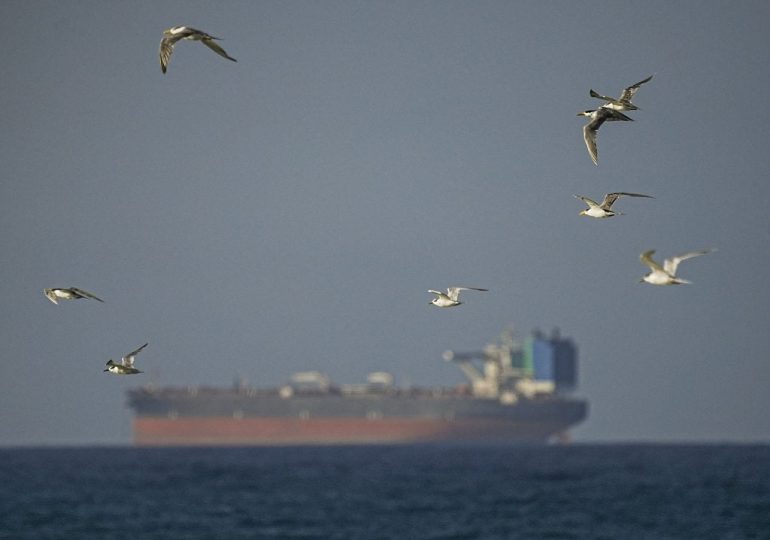
A view of the vessels heading towards the Strait of Hormuz following the two-week temporary ceasefire reached between the U.S. and Iran on the condition that the strait be reopened, seen in Oman on April 8. —Shady Alassar/Anadolu—Getty Images
It’s been hard following the minute-by-minute, day-by-day developments in energy markets triggered by the Iran war—let alone distilling the signal from all the noise. Oil takes big swings up and down on the basis of President Trump’s latest Truth Social post. Today’s announcement from Iran that the Strait of Hormuz is open to commercial traffic boosted the stock market and sent oil prices tumbling. Still, the direction further out remains murky.
But the answer may be right in front of us: long-term structural volatility. The world has woken up to a new baseline of instability in the Middle East that won’t go away so long as the current regime in Iran remains and the country can control or simply block the Strait of Hormuz. And that instability is bound to create price volatility.
Bob McNally, the energy analyst who founded the Rapidan Energy Group, describes the closing of the Strait of Hormuz as the loss of a key foundation of modern energy markets. Without the Strait being reliably open, the whole system creaks and is bound to swing dramatically up and down. “A load-bearing assumption in energy until February 28, or a few days into the fighting, was the United States will never allow anyone to restrict commercial flow through the Strait of Hormuz,” he told me. “This is without precedent.”
Sign up to Future Proof here
McNally, who wrote the book Crude Volatility, argues that throughout history oil markets have depended on a stabilizer to keep price fluctuations from getting out of hand. Between the 1930s and 1960s, the Texas Railroad Commission, which regulates the state’s oil industry, effectively set oil prices globally by creating production limits. More recently, OPEC took on that role as its 12 members worked together to set production limits in their own countries—thereby controlling the price. This war has reminded us of what ensues without the stabilizer.
Closing the Strait of Hormuz limits the ability of OPEC’s most important member states, like Saudi Arabia and the United Arab Emirates, to get their product to market. And it limits OPEC’s ability to stabilize prices. In short, we all need to prepare for persistent price volatility baked into the structure of the energy system, likely for years to come, even as the Strait of Hormuz reopens. Iran has shown that it can close the strait. The mere possibility of a closure is enough to generate volatility.
So, what does the future of energy look like if volatility is part of the equation? Many people, myself included, have spent much of the last month considering where energy prices may go and how that pricing will flow through to other fuels and power sources. But even without the guarantee of a persistently high price, volatility on its own has a way of shaping markets. It’s long been understood that oil price volatility slows capital spending broadly and at individual firms. Ben Bernanke, chairman of the Federal Reserve from 2006 to 2014, made the case in a seminal 1983 paper: firms postpone irreversible investment decisions when uncertainty rises. The act of waiting has value. A 2019 study looking across 54 countries confirmed the effect at the company level.
Of course, the context was different in previous periods of volatility. Hydrocarbon alternatives were limited and speculative until advances over the past decade. Today, the prospect of dramatic oil and gas price fluctuations may be enough to convince investors that there is a market for clean energy free of those swings. In my conversations in the last two weeks, I heard just that. Investors still don’t know exactly what’s to come, but they feel assured that alternative fuels and power sources have a path to market.
And yet the public markets don’t really reflect that. Stocks have brushed aside the prospect that turmoil in the region will persist much longer, counting on Trump to back off the hostilities.
The ceasefire will need not just to hold but to turn into a durable solution. Otherwise the wakeup call is coming soon. Cooking fuel is already inaccessible in parts of Asia. Jet fuel is running low in Europe. Fuel prices are higher globally. Even though the U.S. has been somewhat insulated, the country will begin to send more hydrocarbon products to other markets, leaving costs to rise at home. At the spring meetings of the International Monetary Fund (IMF) and World Bank in Washington this week, the IMF warned of slowing growth and that “downside risks dominate” the economic outlook. “We’ve been sort of in la la land,” says McNally. “Well, la la land ends this month.”
To get this story in your inbox, sign up to TIME’s Future Proof newsletter here.
Leave a comment