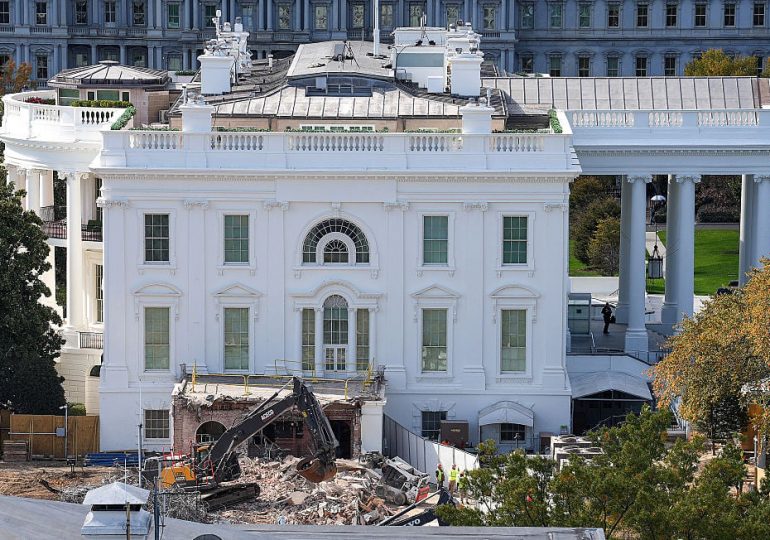
An excavator works to clear rubble after the East Wing of the White House was demolished in Washington, D.C., on Oct. 23, 2025. The demolition is part of President Donald Trump’s plan to build a multimillion-dollar ballroom on the eastern side of the White House. —Eric Lee—Getty Images
As the court battle over President Donald Trump’s White House ballroom drags on, his planned reconstruction of an underground military complex is being pulled into the spotlight.
In the fall, the Trump Administration began demolishing the East Wing of the White House to make way for the President’s $400 million ballroom. The move prompted the National Trust for Historic Preservation to file a lawsuit against Trump and members of his Administration, in which the group argued that the construction was unlawful. Months of litigation ensued. Then, on March 31, a judge sided with the preservation group, ordering that “the ballroom construction project must stop until Congress authorizes its completion.” He left open, though, the possibility that some construction could continue if it was “necessary to ensure the safety and security of the White House.”
In response, the Trump Administration is arguing that the project is an important national security upgrade, pointing to a “massive” military complex it wants to build underneath the ballroom.
On Thursday, the judge ruled that the Administration has to stop all aboveground work on the construction project until it receives Congressional approval. But his order permits the White House to continue construction underground, including on the military complex.
Trump’s planned military complex would replace the Presidential Emergency Operations Center (PEOC)—a secure underground bunker dating back to World War II that has long been an open secret in Washington, though details about it have largely remained a mystery to the public.
Here’s what we know about its history, and what Trump is planning to construct.
What is the Presidential Emergency Operations Center?
The federal government built the PEOC, a bomb shelter underneath the now-torn down East Wing of the White House, during World War II. The facility was intended to provide security for top White House officials: If there were an attack, they would be hustled into the bunker for their protection.
The White House Historical Association wrote in a 2024 social media post that “this secret space featured thick concrete walls and steel-sheathed ceilings with a small presidential bedroom and bath inside. Nearby rooms provided ventilation masks, food storage, and communications equipment.”
“The space is far more modern today,” the organization added, noting that “it can become a command center for the president as needed.”
The bunker has been used since its construction decades ago. Amid the fear and uncertainty of the Sept. 11, 2001, terrorist attacks on the World Trade Center and the Pentagon, several officials were escorted to the bunker, including then-Vice President Dick Cheney (then-President George W. Bush was in Florida, but was taken to the bunker later that evening).
The First Lady at the time, Laura Bush, wrote about how she was brought to the facility that day in her memoir.
“I was hustled inside and downstairs through a pair of big steel doors that closed behind me with a loud hiss, forming an airtight seal,” she wrote.
“I was now in one of the unfinished subterranean hallways underneath the White House, heading for the PEOC,” she continued. “We walked along old tile floors with pipes hanging from the ceiling and all kinds of mechanical equipment. The PEOC is designed to be a command center during emergencies, with televisions, phones, and communications facilities.”
Years later, Trump was also briefly taken to the bunker during protests at the White House in May 2020 following the murder of George Floyd by a Minneapolis police officer. He later confirmed to Fox News that he “went down during the day and I was there for a tiny little short period of time,” but claimed that “it was much more for an inspection.”
How does Trump want to rebuild the facility?
Trump and his Administration have shared a little information about his plans for the bunker in recent weeks.
“The military’s building a massive complex under the ballroom, and that’s under construction and we’re doing very well,” he told reporters on Air Force One on March 29. “The ballroom essentially becomes a shed for what’s being built under the military, including from drones and including from any other thing.”
He said the ballroom would have “high grade bulletproof glass.”
A few days later, he told reporters that the judge’s March 31 ruling permits construction to continue if necessary for the “safety and security of the White House,” arguing that his project fell under that category.
“We are allowed to continue building as necessary to cover the safety and security of the White House and its grounds,” Trump said. “Well, that’s what we’re doing, because everything’s bulletproof glass, etc. etc., including the ballroom.”
“We have bio defense all over,” he continued. “We have secure telecommunications and communications all over. We have bomb shelters that we’re building. We have a hospital and very major medical facilities that we’re building. We have all of these things, so that’s called: I’m allowed to continue building as necessary.”
In one document filed in the case earlier this month, the Administration’s attorneys described some of the plans for the construction project, including “protective missile resistant steel columns, beams, drone proof roofing materials, and bullet, ballistic, and blast proof glass,” which they said “are largely made, being used, and/or on their way to the project.”
“Likewise, the bomb shelters, hospital and medical area, protective partitioning, and Top Secret Military installations, structures, and equipment, are built and/or ready to be built, installed, and placed,” they continued.
Little else is known about the new bunker being constructed, and other members of the Trump Administration have been tight-lipped about the project. In court filings obtained by news outlets, the Secret Service said completing the project was critical but shared few details about the construction. Secret Service Deputy Director Matthew Quinn said in a filing that the agency had hired a contractor, but that construction underneath the ballroom was not yet done, adding that pausing construction would “consequently hamper the Secret Service’s ability to meet its statutory obligations and protective mission.”
Quinn offered to share more information about the project with the judge in private, including on “law enforcement sensitive and/or classified information.”
The White House director of management and administration, Joshua Fisher, said at a National Capital Planning Commission meeting at the start of the year that “There are some things regarding this project that are, frankly, of top-secret nature that we are currently working on.”
When a reporter on March 30 asked White House Press Secretary Karoline Leavitt if she could share more information about the bunker, she replied, “I cannot tell you more about that actually.”
“The military is making some upgrades to their facilities here at the White House, and I’m not privy to provide any more details on that,” she said.
Leave a comment