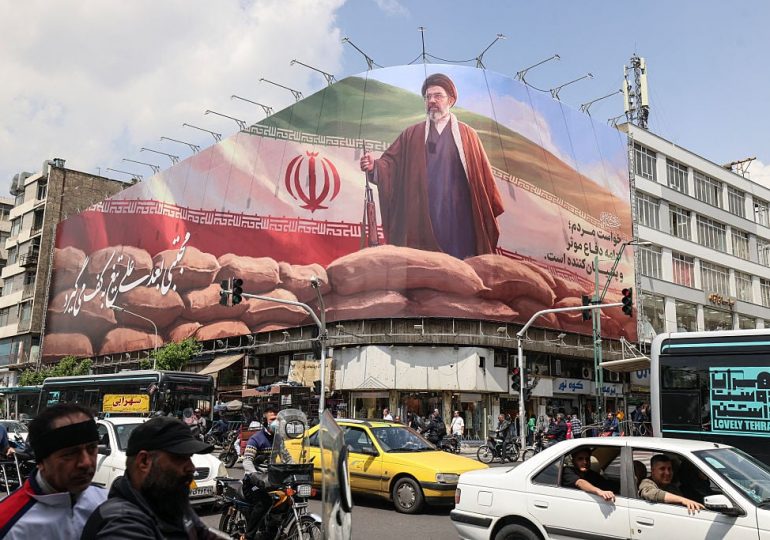
Commuters drive past a large billboard depicting Iran’s Supreme Leader Ayatollah Mojtaba Khamenei on a street in Tehran on April 20, 2026. —ATTA KENARE–AFP via Getty Images
On Apr. 17, when Iran’s Foreign Minister Abbas Araghchi announced that the Strait of Hormuz would be reopened to commercial shipping, the backlash within Iran was immediate. Hardline commentators in Iran, semi-official news outlets, and voices on state television questioned the timing and the language of his statement. On Saturday, Iranian armed forces declared that the Strait was closed again because the United States continued its naval blockade of Iran.
The sequence of events was quickly interpreted in sections of the American press as evidence of a rift between Iran’s political leadership and its military hardliners associated with the Islamic Revolutionary Guard Corps (IRGC). The argument: that those willing to compromise may no longer command the support of the forces that now hold real power in Iran. That reading oversimplifies a complex reality by incorrectly assuming that a distinction exists between political and military decision-making in the Islamic Republic.
The war has not pushed Iran toward a dual structure in which civilians speak one language and the security establishment speaks another. After the war, power in Iran has become more concentrated within a military-security core, and the space for visible flexibility has narrowed. What the recent controversy revealed was a system under pressure from two directions at once: President Donald Trump’s coercive diplomacy from the outside, and a domestic ideological support base that frames any signal of flexibility as weakness or capitulation.
Where power lies
The more relevant question is: Who is making the decisions in Iran today? Since the start of the war, the trajectory of power in Iran has been toward further consolidation. Authority over questions of war, diplomacy, and escalation has increasingly shifted to a relatively cohesive military‑security core, which includes a network of actors spanning the IRGC, the Supreme National Security Council (SNSC), and political figures whose influence rests on deep ties to the security establishment.
Iran’s civilian institutions have not disappeared or become irrelevant. The presidency, the foreign ministry, and other parts of the Iranian state remain active, but their roles have been redefined. They no longer function as independent centers of strategic direction but instead implement decisions shaped elsewhere. This should help explain why the notion that a senior diplomat could signal a major policy shift without prior authorization is misleading. Figures such as Araghchi operate inside a system where diplomacy is not separate from military strategy but embedded in it. The same structure that manages escalation also calibrates de-escalation.
The SNSC has long functioned as a key decision‑shaping body, but it too is now more heavily weighted toward military figures than civilian ones. Mohammad Bagher Zolghadr, the current secretary of the top national security body, is a senior IRGC commander. Ahmad Vahidi, who serves as the acting chief commander of the Revolutionary Guards, is another key person in the system.
The rise of Mohammad Bagher Ghalibaf, a former Revolutionary Guards commander and the speaker of the Iranian parliament, has to be understood in this context. His significance lies less in his formal parliamentary position and more in his emergence as the most visible political face of the security core that has emerged in Tehran since the war. Ghalibaf does not stand apart from the security core or control it. He operates within a network defined by shared institutional backgrounds and military experience. The result is not a fragmented field of competing centers but a relatively cohesive structure in which differences tend to revolve around tactics and presentation rather than strategic direction.
There is also the question of the Supreme Leader and his role. Under Ayatollah Ali Khamenei, the system was structured around a figure who stood above both formal and informal civilian and military institutions and retained the final say on almost all strategic matters. In a departure from the practice of Ayatollah Ruhollah Khomeini and Ayatollah Khamenei—supreme leaders who towered over the system—Iran’s security structure and decision-making processes have functioned differently since Mojtaba Khamenei was chosen as Supreme Leader following his father’s assassination at the beginning of the war.
Khamenei Jr., as Supreme Leader, is not quite supreme. He operates as one voice within a broader consensus-building process among security elites—a position that reflects both the transitional nature of the current moment and the evolving balance of authority within the Islamic Republic.
Pragmatists and ideologues in Tehran
The most consequential divide in Iran today is not between civilian institutions and the military, but within the hardline camp that underpins the country’s security establishment. On one side stand security‑oriented elites like Ghalibaf, who approach the war through a pragmatic lens. For them, diplomacy is not a concession but an instrument—one to be deployed alongside military pressure, not instead of it.
On the other side runs a more ideological current, most clearly associated with figures and networks linked to the ultra‑hardline Stability Front, known in Persian as Jebhe-ye Paydari. This camp is far less flexible. It is deeply skeptical of negotiations and more inclined to read any visible adjustment, especially one made under pressure, as capitulation. That distinction helps explain the backlash to Araghchi’s statement. The criticism that surfaced in semi‑official outlets and on state television was not framed as a rejection of diplomacy in the abstract. It targeted the way the reopening of the Strait of Hormuz was presented, and what that framing appeared to concede symbolically at a moment of acute pressure. In a system where signaling is tightly tied to perceptions of strength, even calibrated flexibility can be recast as weakness.
The same divide also clarifies why dissent surfaces most visibly in certain institutions. State broadcasting in Iran—often described by outside observers as simply “official media”—is in practice controlled by figures aligned with the Stability Front, who were appointed by Ali Khamenei, and functions as a dedicated platform for that ideological current. A similar dynamic plays out in parliament, where the same camp holds a commanding majority and uses it to challenge the tone and direction of policy whenever an opening presents itself.
These actors are not the core decision‑makers on questions of war and peace. But they are deeply entrenched and capable of shaping the political environment in which decisions are presented and justified. The result is a recognizable pattern: tactical disagreements get amplified in public, creating the appearance of fracture even when the underlying strategic direction remains broadly, if quietly, aligned.
A system in transition
The Hormuz episode revealed the inner workings of a system in transition—one in which an emerging security–centered order now coexists uneasily with remnants of the older hybrid arrangement, part ideological, part coercive, that took shape over decades under Ali Khamenei. That older system always had a strong security component, but its internal balance has shifted. Since the war began, the security elite has moved closer to the center of decision‑making, while the ideological camp has grown less decisive at the core yet remains highly capable of exerting pressure. That pressure carries weight because the war did not simply militarize the state. It also politicized the regime’s support base in ways the leadership did not fully anticipate.
During the war, the Islamic Republic worked hard to bring its supporters into the streets. The strategy served to project resilience outward and signal internal cohesion at a time when the leadership feared that sustained external attacks could open space for unrest at home. In the short term, it helped the system hold. But it also created a new constraint. Those who reliably mobilized were not evenly distributed across the conservative spectrum. They tended to come disproportionately from the more ideological hardline camp—the constituency most suspicious of compromise and most likely to interpret flexibility as surrender.
That dynamic narrowed Iran’s room for maneuver over Hormuz, and external factors compounded the problem. Trump’s style of coercive diplomacy made any Iranian flexibility harder to sustain politically, because it turned even limited movement into proof, in his telling, that pressure was working. Every public declaration of American success, every suggestion that Iran could be pushed further—on sanctions, naval restrictions, or enriched uranium—raised the domestic cost for Tehran of appearing accommodating without a tangible reciprocal gesture in return. In that sense, the reversal over Hormuz was less a sign of institutional disarray than of mounting constraint.
Iran is not fractured along a civilian-military fault line. What it is navigating is a post‑Khamenei transition in which the old order resists displacement, the new one is not yet fully consolidated, and the Supreme Leader appears to function less as an undisputed final arbiter than as a participant in a broader security‑led consensus. That may change if Mojtaba Khamenei eventually consolidates his authority. For now, the system is operating less as a hierarchy organized around a single dominant figure and more as a hardline coalition trying to manage war, diplomacy, and internal competition simultaneously.
Leave a comment