
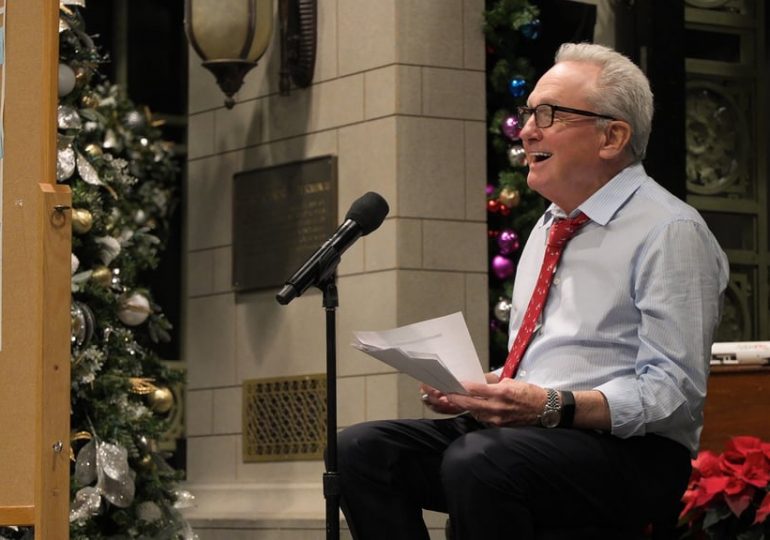
Lorne Michaels —Courtesy of Focus Features
A good documentary filmmaker can make you care about a subject you thought you were done with. Given the public’s fixation on Saturday Night Live in 2025, the show’s 50th year—marked by all manner of celebratory folderol, including a big anniversary show and a series of SNL50 mini-docs—most of us have been SNL’ed into exhaustion. Add to that Susan Morrison’s biography of the show’s creator and stalwart protector Lorne Michaels, Lorne: The Man Who Invented Saturday Night Live, also released in 2025. And don’t forget the 2024 film Saturday Night, a fictionalized retelling of how Michaels brought the show into being. How much Lorne is too much Lorne?
It turns out there’s still room for a little more. At the beginning of his sprightly, entertaining documentary, titled—what else?—Lorne, director Morgan Neville concedes that he’s not likely to get much information directly from his subject. Michaels is notoriously elusive when it comes to speaking with the press, and not even those who work closely with him feel they know him well. Yet by not saying a lot, Michaels somehow reveals plenty, and Neville interviews a broad enough range of his cohorts and colleagues—including current and former cast members like Colin Jost and Maya Rudolph, writers like Conan O’Brien and Paula Pell, and close friends like Paul Simon—to fill in the gaps. By the end of Lorne, Neville makes us feel we know just enough. Any more would be overkill.
The man originally named Lorne Lipowitz was not, as Simon mischievously stated in a totally made-up article he once wrote for Vanity Fair about his friend, born on a kibbutz in Mandatory Palestine. Disappointingly, Michaels merely came from Toronto. He moved to Los Angeles in 1968, where he wrote jokes for Laugh In, returning to Canada a few years later to create a CBC comedy show with his writing partner Hart Pomerantz. He eventually found himself in New York, where he conceived the idea of a weekly live sketch-comedy show unlike anything else then on television. Somehow, he made it happen, and—with the exception of a five-year stretch, from 1980 to 1985, during which he tried to leave the show behind—continued to pull it off week after week, shepherding each episode through a stressful six-day stretch that would begin with little more than a handful of half-baked ideas and culminate in a live high-wire act. SNL has survived against all odds, through great seasons and terrible ones.
Lorne glosses over the low points, mostly spotlighting the hits. Michaels recounts the story of the marvelously absurd “bee hospital” sketch included in the first show, in which cast members—then including John Belushi and Gilda Radner—dressed in bee outfits greet their tiny bee offspring in a bee maternity ward. NBC executives later provided feedback, telling Michaels the sketch clearly hadn’t worked. His solution? More bees. By the third episode, the bees made so much sense to the audience, in their own Dada way, that they became an early signature of the show.
Lorne Michaels
That right there is a bit of strategic comic genius that not every showrunner would have come up with, and it’s key to both Michaels’ survival and that of Saturday Night Live. He explains to Neville why he returned to the show in the mid-1980s, after thinking he’d left it behind forever: “I was built for it,” he says simply, which either makes him a genius or a glutton for punishment, or maybe both. Former cast member Seth Myers explains that when you’re building a live show from the ground up, week after week, “you want a fair amount of structure in the rest of your life.” Maybe that’s why Michaels doesn’t talk a lot about his family (though several of the doc’s talking heads remark on how incredibly well-adjusted his kids are). He knows what’s worth protecting, and that includes both the show he created and his personal life. Late in the documentary, Neville’s camera follows him around his property somewhere in Maine, where he retreats whenever he can, to look out on a little pond or gaze upon the daffodils. But we’ve also seen him intently watching one of the show’s dress rehearsals—a rundown of that week’s material that happens just hours before the show goes live—and then sternly lecturing the writers and cast about all the moments that didn’t work. He can’t be the easiest guy to work for: Lorne includes a series of interstitial cartoons in which Michaels’ voice is re-created, with comic exaggeration, by onetime SNL associate Robert Smigel. They amount to a kind of roasting, which Michaels probably deserves. He has, after all, fired his share of cast members—you don’t build an empire by being nice.
Mostly, though, the people who have worked for him over the years remain loyal and appreciative. If he’s sometimes been tough on them, he has also launched careers. He has also, of course, gotten very rich himself off Saturday Night Live, as well as the movies he’s produced, like Mean Girls and Wayne’s World. But you can’t begrudge him. At one point in Lorne, he mentions a random thought that occurred to him when he was a kid: “If I went to prison, I’d get to read a lot.” He was kind of wrong—prison isn’t fun—but also right, just as he was right about those performers dressed in bee costumes. If Lorne is nothing else, it’s a portrait of a guy who knows when to zig and when to zag. His moves may sometimes seem counterintuitive—but then, that’s how a television show, risky from the get-go, survives for 50 years and counting, through unwatchable seasons and great ones. The executives who expressed dismay over a silly but brilliant bee sketch are long gone. But Michaels endures, not only having the last laugh, but passing it along to us.
Leave a comment