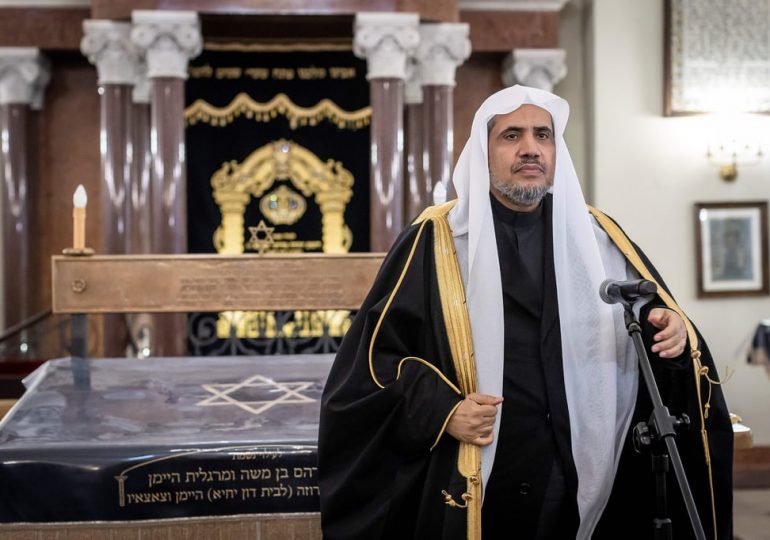
Secretary General of the Muslim World League Mohammad Abdulkarim al-Issa gives a speech during a visit to the Nozyk Synagogue on January 24, 2020 in Warsaw, Poland. —Wojtek Radwanski—AFP / Getty Images
Muhammad bin Abdulkarim Al-Issa has spent more than a decade trying to prevent the kind of war that is now raging in the Middle East.
As Secretary General of the Muslim World League, a Saudi-based organization that aims to promote moderation and interfaith dialogue, he spent years dedicated to what he calls “preventive peace”—the idea that the time to bridge divides is before the fighting starts.
Read more: Trump Says He Does Not Want to Extend Cease-Fire With Iran
A former Minister of Justice in the Saudi cabinet, he was appointed to lead the Muslim World League in 2016 as part of then-Deputy Crown Prince Mohammed bin Salman’s push to position the kingdom as a champion of moderate Islam.
In 2020, he led the most senior Islamic delegation to ever visit the Auschwitz-Birkenau Nazi death camps.
TIME spoke to Dr. Al-Issa about how the Iran War began, the role of religious leaders in solving conflict, and what it will take to bring the fighting to an end.
This interview has been edited for clarity and length.
How did we get to a point of a regional war in the Gulf?
MA: We have reached this point because early warning signs were ignored and not addressed in time. Had United Nations mechanisms, backed by international support, intervened when they should have, the situation would never have escalated to this level.
Unfortunately, this is a common pattern: risks are often downplayed until the cost of resolving them becomes high. Ultimately, a diplomatic solution in the early stages is far more effective than trying to find one when time has already run out.
Furthermore, we are in this position because certain influential countries have prioritized their own political interests over the stability of the region and the world. Because of this, I believe that without a collective international resolve, managing risks in general will remain incredibly complex.
Can the relationship between Iran and Saudi Arabia, and Iran and the Gulf, be repaired when the war ends?
MA: If Iran improves its political conduct, it has the opportunity to repair its relations with the Kingdom and other nations. However, this shift is only possible if Iran engages with its neighbors and the wider world through the logic of political awareness, rather than the ideological lens that has led to the current situation. It is truly regrettable that the Iranian people are the ones bearing the cost of these policies.
In reality, there is no inherent conflict or clash between Sunni and Shi’ite moderation; the facts on the ground prove this.
I have high hopes that we’ll overcome this crisis and there is a solution for this issue that ends this conflict and things will go back to normal. We must use logic and wisdom as well, and tolerance, and we should not be arrogant and stubborn. No one is okay with the arms race that we see in the region, especially weapons of mass destruction. Nobody accepts that. The region cannot tolerate that.
And everyone must know that we should not use religion to find justifications and of course, lie in the name of faith and be abusive towards it. We are responsible for preserving the truth of the faith and the diversity in sects in all faiths. It’s not limited to Islam and Christianity and other faiths have it as well.
How do you think this conflict ends?
MA: This conflict will end through peaceful resolution, using logic and prioritizing the interests of the people.
The Iranian leadership must know the interests of the Iranian people and the future generations of Iran. It’s a responsibility that they shoulder. And everyone must know, Iran and others, that even if they emerge with a victory, it will come with a lot of hardship and tragedy.
But there must be a remedy for Iran and its nuclear program, and there should be no danger that is overlooked. Not at all.
Gulf countries were exposed to Iranian aggression and attacks and it’s a very dangerous situation. It’s completely barbaric. The Gulf countries are not involved in this war; despite that fact, they received thousands of missiles and drones, and any justification from the Iranians is false because they target civilian infrastructure and civilians.
Why did they target civilian neighborhoods? That means there are intentions which are not pure and that’s the problem and Iran must reconsider, and we hope that in the second round of negotiations, they reach a solution. Iran must know it’s one of the countries of this world, and it’s a member of the United Nations, and that in the interest of the Iranian people, it should be managed with political wisdom with logic and not with ideology.
Here in the U.S., we’re witnessing a clash between the religious and the political when it comes to matters of war, specifically the Iran war. Was the Pope right to speak out against the war?
MA: It is only natural for the Pope to advocate for peace over war. We, along with all those who cherish peace, stand against conflict in our world. True religious leaders are peacemakers, not advocates for war. However, while we join the Pope in calling to spare the region the horrors of war, we also call for more robust diplomatic dialogue and the triumph of wisdom and logic.
We cannot be lenient toward the threat of weapons of mass destruction to the region; we must rely on international mechanisms that are actually effective. When we say no weapons of mass destruction and no arms race in the region—and also no to exposing the region to the woes of war—the balance point between them is diplomacy.
We were encouraged by the return to diplomatic efforts in Islamabad, and as the second round begins, we remain hopeful for a resolution. This requires Iran to prioritize the well-being of its own people and protect the region from further escalation by immediately abandoning its nuclear program, which destabilizes the region and triggers a dangerous arms race. Simply put, we urge Iran to exercise political awareness rather than the ideological illusions it has used to threaten its neighbors and violate state sovereignty.
We constantly call on it to abandon its negative behavior toward its neighbors, especially its recent criminal attacks that targeted peaceful neighbors who are not even parties to the conflict. The targeting of civilian infrastructure completely exposes the falsehood of the Iranian narrative regarding these strikes.
Political and military leaders in the U.S. and Iran have cast the current conflict in religious terms. What are your thoughts about those people who invoke religion to justify war?
MA: The war in the region is not a religious war at all. Even the discourse that is put forward as a religious discourse, and though some understand that the war is religious, it is a discourse that does not represent faith. Not all extremists who put themselves forward as religious leaders are truly representative of the faith. They must understand this does not represent true faith.
Religion should only interfere in wars to bring about peace and not to justify wars. We must know this fact. If you ask all faiths, they will give you the same answer. The evildoers should not be let alone. We must rectify that, but through legal mechanisms and not through chaos.
If you could speak to them directly to the leaders of Iran and the U.S., what would you say?
MA: I’ll say to the Iranian leadership, the interest of the Iranian people should be above everything else, above the ideology, above any religious interpretation. That goes against the faith. And it even goes against the logic of Shi’ite facts, which we hear from our Shi’ite friends when they visit us and when we talk to them. And we say that you are at a transformative point, at a crossroads, and the chance is there to be decisive, but it needs wisdom for you to achieve it.
As for the United States of America, I say invest in diplomacy to end this war. And we tell everyone we are against the race to armament, especially weapons of mass destruction and there should be no nuclear weapons, and international law should be implemented in this regard.
You’ve been working in this field for a long time, building relationships between different faiths. Do you think things have gotten better during that time?
MA: They have improved tremendously. There are meetings between religious leaders. There is cooperation and solidarity. There is a tangible impact from all that. And the role of religious leaders is very important.
More than 80% of our world today identifies as having some religious affiliation. Of course, religions differ from one place to another, but 80% listen to religious discourse because they are people of faith, and the remaining 20% recognize the importance of the 80%.
That’s why it’s very important that religious leaders should have a big contribution in finding resolutions to the conflicts through practical initiatives. We have been working for the last 10 years on preventive peace.
Leave a comment