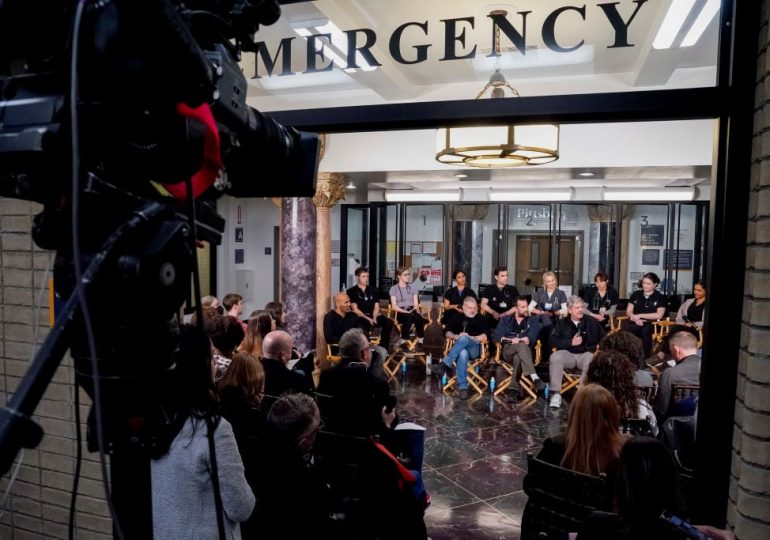
Stars of “The Pitt” on Jan. 30, 2025 in Burbank, Calif. —Evans Vestal Ward—WBTV via Getty Images
I spent 15 years working in the ER, and watching HBO’s The Pitt felt less like entertainment and more like reliving some of the hardest moments of my career.
I remember the day every computer in our ER went dark and the chaos that followed. The times violent patients attacked our staff. The day a gang member walked in with a machete. The colleague we found overdosed in the bathroom after diverting narcotics.
I’ve lost count of how many patients I’ve pronounced dead and how many sexual assault survivors I’ve cared for. Every seasoned ER doctor has.
The Emmy Award-winning series offers a striking portrayal of life in high-pressure workplaces: relentless pace, constant decisions, and the consequences of professionals pushed beyond healthy limits.
To say medical personnel are affected by this work is an understatement. Many carry moral injury, the psychological toll of being forced to act against their values within a broken system.
Read more: America’s Moral Injury Pandemic
And the healthcare system is a big source of that distress across the country.
It’s no surprise that burnout rates in emergency departments are high. One study of ER staff found that over 60% of emergency physicians, roughly 72% of ER nurses, and 75% of paramedics report burnout. Research points to three drivers: culture of wellness, workplace efficiency, and individual well-being.
In The Pitt, we see breakdowns in all three. Administrators push the team to move faster in unsafe conditions while boarding patients who have already been admitted. We also see a culture where superhuman endurance is expected and depletion is normalized.
These systemic issues are real and problematic. They deserve to be fixed.
But this isn’t just a story about a broken system. It’s about what happens to the people inside it and how they recover. Even if we fixed the healthcare system tomorrow, burnout wouldn’t disappear. High performers across every industry would still be left trying to recover without a clear path forward
Recovery requires giving people the skills to heal from sustained stress, not just endure it.
The Pitt reveals a deeper truth not just about medical professionals, but about high performers across every industry.
The skills high performers were never taught
Burnout is not a personal failure or weakness. It’s what happens when high performers adapt to prolonged stress in the only ways they know how. We harden, push through, and put up walls. We cope in ways that help us survive but harm us in the long run: disconnecting, overworking, or numbing with food or alcohol.
In The Pitt, Dr. Robby tells a resident to put up “a force field.” But force fields don’t heal anything. They add cost, trapping the very things that need to be processed.
In medicine, we’re taught how to deliver devastating news to patients and families, but never how to handle that tragedy in a way that doesn’t harm us. We train high performers across industries, how to perform under pressure. But we don’t teach them how to recover from it.
After navigating my own burnout, I became focused on a single question: How do we actually help high performers recover?
I’ve found that burnout recovery requires skills, not just rest or self-care slogans. Specifically, there are three skills that address the types of exhaustion burnout creates: self-stewardship, emotional processing, and a sense of purpose.
Self-stewardship
Self-stewardship means learning to proactively manage your energy and physiology. This is not about bubble baths or spa days. High performers routinely override their physiologic need for sleep, hydration, nutrition, movement, sunlight, and connection. We treat these as optional. They aren’t.
Sustainable success requires treating your energy as something to steward, not deplete.
Emotional processing
The second skill is emotional processing: the ability to feel and move through emotions in real time.
High performers are taught to be objective, efficient, and unemotional. But emotions don’t disappear when they are ignored. They build. So we often buffer our emotions through stress eating, scrolling, or smoking.
The solution here is a skill I call emotional bounce. It starts with noticing and naming what you’re feeling—what psychologists call affect labeling. From there, you choose: Do I want to stay in this feeling, or move through it?
When I’m washing my hands, I take 60 seconds to notice and name my emotions. It’s a small habit, but it changes everything. Emotions aren’t meant to be avoided; they’re meant to be processed.
Thinking on purpose
The third skill is thinking on purpose: becoming aware of and reshaping the thoughts that drive stress and self-criticism.
High performers are hardest on themselves. I should be able to handle this. I should be better. In medicine, that often means believing we should be able to save everyone.
But you can do everything right and still lose a patient. That’s not a failure; it’s a medical reality. Learning to question automatic thoughts and replace them with more accurate, compassionate ones isn’t soft. It’s essential.
For too long, high performers have treated burnout as a badge of honor, or the price of success. The Pitt shows us exactly where that leads.
Burnout recovery isn’t about stepping away from ambition. It’s about building the internal capacity to sustain it, and ensuring our most experienced professionals can continue to mentor and lead the next generation.
The goal was never just to survive. It was always to thrive.
Leave a comment