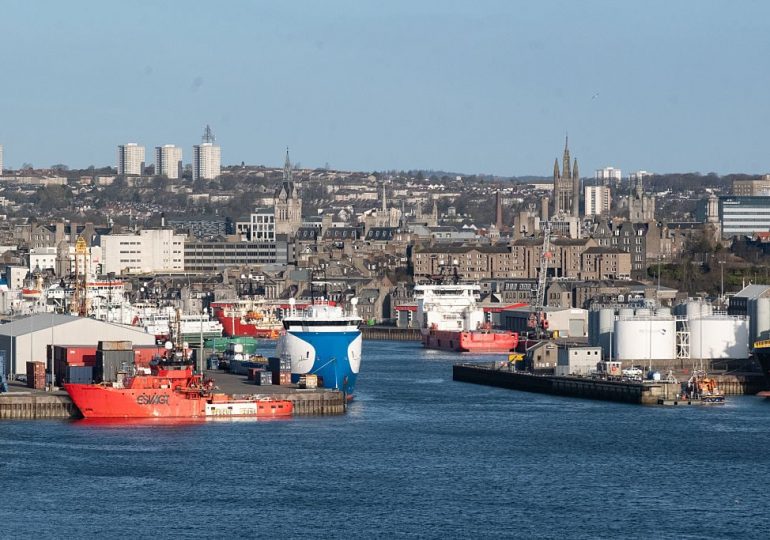
The U.K.’s Conservative Party is campaigning to “Get Britain Drilling in the North Sea,” claiming that increasing the country’s oil and gas production could generate billions of pounds in tax revenue to offset rising energy costs for consumers. —Paul Reid—Getty Images
President Donald Trump is urging the U.K. to expand its drilling in the North Sea in the face of global energy shocks triggered by the war in Iran.
His comments come as the country’s Labour party is facing mounting pressure from opposition parties and trade groups to reverse a 2025 ban on oil and gas drilling in the North Sea to meet energy needs.
The crisis has sent energy bills in the country soaring—Brent crude, the global benchmark for oil, and European benchmark gas prices have both risen more than 30% since the strikes on Feb. 28. With no end in sight, one U.K. based energy consultancy has predicted that average annual household energy bills could go up by £332 ($449) by July—a further squeeze for households that were already being pinched by rising prices following Russia’s invasion of Ukraine.
Why is Trump criticizing U.K. energy policy?
In an April 14 post on Truth Social, President Trump said the U.K. should tap into the North Sea’s oil and gas reserves to help stabilize European energy resources in the wake of the shortages.
“Europe is desperate for Energy, and yet the United Kingdom refuses to open North Sea Oil, one of the greatest fields in the World. Tragic!!!” Trump wrote on Tuesday.
”U.K., which is better situated on the North Sea for purposes of energy than Norway, should, DRILL, BABY, DRILL!!! It is absolutely crazy that they don’t… AND, NO MORE WINDMILLS!”
The energy shock from the Iran war is expected to hit the U.K. the hardest compared to other rich economies, according to a recent forecast from the IMF. The European Union has also warned member states that the region could face prolonged energy shocks if the conflict continues.
What is the U.K.’s stance on drilling North Sea oil and gas?
Last year, the U.K. banned new licenses for oil and gas fields in the North Sea as part of its commitment to reach its net-zero emissions targets. Oil and gas currently meets 75% of the country’s energy needs. The government has been facing mounting pressure to reverse the ban following the breakout of the war in Iran.
The Conservative Party and Reform U.K., a right-leaning party, have both called for increased domestic production, arguing it would bolster energy security, support jobs, and lower bills.
But even if the U.K. were to ramp up production now, the impact wouldn’t be felt for some time. Between 2010 and 2024, the government approved hundreds of new North Sea oil and gas licenses in seven licensing rounds, which to date have only produced the equivalent of 36 days of extra gas, according to research by the energy consultancy Voar and the campaign group Uplift.
“If you drill today, you’re not going to see the oil in a very long time, because it takes several years to explore, find the oil, start a new oil field, and produce,” says Daniela Schmidt, professor of earth science at the University of Bristol.
Who owns most of the North Sea oil?
The U.K. is the second-largest driller in the North Sea behind Norway. But while Norway has a majority state-owned energy company, the U.K. licenses out new oil and gas projects to private companies.
“[The oil] isn’t owned in most cases—and that includes the U.S. and the U.K.—by the people. So it will not reduce oil prices, because it is to the benefit of the big producers, Exxon, Shell, BP, they will have more oil, and they will make more money,” says Schmidt. The price of gas is also set on international markets in the U.K., another reason why more drilling wouldn’t necessarily lower prices.
How much oil is still left in the North Sea?
The North Sea is considered a “mature basin,” which means that much of the resources it contains have been extracted.
For both oil and gas, it’s estimated that 93% of the anticipated total amount of oil and gas that could be extracted up until 2050 has already been removed, according to research from the Energy & Climate Intelligence Unit, a U.K. based non-profit climate research group.
While Norway has only used up 57% of the “expected recoverable resource” from the part of the North Sea it has sovereignty over, the U.K. has already used up the large majority of its North Sea resources.
“The production has peaked,” says Schmidt.
What is the climate impact of North Sea oil?
Offshore drilling can have destructive impacts on oceans and coastal communities, generating pollution and harming wildlife. Oil spills and gas leaks can also radically transform ecosystems.
Not to mention that the burning of fossil fuels is the biggest driver of global warming—the most important reason nations should be cutting down on drilling rather than expanding, says Schmidt. “If we continue to drill, this warming will accelerate, and therefore the impacts, the losses and damages, the death we see in the summers already, the impacts on ecosystems, will be even more accelerated.”
Leave a comment