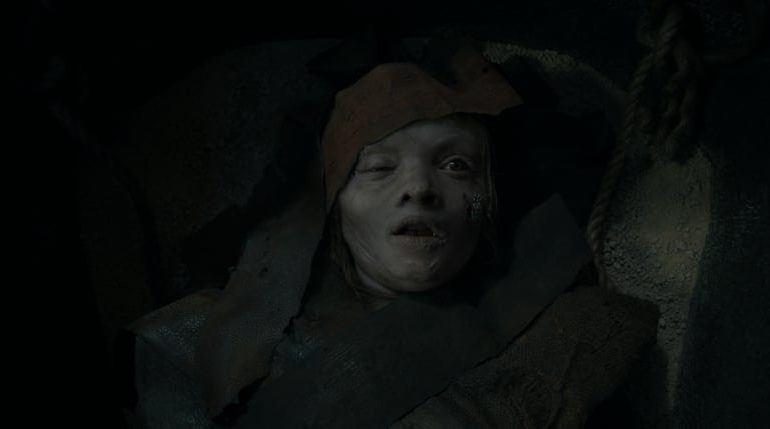
Natalie Grace as Katie in Lee Cronin’s The Mummy —Warner Bros. Pictures
Warning: This post contains spoilers for Lee Cronin’s The Mummy, now in theaters.
“BRENDAN FRASER IS NOT IN LEE CRONIN’S THE MUMMY”
With just two weeks to go until the April 17 release of Lee Cronin’s The Mummy, the official Blumhouse X account started tweeting this message every day for nearly a week. The all-caps missive was clearly intended to clear up any remaining speculation that the star of Stephen Sommers’ beloved 1999 take on The Mummy would make an appearance in Cronin’s forthcoming gorefest.
Although the tweet-spree may have seemed like an over-reaction to the online confusion surrounding Cronin’s Mummy, the filmmaker’s reimagining of the title tilts far more toward a gleefully sadistic body-horror flick than it does family-friendly cult classic—given that, it was probably a point that was necessary to hammer home. Cronin’s Mummy, which arrives on the heels of his success writing and directing 2023’s Evil Dead Rise, the highest-grossing Evil Dead entry to date, takes the Universal franchise in a completely different direction than its predecessors. In Cronin’s update, the Mummy story has nothing to do with cursed Ancient Egyptian high priest Imhotep rising from the dead to wreak eternal terror. Instead, it deals in the far crueler and more sordid realm of child abduction, torture, and possession.
(L-R): Jack Reynor as Charlie and Natalie Grace as Katie in Lee Cronin’s The Mummy —Warner Bros. Pictures
What happens in Lee Cronin’s The Mummy?
The movie opens with 8-year-old Katie Cannon (played by Emily Mitchell as a child and Natalie Grace as a teen) being kidnapped from the back garden of the Cairo apartment she shares with her father Charlie (Jack Reynor), pregnant mother Larissa (Laia Costa), and older brother Sebastián (played by Dean Allen Williams as a child and Shylo Molina as a teen). Despite her parents’ desperation and search efforts by the local police department, no one is able to locate Katie. Eight years later, the bereaved Cannon family has returned to America and is living in the Albuquerque home of Larissa’s mother Carmen (Veronica Falcón), now joined by 8-year-old Maud (Billie Roy), the child Larissa was carrying at the time of Katie’s abduction. When Charlie receives a call alerting the family that Katie has been found after being exhumed from a 3,000-year-old sarcophagus, he and Larissa rush to Egypt to retrieve her—only to find a seemingly-mummified and near-catatonic version of their daughter waiting for them.
“There’s a chance to play around with lore in a different way,” Cronin told IndieWire of reinventing the iconic movie monster. “Also a mummy being somewhat of a blank canvas that you can then put horrific traits into because it’s not Dracula. It’s its own thing. It is kind of like a blank space.”
May Calamawy as Detective Dalia Zaki in Lee Cronin’s The Mummy —Warner Bros. Pictures
The reason for Katie’s demonic behavior
Back in Albuquerque, Katie’s newfound penchant for seemingly random outbursts of violence quickly spirals into all-out demonic behavior. This makes sense once Dalia (May Calamawy), the Cairo detective still working the case, at long last pieces together the truth about what happened to Katie: she was taken by a woman referred to only as the Magician (Hayat Kamille) who cast a spell to turn Katie into a vessel capable of containing an ancient evil known as the Nasmaranian. But knowing a demon is responsible for Katie’s actions doesn’t make her gruesome self-mutiliation any easier to stomach. Especially once she’s entranced both her siblings into doing the same thing.
Lee Cronin’s The Mummy has an increasingly mean-spirited edge to it as it goes on, culminating in a visceral, Evil Dead-style final showdown hinging on an emotional sacrifice that feels a bit too sappy to cap off such a relentlessly vicious spectacle. On the other hand, while we won’t fully spoil the ending, this twist allows for the film to close on a more satisfying note of karmic justice where the cycle of horror is passed on rather than simply ended. Talk about an inescapable curse.
Leave a comment