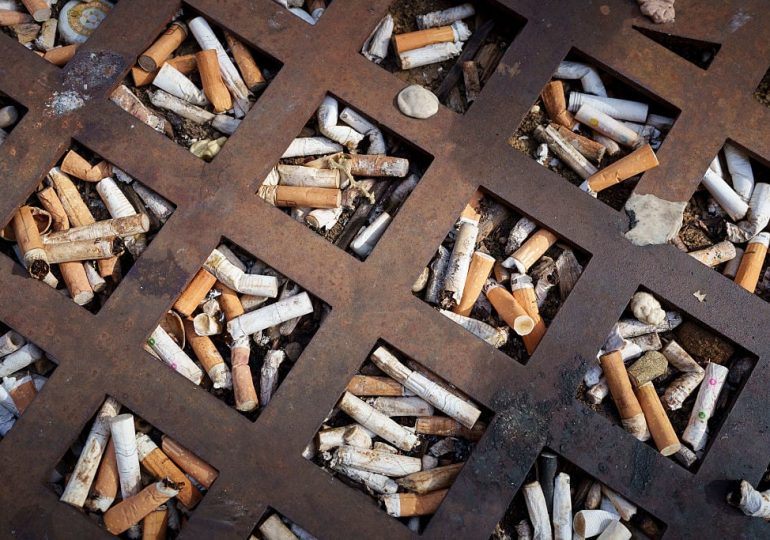
Many cigarette butts have been stubbed out in some street furniture in London, England, on Sept. 24, 2025. —Richard Baker—In Picturtes/Getty Images
This may be the last year in the U.K. that an 18-year-old can, on their birthday, buy a pack of cigarettes. For anyone whose 18th birthday comes in 2027 or later, the government is set to pass a law banning them from ever buying tobacco products in an effort to create a “smoke-free” generation.
Both the Houses of Commons and Lords in the U.K. Parliament earlier this week signed off on final amendments to the Tobacco and Vapes Bill, which aims to prevent anyone born in 2009 or younger from starting smoking by making it illegal to sell them tobacco.
The landmark legislation, which has been in the works since 2024, now awaits King Charles III’s royal assent, though it’s expected to be just a formality, and he has previously expressed approval for the move.
Wes Streeting, the U.K. Secretary of State for Health and Social Care, called the Parliament’s wrap-up a “historic moment,” adding that the legislation will “save lives, ease pressure on the NHS [National Health Service], and build a healthier Britain.” Baroness Gillian Merron, an undersecretary of the same department, told legislators in the House of Lords on Monday that the bill “will be the biggest public health intervention in a generation.”
Here’s what to know.
What does the legislation say?
The law, which would make it an offense to sell tobacco, herbal smoking products, or cigarette paper to someone born in or after 2009, will apply in the United Kingdom’s four constituent countries: England, Scotland, Wales, and Northern Ireland.
The bill expands existing laws on smoke-free premises to make them vape-free. Vaping in cars with passengers under 18 would be prohibited, as well as in playgrounds, outside schools, and at hospitals. Outside hospitals, however, vaping would still be allowed to support those trying to quit.
The bill will also empower ministers to regulate the flavors, packaging, and display of vapes and nicotine products. Advertising for smoking and vaping products will also be broadly banned. Managing or controlling vending machines with vapes or nicotine products is also an offense, unless in mental health hospitals mainly for inpatients. The U.K. already only permits persons aged 18 and up to buy vapes.
As part of increased oversight, the bill also provides powers to introduce a licensing scheme for the retail sale of tobacco and herbal smoking products, vapes, and nicotine products in England, Wales, and Northern Ireland.
Violators in England and Wales could face fixed penalty notices, where payment of the fine within a specific time means they could avoid court. The fine is £200 (about $270) for minor infractions, and could go up to £2,500 (about $3,300) for offenses in connection with retail licenses.
According to a policy document published in 2024 about the bill, the age of sale restrictions for tobacco will come into force in January 2027, while other measures introduced through regulations will have separate enforcement dates.
Why is the U.K. implementing such a law?
More than 5 million people aged 18 and up smoke in the U.K., latest statistics show, with the largest proportion coming from the 25- to 34-year-old age group.
Smoking is a leading cause of preventable illness and death in the U.K., according to the NHS, which reported that in 2019, more than 74,000 deaths in England were attributed to smoking among adults aged 35 and up. According to the House of Commons Library, there were more than 400,000 hospital admissions due to smoking between 2022 and 2023.
Smoking also impacts the U.K. economy negatively, according to Action on Smoking and Health, an advocacy group established by the Royal College of Physicians. Lost economic productivity and associated health and social care costs in England because of smoking add up to £43.7 billion (about $59 billion) and rise to £78.3 billion (about $100 billion) when factoring in the cost of smoking-related early deaths.
How have U.K. residents reacted?
An August 2024 YouGov survey found that 61% of U.K. adult respondents approved of phasing out smoking by banning it for those born in 2009 or after. In another YouGov survey for ASH conducted between February and March 2025, 68% of respondents backed a “smoke-free generation” proposal.
Forest, a smoker rights group, meanwhile, found in a survey conducted between August and September 2025 that 35% of its 2,000 respondents would support a generational ban.
Pushback has come from conservatives and from other members of the tobacco industry. Nigel Farage, the leader of the far-right party Reform UK and a smoker himself, has said that if Reform ever comes into power, the law would be scrapped.
“How is the ban meant to work?” Farage wrote in the Telegraph in March. “Ten years from now, a 27-year-old will not be legally able to buy cigarettes, but a 28-year-old will be able to. A decade later 37-year-olds will not be deemed old enough to smoke, but 38-year-olds will be free to do so. And so forth.”
Some retailers have also raised economic concerns about the legislation. The restrictions the bill would impose on their businesses could make one in 10 corner shop owners consider closing, according to a survey commissioned by retail group C-Talk and conducted by Merlin Strategies.
Do other places have similar generational bans?
The U.K. would be the second country worldwide to enforce a generational tobacco ban. The Maldives, an archipelagic nation of 500,000, became the first country to do so last year, banning anyone born on or after Jan. 1, 2007 from using, buying, or selling tobacco products.
New Zealand pioneered generational tobacco ban legislation when it passed a similar law in 2022, some provisions of which were set to take effect in 2024. But after a more conservative government came into power in 2023, that law was scrapped. Still, New Zealand inspired other nations, including the U.K. and Canada, the latter of which has reportedly also entertained the idea.In the U.S., similar generational tobacco ban bills have been filed in Hawaii and Massachusetts.
Leave a comment