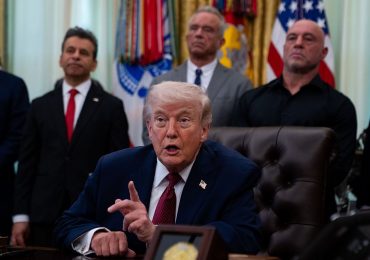
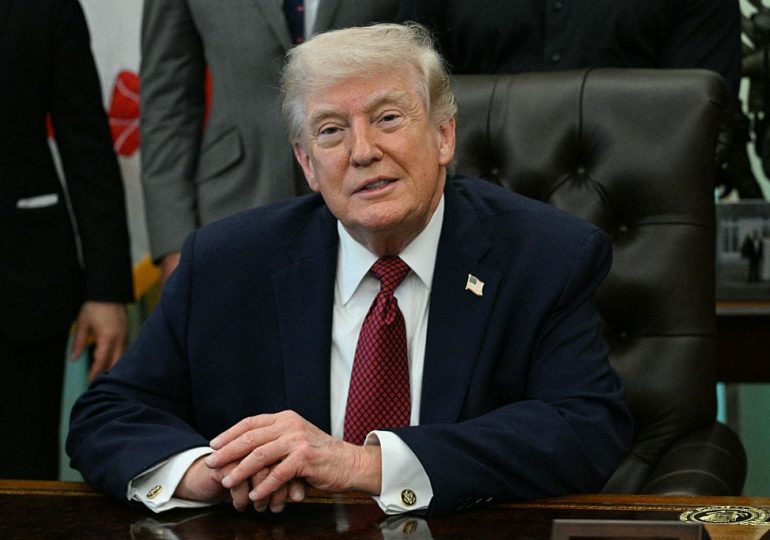
President Donald Trump in the Oval Office of the White House on April 18, 2026. —Jim Watson—AFP/Getty Images
In peace talks between Ukraine and Russia, an unusual proposal has reportedly emerged: naming a contested 50-mile-long, 40-mile-wide sliver of Ukraine’s industrial heartland “Donnyland,” a nod to both “Donbas” and U.S. President Donald Trump.
Ukrainian officials first floated renaming part of the Donbas region that Russia wants control over to “Donnyland” as part of an effort to get the Trump Administration to take a harder line against Russia’s territorial demands, people familiar with the monthslong negotiations told the New York Times.
Control of the region, which has been decimated by years of fighting, has become a key point of contention in negotiations. The Donbas, situated in eastern Ukraine along the Russian border, is internationally recognized as part of Ukraine, but parts of it have been occupied by Russia since 2014. In February 2022, Russia launched a full-scale invasion of Ukraine, expanding its military occupation to control large swathes of Donbas. Russian President Vladimir Putin has said Russia will continue its military campaign until it secures control of the full administrative borders of Donetsk and Luhansk, which make up the Donbas.
Trump, who pledged in his presidential campaign to end the Russia-Ukraine war within 24 hours, has attempted to broker a peace deal between Russia and Ukraine for months now to no avail. It was as the President appeared to be taking a soft approach to Russia, repeatedly criticizing Ukrainian President Volodymyr Zelensky and attempting to pressure him to accept a peace deal that involved significant Ukrainian concessions, that the idea for “Donnyland” was discussed.
In December, Zelensky suggested that parts of the Donbas could become demilitarized or free economic zones, although sticking points remain over how much administrative power and policing either country would have in the areas. Ukrainian negotiators have considered a neutral administrator or governing body with both Russian and Ukrainian representatives, or for Trump’s Board of Peace, to oversee the area, the Times reported. Negotiators have reportedly also considered a “Monaco model” arrangement in which part of the Donbas becomes a semiautonomous ministate with special offshore economic status.
Neither side has endorsed any of these proposals. The idea for “Donnyland” has also only come up in discussions, not in any written proposals. Still, a Ukrainian negotiator has taken the idea as far as making a ChatGPT-generated green and gold-colored flag and national anthem for “Donnyland,” according to the Times. It is not clear whether U.S. officials have seen the designs.
TIME has reached out to the White House and the Ukrainian and Russian foreign ministries for comment.
If it comes to be, “Donnyland” would not be the first time a foreign country has tried to name something after Trump.
‘Fort Trump’
In 2018, then-President of Poland Andrzej Duda pitched the idea of a permanent U.S. military base in Poland named “Fort Trump.” The proposal included an offer from Poland to contribute $2 billion toward infrastructure and support costs.
Aimed at bolstering NATO’s eastern flank and deterring potential Russian aggression, Duda first publicly presented “Fort Trump”—which had been discussed by Polish officials for months before—during his visit to Washington in September 2018. Trump said at the time that Duda “offered us much more than $2 billion to do this, and so we’re looking at it.”
But the proposal drew criticism from within Poland as detractors called it overly sycophantic. “Fort Trump” never materialized, but the U.S. did expand its military presence in Poland, including establishing a permanent U.S. Army corps headquarters in Poznań in 2022.
‘Trump Heights’
In March 2019, Trump broke with longstanding U.S. policy and became the first world leader to formally recognize Israel’s sovereignty over the Golan Heights. Israel seized the Golan Heights from Syria during the Six-Day War in June 1967 and later annexed the territory in 1981. Most of the world, including the United Nations, still consider the Golan Heights to be occupied Syrian territory.
In honor of Trump’s decision, Israeli Prime Minister Benjamin Netanyahu announced in June 2019 the creation of a settlement in the Golan Heights named “Trump Heights” or “Ramat Trump” in Hebrew. At the time, U.S. Ambassador David Friedman said of the ceremony, which took place shortly after Trump’s birthday, “I can’t think of a more appropriate and a more beautiful birthday present.” Trump posted on X (then known as Twitter) at the time, “Thank you PM @Netanyahu and the State of Israel for this great honor!”
A man takes a photo of the sign for the new settlement named after U.S. President Donald Trump at the entrance to the gated community in Golan Heights on on July 3, 2020. —Amir Levy—Getty Images
The settlement, which had just around two dozen families living there in 2024, is marked by a sign bearing the U.S. and Israeli flags. Israel’s government announced in December 2024 plans to invest $11 million to double the Israeli population in the Golan Heights.
‘Trump Route for International Peace and Prosperity’
Last August, Armenia and Azerbaijan signed a peace declaration at the White House, aimed at ending years of fighting since 1988 over the ethnic Armenian enclave of Nagorno-Karabakh. More than 100,000 Armenians fled the region following a military offensive by Azerbaijan in September 2023, in what has been widely described as ethnic cleansing.
Read More: In Places Trump Has Touted Bringing Peace, Conflict Still Rages
The agreement, brokered by Trump and signed at the White House, outlined a new transit route through southern Armenia linking Azerbaijan to its Nakhchivan exclave and allowing for transit from Europe to Central Asia bypassing Russia and Iran. The route, which the U.S. has exclusive development rights over for 99 years, was named the “Trump Route for International Peace and Prosperity” (TRIPP).
Leave a comment