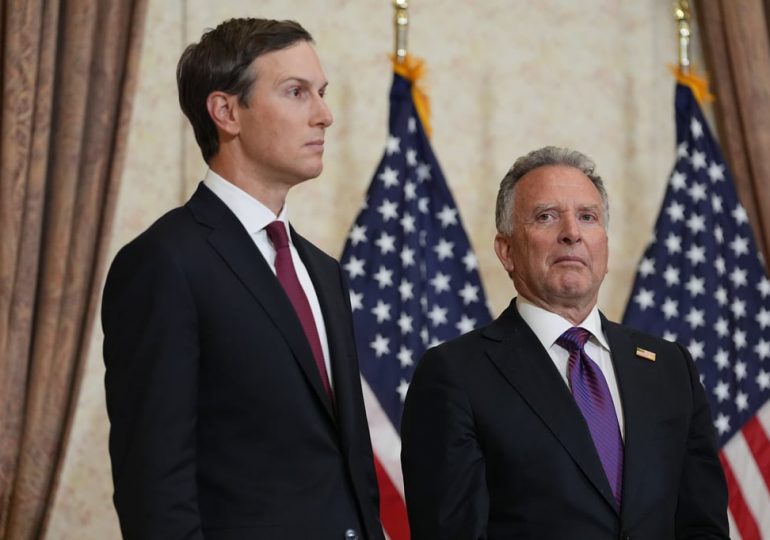
Jared Kushner, left, and Steve Witkoff, Special Envoy for Peace Missions stand at a news conference after meeting with representatives from Pakistan and Iran, April 12, 2026 in Islamabad, Pakistan. —Jacquelyn Martin—Pool/Getty Images
As the Trump administration weighs a second round of U.S.-Iran talks, the failure of negotiations in Pakistan is fueling concern about whether its envoys can deliver a deal.
Former diplomats tell TIME that Jared Kushner and Steve Witkoff, who led the Iran negotiations with Vice President JD Vance, lack the expertise and diplomatic experience needed to secure an agreement. That, they warn, risks prolonging the war and further destabilizing the global economy.
“Iran and the U.S. under Kushner and Witkoff? Failure. They get an F in diplomacy,” said Aaron David Miller, a former US State Department Middle East negotiator who served six secretaries of state.
Miller pointed to Kushner and Witkoff’s track record, citing failed negotiations between Russia and Ukraine and stalled negotiations between Israel and Hamas as Israel continued its strikes in Gaza. He argued that while even the most experienced negotiators would face steep challenges in such conflicts, Kushner and Witkoff failed to convey to either side the sense of urgency that a desirable deal was within reach—an essential condition for pushing negotiations forward.
“You accept the notion that a successful negotiation, if you have urgency, is based on finding some balance of interest between the parties. If you want out of this, I think they’re going to have to come up with something that allows the Iranians to say they won something,” Miller said, while suggesting that one possible concession could be giving Iran a pathway to resume uranium enrichment at a much later date.
Doubts over Kushner and Witkoff’s diplomatic experience
Asked about Kushner and Witkoff’s future roles in the Iran discussion, a White House official told TIME that Vance, Secretary of State Marco Rubio, Witkoff and Kushner “have been working together on these discussions and will continue to do so.”
If talks resume, veteran diplomats say the U.S. delegation must recognize the importance of “doing their homework” and setting clearly defined goals.
David Satterfield, a former U.S. Ambassador to Turkey and a career diplomat for four decades, warned that if the administration cannot clearly articulate a set of strategic goals—both internally and publicly—the chance of reaching a deal with Iran will diminish.
“Not only does the U.S. need to make clear what its goals were, and to know internally where it was prepared to concede, and where it was not prepared to concede, where the line would be held, the red lines, but to have a realistic sense of what the other side was bringing with it,” Satterfield said.
Before joining the Trump administration, both Kushner and Witkoff were real estate businessmen with no government experience. Kushner, who serves the White House as a Special Envoy for Peace, has touted his diplomatic approach centered on finding shared interests.
“Make deals and not lecture the world,” Kushner explained in a joint interview with Witkoff in 2025. “Focus on interests over values sometimes, and figure out where we have joint interests with other countries and pursue those joint interests.”
He has also been accused of downplaying the importance of historical context in negotiations. During the Israel-Hamas war in 2023, Kushner said in an interview with Lex Fridman that he had told previous envoys in the Middle East, “I don’t need a headache, and I don’t need a history lesson.”
“I want a very simple thing…what’s the outcome that you would accept?” Kushner said.
At a summit hosted by Saudi Arabia’s Public Investment Fund two weeks ago, Kushner said that “peace is not that different from business,” and that he had been able to leverage business relationships in diplomacy.
That view is now drawing skepticism. “How could he say that?” Miller said. “He’s comparing leasing an apartment building on Fifth Avenue to negotiating a historic conflict driven by security, pain, and trauma.”
“I’m not saying you need to be a diplomat to be a good negotiator. Henry Kissinger was not a diplomat. My former boss, James Baker, was not a diplomat. But you need to have some sense of history, and you need to know geography,” he added.
Lack of nuclear expertise complicates negotiations
Robert Einhorn, former senior State Department official who participated in the Iran nuclear negotiations from 2009 to 2013, said that unlike business deals—where negotiators may have authority to close an agreement on the spot—diplomatic negotiations on issues like denuclearization are constrained by domestic politics on both sides.
“The negotiator at the table has to think about how the domestic audiences will affect the outcome,” Einhorn said. “And I think the negotiator on a nuclear issue is more constrained by his or her government bureaucracy and by public opinion.”
Einhorn also noted that earlier Iran nuclear talks were a “methodical, deliberative interagency process that operated at all levels” of government, and that expert input is critical to achieving goals such as “no enrichment of uranium,” as President Trump demanded in a Truth Social post.
“What does it mean, zero enrichment?” Einhorn asked. “Does it mean no infrastructure supporting enrichment? Does it mean that already existing enriched uranium, including the 440 kilos of highly enriched uranium, would have to be exported or diluted? You have to have experts that understand the various dimensions of the problem.”
Key sticking points unresolved
The question of how to verifiably limit Iran’s nuclear capabilities is understood to have become the main obstacle in the peace negotiations. During talks over the weekend, the U.S. pushed for Iran to remove all highly enriched uranium from the country. Iranian officials would only agree to a “monitored process of downblending,” Axios reported.
The duration of the moratorium on Iran’s uranium enrichment was another sticking point. The U.S. proposed a 20-year moratorium on Iran’s uranium enrichment, while Iranian officials countered with a shorter “single digit” period.
That disconnect echoes earlier rounds of indirect talks in Muscat and Geneva in February, according to several news reports. Iranian officials were understood to be confused when the White House again sent Kushner and Witkoff, neither of whom has a background in nuclear policy. According to UK-based outlet Amwaj, citing unnamed Iranian sources, Iranian Foreign Minister Abbas Araghchi explained the stages of nuclear fuel production and the difference between an enrichment facility and a reactor to Witkoff on several occasions during the negotiation in Muscat.
More importantly, Miller added, the advisors must be willing to confront the president on the potential consequences of his decisions—something current administration officials have not done since the Iran War began on Feb. 28, according to Bloomberg.
“There is a discussion in which the president’s advisors talk truth to power and basically say to him…‘You’ve got the ultimate control. But if you’re going to do this, this is exactly what is likely to happen. And in my judgment…if you do this, you might fail,’” Miller said.
Such frank internal debate, he argued, depends on advisers willing to risk the consequences.
“Trump had four secretaries of defense in his first term. He had six national security advisors [during his two terms]. They know what happens if they embarrass the president or they become a problem.”
Leave a comment