—Photo-Illustration by TIME (Source Images: Julien De Rosa—AFP/Getty Images, Gallo Images/Orbital Horizon/Copernicus Sentinel Data/Getty Images (2), Giuseppe Cacace—AFP/Getty Images)
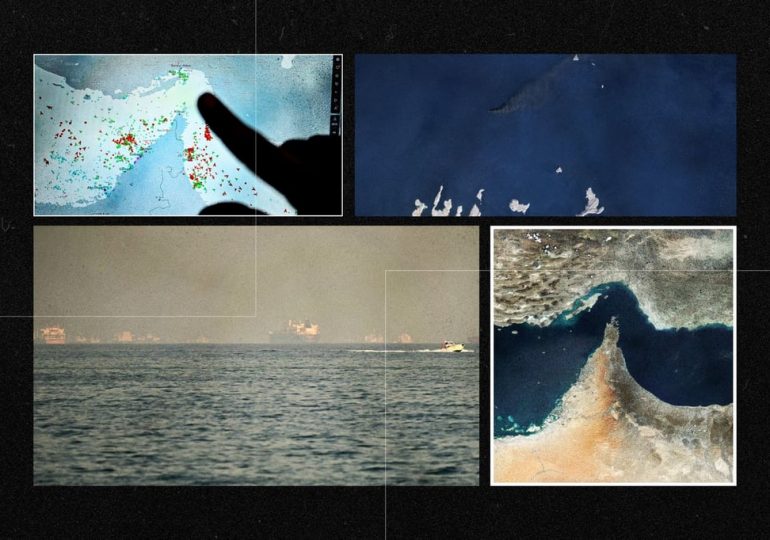
As the U.S. blockade of Iranian ports and ships in the Strait of Hormuz enters its fourth day, pressure is building on Tehran, whose oil exports are its main source of revenue, totaling some $45 billion last year, or 13% of GDP.
But the blockade also squeezes purchasers of Iranian oil—most notably China, which in recent times has purchased up to 90% of Iran’s seaborne crude, including more than 500 million barrels last year. Speaking alongside Abu Dhabi Crown Prince Khaled bin Mohamed in Beijing on Tuesday, Chinese President Xi Jinping warned that “we must not allow the world to revert to the law of the jungle.”
Still, while the energy shortfall is problematic for China, in other ways Washington riding roughshod over established maritime norms plays in Beijing’s hands, especially regarding its claims over Taiwan, the self-ruling island Xi has repeatedly threatened to invade. By unilaterally obstructing Iranian ports and vessels paying Iranian transit tolls—Tehran had been charging up to $2 million for safe passage to ships, which Trump also vowed to interdict—the Trump administration could be interpreted as saying national security takes precedence over established treaty law.
Those rules are chiefly set out in the United Nations Convention on the Law of the Sea, or UNCLOS, which since 1994 has served as the foundational treaty establishing global legal standards for ocean usage, resource management, and maritime jurisdictions. Although the U.S. has not signed UNCLOS, it recognizes most of the convention as “customary international law.” China has signed and ratified UNCLOS, though has attached addendums regarding its interpretation of certain clauses (to its own benefit, naturally).
Under UNCLOS Article 38, the Strait of Hormuz is a “strait used for international navigation,” whereby the right of transit passage is immutable, even during conflict. The U.S. justification in Iran—targeting vessels in international waters that engage with a rogue state—erodes the concept of the high seas as a sanctuary for neutral commerce.
The fear is China can use the example of current U.S. action in the Gulf to argue that national security similarly supersedes UNCLOS in the South China Sea and Taiwan Strait, moving from gray zone harassment to a formal, legalized blockade of islands or shipping lanes it claims as territorial waters. “It would set a precedent for China to argue that the Taiwan Strait is not an international waterway,” Carlyle Thayer, emeritus professor at the Australian Defence Force Academy, tells TIME.
Since June 2022, China has moved toward such a stance, claiming the Taiwan Strait is in fact “internal waters, territorial sea, contiguous zone, and exclusive economic zone,” as Chen Binhua, spokesperson for the Taiwan Affairs Office of China’s State Council, reaffirmed last year. “Both sides of the Taiwan Strait are Chinese territory, and China enjoys sovereignty, sovereign rights and jurisdiction over the Taiwan Strait.”
Beijing has been drastically ramping up its blockade capability as tensions continue to grow with the China-skeptic government in Taiwan. On Dec. 29, China launched its most extensive military drills around Taiwan, involving more than 200 aircraft and dozens of naval and coastguard vessels simulating a total blockade of the island.
As well as the world’s largest navy consisting of more than 370 battle force People’s Liberation Army (PLA) vessels, China controls a shadow fleet of up to 200,000 fishing boats as an informal militia. According to a January U.S. congressional report, these vessels are wielded to expand Chinese influence, monopolize sea lanes, and push Indo-Pacific nations toward economic dependency.
The danger is that the U.S. asserting the right to control passage through a global chokepoint based on the behavior of the littoral state, in this case Iran, could be interpreted as handing China the reciprocal right to police the Taiwan Strait and wider South China Sea, stopping any vessel it deems a threat to its interpretation of “One China” sovereignty.
By establishing a new “custom” in customary international law where superpowers can blockade straits without a U.N. mandate, the worry is that the U.S. effectively hands China a legal toolkit. Beijing can argue that Washington has de-facto amended international norms, allowing China to legally enforce its interpretation of “One China” via similar blockade tactics, framing them not as aggression, but as the new standard for maritime regional order.
Moreover, the U.S. faces credibility challenges when criticizing China’s actions because of its own record of military interventions and coercive measures. “I think the Chinese believe that the willingness of the international community to ‘punish’ them is probably lower now,” says Oriana Skylar Mastro, a professor and expert on China’s military at Stanford University.
UNCLOS already contained significant ambiguity. In 2013, retired PLA Senior Colonel Zhou Bo led a Chinese delegation to the Pentagon to attempt to thrash out some of the differences of interpretation. For example, UNCLOS doesn’t make clear whether military vessels are bound by the same rules as civilian ones. And while it states that foreign vessels can transit “with due regard” to littoral states, what that means practically is hotly debated. Another bone of contention is what “peaceful purpose” entails. “Anyone can say, ‘I’m doing this for peaceful purposes,’” Zhou tells TIME. “So, there are loopholes.”
Of course, there are additional legal frameworks outside of UNCLOS that specifically govern behavior during times of conflict, such as the law of naval warfare, which does allow for blockades. Under those terms, states like the U.S. can exercise the belligerent right of visit and search against neutral flagged ships to determine that no war material or war-sustaining aid is going to an adversary. (Iran has similar rights to the extent it can exercise them.) “So, the question is whether that $2 million toll is a sufficient threshold for providing a war-sustaining benefit to the Iranian regime,” says James Kraska, a professor of International Maritime Law at the U.S. Naval War College. “I can see arguments on both sides.”
But even that legal pretense may be beneficial to Beijing, which could justify a quarantine or blockade scenario against Taiwan on the basis that any cargo to or from the import-reliant island of 24 million is “war-sustaining.” (The fact that Taiwan is only recognized by 12 governments and barred from the U.N. adds to its precariousness.) “I would be positive that China is making those calculations and that the United States and Taiwan and other allied states are similarly reviewing those possibilities,” says Kraska.
Of course, were the Strait of Hormuz blockade to stand alone, the damage might be easy to shrug off. But while the last U.S. President to green light a naval blockade was George H.W. Bush as part of U.N. sanctions enforcement during the 1990–1991 Gulf War, Trump has now unilaterally ordered three in the past year: against Venezuela, Cuba, and now Iran.
“Our credibility is weakened and that is very important,” says Mastro, pointing to the U.K.’s refusal to allow the U.S. to use its military base in Diego Garcia to attack Iran. “Our ability to achieve our goals largely depends on other countries’ willingness to host U.S. military forces. When you don’t have a legitimate argument, it can impact your ability to execute.”
Still, operationally at least, recent U.S. blockades appear successful in exerting pressure. On Tuesday, Trump teased that the U.S. and Iran will return to Pakistan for more peace talks later this week. But it remains to be seen whether there will be hidden costs for the U.S. and allies down the line.
“All the actions that Trump is taking assist China in that sense,” says Thayer. “Up until now, China’s assertiveness and aggressiveness in the region have been the focus. Now China can then turn around and say, ‘we’re upholding the international order and we’re against bullying.’”
Leave a comment