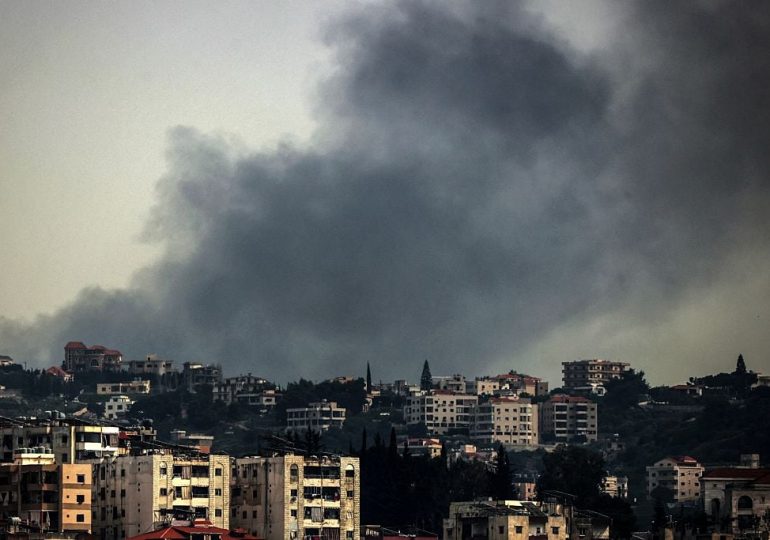
Smoke rises from the site of an Israeli airstrike that targeted the southern Lebanese town of Deir al-Zahrani on April 15, 2026. —Mahmoud Zayyat—AFP/Getty Images
President Donald Trump announced on Thursday that Israel and Lebanon have agreed to a temporary ceasefire after weeks of Israeli strikes targeting the Iran-backed militant group Hezbollah that have killed more than 2,000 people in Lebanon and strained negotiations between the U.S. and Iran.
In a post on Truth Social, Trump said that he had spoken with Lebanese President Joseph Aoun and Israeli Prime Minister Benjamin Netanyahu, who “have agreed that in order to achieve PEACE between their Countries, they will formally begin a 10 Day CEASEFIRE at 5 P.M. EST.”
“I have directed Vice President JD Vance and Secretary of State Rubio, together with the Chairman of the Joint Chiefs of Staff, Dan Razin’ Caine, to work with Israel and Lebanon to achieve a Lasting PEACE,” Trump wrote.
Shortly afterward, Trump added in another post that he would be inviting Aoun and Netanyahu to the White House for the “first meaningful talks between Israel and Lebanon since 1983, a very long time ago.”
”Both sides want to see PEACE, and I believe that will happen, quickly!” the President said.
Lebanese Prime Minister Nawaf Salam welcomed Trump’s announcement and called the ceasefire “a central Lebanese demand” in a statement on Thursday.
The Israeli government and Hezbollah did not immediately comment on the matter.
Read more: Israel’s War Against Lebanon, Explained
Daniel Shapiro, who served as the Deputy Assistant Secretary of Defense for the Middle East in the Biden Administration and as the U.S. ambassador to Israel from 2011 to 2017, tells TIME that the ceasefire will rest on Hezbollah’s cooperation.
“I think Israel and the Lebanese government have a real interest in it holding,” he says about the ceasefire. “The real question is, will Hezbollah respect it? … It’s very possible Hezbollah will seek to violate it.”
Shapiro notes that the short 10-day window will be critical in shaping what happens next in the conflict.
“If the Lebanese government can use that 10 days to take some actions that remove Hezbollah weapons or fighters from South Lebanon away from the border, then it’s less likely that there would be a resumption of fighting immediately after the 10 days,” he says. “It will really depend on whether there’s significant diplomatic progress and there’s significant disarmament progress.”
Aoun’s agreement to a ceasefire shows “courage,” Shapiro says, noting that the Lebanese president is inevitably “taking some risks.” Aoun could face opposition from supporters of Hezbollah in the Lebanese government, according to Shapiro, and will “undoubtedly be subject to threats.”
Earlier on Thursday, ahead of Trump’s ceasefire announcement, Aoun’s office described the phone conversation between the Lebanese president and Trump.
“During the call, President Aoun renewed his thanks for the efforts Trump is exerting to reach a ceasefire in Lebanon and secure lasting peace and stability, paving the way for achieving the peace process in the region,” the Lebanese presidency stated in a post on X. “He wished for the continuation of these efforts to stop the fire at the earliest possible time. Trump responded with his support for President Aoun and Lebanon, and his emphasis on his commitment to meeting the Lebanese request for a ceasefire at the earliest possible time.”
Israeli and Lebanese officials met in Washington, D.C., on Tuesday for “working-level peace talks,” seeking to end the Israeli military campaign in Lebanon.
Following the meeting, both Yechiel Leiter, Israel’s ambassador to the U.S., and the State Department struck a positive tone in describing the talks.
Leiter told reporters that Lebanon must “completely” cut associations with Tehran and Hezbollah.
“We discovered today that we’re on the same side of the equation. That’s the most positive thing we could have come away with,” the ambassador said. “We are both united in liberating Lebanon from an occupation power dominated by Iran called Hezbollah.”
Israel’s attacks in Lebanon have killed at least 2,000 people since Hezbollah joined the Iran war at the beginning of March, according to the Lebanese health ministry. More than a million people have been displaced since the fighting began, per the International Rescue Committee (IRC). TIME has been unable to independently verify these figures.
Aoun said last week that “the only solution to the situation Lebanon is facing is a ceasefire with Israel that would lead to direct negotiations between the two countries.”
Leave a comment